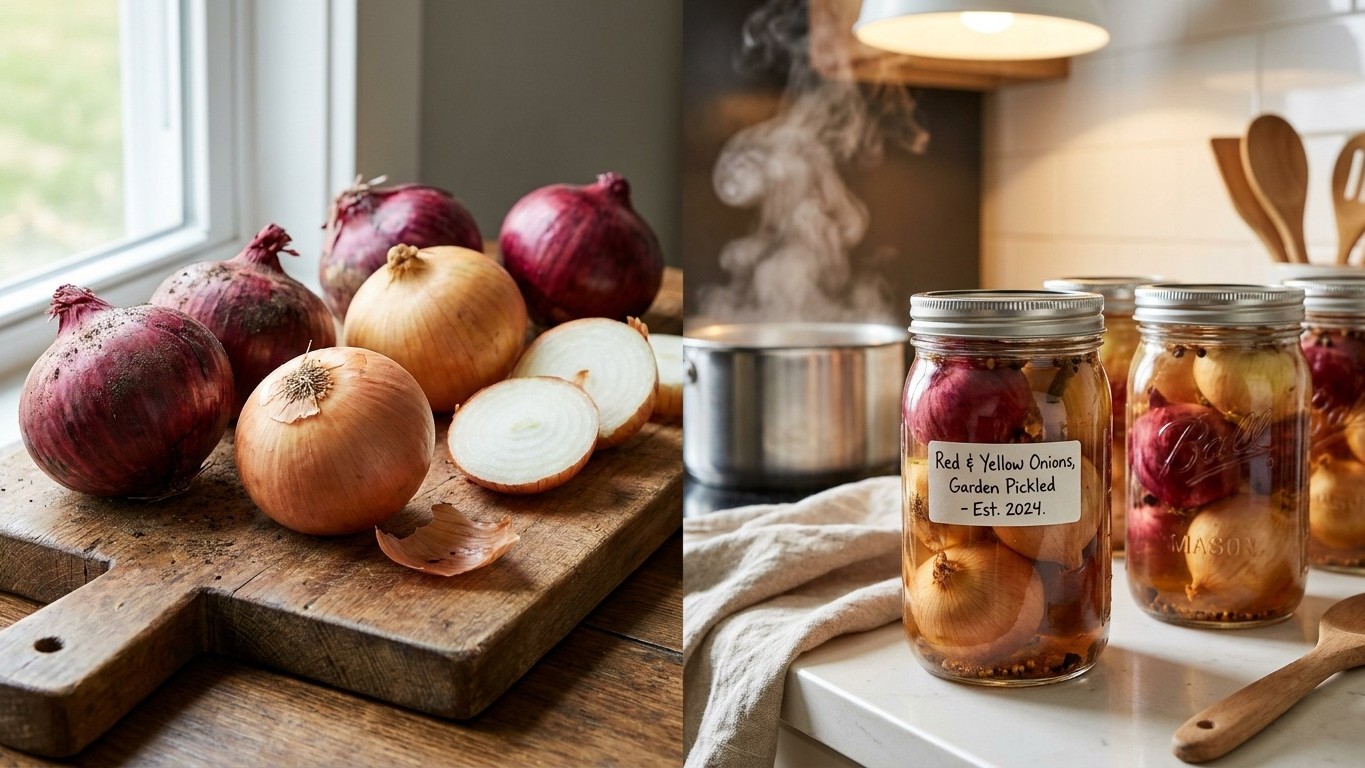

An onion pulled straight from the garden is a low-acid vegetable, full stop, and that puts it on the pressure-canner side of the safety line the National Center for Home Food Preservation (University of Georgia) uses to sort every food that goes into a jar. Slice that same onion into a jar of vinegar brine, though, and the chemistry underneath it changes. It’s no longer the vegetable the lab tested. It’s a pickle.
The short answer
The National Center for Home Food Preservation draws its line at pH 4.6. Above that number, a food is classified low-acid and needs a pressure canner running at 240 to 250 F to reach a temperature hot enough to destroy the most dangerous spores that can survive in a sealed jar. At or below pH 4.6, a food is classified acid, and a boiling-water canner at 212 F (sea level) does the job, because the acid itself keeps the danger from developing in the first place.
The Center’s guidance on safe canned foods lists the categories plainly: red meats, seafood, poultry, milk, and all fresh vegetables except most tomatoes fall on the low-acid side. Fruits, pickles, sauerkraut, jams, jellies, marmalades and fruit butters fall on the acid side. An onion, straight out of the garden bed you grew it in, is a fresh vegetable. There’s no gray area here, no “it depends on the variety.” Yellow, white, red, sweet, storage type, doesn’t matter. Every onion starts life on the low-acid side of that line.
Here’s where it gets useful for anyone standing at the stove with a basket of onions and a stack of jars. The moment you pickle an onion, you’re not seasoning it. You’re moving it across the pH 4.6 line on purpose. Vinegar, added in the right proportion with a canning method the National Center for Home Food Preservation has actually tested, drops the pH low enough that the food no longer behaves like the fresh vegetable it started as. That’s why pickled onions are processed in a boiling-water canner while plain preserved onions require a pressure canner. Same crop, two completely different safety categories, depending entirely on what you did to it before the lid went on.
This matters more than it sounds like it should. A jar of onions canned as if they were pickles, but without enough acid actually added, looks identical to a jar that’s safe. There’s no visual difference between the two on the shelf. The only thing separating them is chemistry you can’t see and, as it turns out, can’t taste either.
Why it falls where it does
Acidity isn’t a flavor consideration in home canning. It’s a control mechanism. The organism everyone in food preservation is ultimately guarding against is Clostridium botulinum, a bacterium that survives as a spore in soil and on the surface of vegetables, including onions, no matter how carefully they were washed. Heat alone from boiling water isn’t enough to kill those spores. But the bacterium can’t produce its toxin, and can’t do any harm, unless three separate conditions line up at the same time.
- A moist, low-acid food. Acid at or below pH 4.6 removes this condition entirely, which is exactly why pickling changes an onion’s canning requirements. A pressure canner removes it a different way, by reaching a temperature high enough to destroy the spores themselves.
- A temperature between 40 and 120 F. This is the range where the organism can grow and produce toxin. Proper canning removes this condition by processing the food hot enough, then storing sealed jars outside that window going forward.
- Less than 2 percent oxygen. A sealed canning jar creates exactly this kind of low-oxygen environment. This condition can’t be removed by opening the jar and checking, because by the time a jar is opened the food inside has already been sitting in that environment for weeks or months.
Read that list again and you can place almost any food you’d want to preserve without needing a chart for each one. Garlic stored in oil at room temperature? Low-acid, sealed away from air, sitting well within that temperature range, all three conditions present. Green beans in a boiling-water bath? Low-acid vegetable, sealed jar, and boiling water never gets hot enough to destroy the spores, only a pressure canner does. Cucumbers packed in a tested vinegar brine? The acid knocks out condition one before the other two ever get a chance to matter.
This is also why the danger is invisible in the most literal sense. Botulinum toxin has no taste and no smell. A jar can look normal, smell fine when opened, and still be lethal. Nobody has ever safely canned their way around that fact by trusting their senses, and nobody ever will.
What that means at the stove
Because onions start out low-acid and only cross the line when acid is deliberately added, the practical sequence at home follows a fixed order rather than a matter of preference.
- Decide up front whether you’re preserving plain onions or making pickled onions, because the two products require different equipment and there’s no adjusting midway through.
- If you’re preserving onions as a plain vegetable, with no acid added, plan on a pressure canner from the start. A boiling-water bath is not a substitute, regardless of how the onions are cut, blanched, or packed.
- If you’re making pickled onions, source a tested recipe from the National Center for Home Food Preservation or the USDA Complete Guide to Home Canning rather than adapting a family recipe or a recipe found elsewhere, since the acid level in those untested versions hasn’t been verified.
- Prepare the vinegar solution called for in that tested source, using a commercial vinegar of known, labeled acidity rather than homemade vinegar or a vinegar of unknown strength.
- Pack the jars following the tested recipe’s instructions for how the onions and liquid are combined.
- Process the filled jars in the canner appropriate to the product, pressure canner for plain low-acid onions, boiling-water canner for properly acidified pickled onions.
- Let jars cool undisturbed, then check that each lid has sealed before moving them to storage.
- Label every jar with the contents and the date, since a jar without a label is a jar nobody can later verify was processed correctly.
Notice what’s missing from that list. No time, no pressure figure, no vinegar ratio. Those numbers exist, they’re published, and they matter enormously, but they belong to a tested recipe for a specific jar size and pack style, not to a general explanation of the process.
What goes wrong
- Canning plain onions in a boiling-water bath because “they’re just a vegetable.” Onions are low-acid, and boiling water never reaches the temperature needed to destroy botulinum spores. The fix is simple: plain onions require a pressure canner, no exception.
- Storing onions in oil at room temperature for later use. This setup checks all three conditions the bacterium needs at once, moist low-acid food, oxygen sealed out by the oil, and a temperature well inside the danger range. The safe alternative is refrigeration for short-term use or a tested, acidified canning method for longer storage.
- Using homemade or unlabeled vinegar in a pickling recipe. A vinegar of unknown acidity can’t be trusted to push the pH below 4.6, which means the “pickle” might still behave like a low-acid food underneath a false sense of security. The remedy is a commercial vinegar with acidity clearly stated on the label, used exactly as the tested recipe specifies.
- Adjusting a pickled onion recipe by adding more onions or less vinegar to stretch a batch. Changing the ratio changes the final acidity of the jar, even if it looks and tastes the same as a properly made batch. Stick to the tested proportions and process a second batch instead of stretching one.
- Tasting a jar that looks or smells slightly off to decide if it’s safe. Botulinum toxin has no taste and no smell, so this test tells you nothing. Any jar with a bulging lid, an unsealed lid, or unusual appearance should be discarded without tasting, following National Center for Home Food Preservation guidance.
Where the exact figures come from
This page hasn’t given a single processing time, pressure setting, or vinegar ratio, and that’s on purpose. Those figures depend on jar size, pack method, and altitude, and they’ve been tested in a lab to guarantee the temperature the food reaches is high enough for long enough. An untested figure, borrowed from a general recipe or estimated from a similar food, can look reasonable on paper and still fail to destroy the spores in that specific jar.
The National Center for Home Food Preservation publishes the exact times and pressures for onions, plain and pickled, on its dedicated page for the food. That’s the source to use before the first jar goes in the canner, and it’s the same organization that draws the pH 4.6 line this whole page is built around.
Common questions
Can I can onions I grew myself the same way I’d can green beans?
Yes, in the sense that both are low-acid vegetables and both need a pressure canner rather than a boiling-water bath. The specific processing figures still differ between the two foods, so each needs its own tested guidance from the National Center for Home Food Preservation rather than borrowing figures from one to use on the other.
Does adding vinegar to a jar of plain onions make it safe for a boiling-water bath?
Only if the recipe itself has been tested to confirm the resulting pH is at or below 4.6, and only if it’s followed exactly, with the vinegar strength and proportion specified in that tested source. Adding vinegar casually, without following a tested recipe, doesn’t guarantee the acid level needed to move the jar to the acid side of the line.
Why do onions need a pressure canner if they’re eaten raw all the time without any illness?
Eating a raw onion and sealing one in an airless jar for weeks or months are two completely different environments. Botulinum spores present on the surface of a raw onion pose no threat in open air, but a sealed, low-oxygen jar sitting at room temperature creates exactly the conditions the organism needs to grow and produce toxin.
I grew a large onion harvest this year. What’s the first decision before I start preserving any of it?
Decide whether each batch will be preserved plain or pickled before you touch a jar, since that choice determines which canner and which tested recipe you’ll need from the start. If you’re still deciding what to do with a big harvest, the growing guide for onions on this site covers curing and storage options that don’t involve canning at all, which is worth considering for onions you plan to use within a few months.