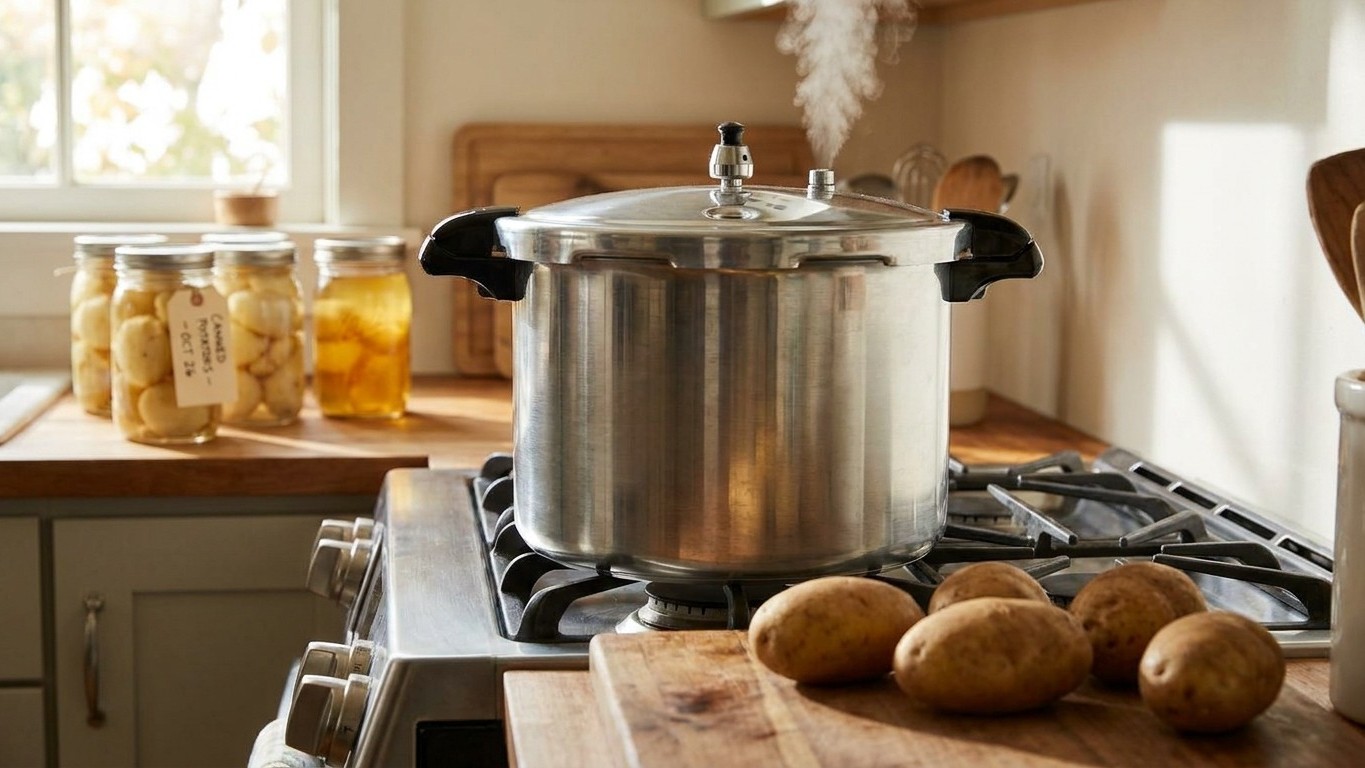

Potatoes are a low-acid vegetable, which puts them firmly above pH 4.6. That means a boiling-water canner, no matter how long you run it, cannot make a jar of potatoes safe to eat. A pressure canner is the only method the National Center for Home Food Preservation recognizes for this food. There is no workaround, no shortcut, no “just boil it longer.”
The short answer
The dividing line in home canning sits at pH 4.6. Above that line, a food is classified low-acid and needs a pressure canner reaching 240 to 250 F. At or below it, a food is acid, and a boiling-water canner holding 212 F at sea level does the job. This isn’t a matter of preference or tradition. It’s the temperature at which Clostridium botulinum spores actually die, and boiling water never gets hot enough to do that reliably in a sealed jar.
The National Center for Home Food Preservation, based at the University of Georgia, lays out which foods fall on which side. Low-acid foods include red meats, seafood, poultry, milk, and nearly all fresh vegetables except most tomatoes. Acid foods include fruits, pickles, sauerkraut, jams, jellies, marmalades, and fruit butters. Potatoes, being a fresh vegetable with no natural acidity to speak of, land squarely in the low-acid column.
That classification isn’t up for debate the way some kitchen questions are. A tomato’s acidity can shift depending on variety and ripeness, which is why tomato recipes often call for added lemon juice or citric acid to nudge them safely below 4.6. Potatoes don’t have that flexibility. There’s no acid you can add to a potato that would meaningfully change its chemistry without changing the food into something else entirely. So the only path forward is heat under pressure, hot enough and sustained enough to reach the temperatures a boiling-water bath physically cannot produce.
If you grew your own crop this season, the growing guide covers everything up to harvest and curing. The moment the potatoes are out of the ground, you’re deciding how to put them up for winter. The dividing line between “quick refrigerator use” and “shelf-stable jar” runs through a pressure canner, and there’s no version of this food that skips that step safely.
Why it falls where it does
Acidity does one specific job in food preservation: it creates an environment where dangerous bacteria can’t multiply, even if their spores survive processing. Below pH 4.6, Clostridium botulinum spores may still be present in a jar, but they can’t germinate and produce toxin. Above that line, they can, if the other conditions line up. That’s the entire reason the pH 4.6 threshold exists as a hard rule rather than a guideline. It’s not about flavor or texture. It’s about whether the chemistry itself blocks bacterial growth.
Potatoes sit well above that line, with no natural acid to speak of. So the food itself provides zero protection. Everything has to come from the processing method instead, which is why pressure and the temperatures it produces become non-negotiable.
Botulism doesn’t happen because of one bad ingredient or one skipped step. It happens when three separate conditions show up in the same jar at the same time. Remove any one of them, and the danger disappears. Leave all three in place, and you have exactly the environment the organism needs.
- A moist, low-acid food. Potatoes qualify on both counts, they hold plenty of water and carry no acidity to interfere. High heat that penetrates the entire jar, sustained long enough, is what neutralizes this condition, since it destroys the spores themselves.
- A temperature between 40 and 120 F. This is the range where spores can germinate and multiply. Proper processing pushes the jar’s contents well above 120 F for the full processing period, and proper storage afterward keeps sealed jars out of that window entirely.
- Less than 2 percent oxygen. A sealed canning jar creates exactly this kind of low-oxygen environment once it cools and seals. There’s no practical way to “un-seal” a jar and still preserve the food, which is why the heat step has to do all the work of eliminating spores before the seal forms.
Potatoes check every box on that list by default. Dense, moist, low-acid, and destined for a sealed jar. That combination is precisely why the processing method has to be strong enough to knock out the first condition entirely, since the other two are simply what canning does by nature.
What that means at the stove
The sequence matters as much as the equipment. Skipping ahead or reordering steps is one of the more common ways home canners run into trouble, even when they’re using the right canner.
- Select potatoes that are firm, free of green discoloration, and free of soft or decayed spots, since damaged flesh can harbor bacteria that heat alone may not fully reach.
- Wash and peel the potatoes, then cut them into a uniform size if the tested recipe calls for pieces rather than whole small potatoes, since uneven pieces heat unevenly inside the jar.
- Pack the potatoes into clean, heated canning jars, following the fill guidance in a tested recipe for that particular jar size.
- Add the liquid called for in the tested recipe, again following the specific guidance rather than estimating.
- Wipe the jar rims clean before applying lids, since any food residue on the sealing surface can prevent a proper seal.
- Load the jars into the pressure canner according to the canner manufacturer’s instructions and the tested recipe’s guidance for that food.
- Vent the canner as instructed before bringing it up to pressure, since skipping this step is one of the most common causes of under-processing.
- Once processing finishes, allow the canner to depressurize naturally before opening it, rather than forcing a faster cool-down.
- Remove jars, let them cool undisturbed, then check seals before labeling and storing them.
Notice what’s missing from that list on purpose. No time, no pressure level, no ratio of liquid to potato. Those figures come from tested recipes for specific jar sizes, and they’re the one part of this process that shouldn’t be improvised or borrowed from a different food.
What goes wrong
- Using a boiling-water canner because “it’s just going to be reheated anyway.” Reheating on the stove before eating does not reliably destroy botulinum toxin once it’s present, and toxin has no taste or smell to warn you. Only a pressure canner reaching the correct temperature during processing prevents the toxin from forming in the first place.
- Guessing at processing time because the jars “look done.” Potatoes are dense and starchy, which makes them one of the hardest foods for heat to penetrate to the center. A time that worked for a thinner vegetable, or a smaller jar, will not necessarily reach the middle of a jar of potato pieces. Use the tested time for the exact food and jar size, not an approximation.
- Skipping the venting step to save time. A canner that hasn’t vented properly can register full pressure without the jars actually reaching the temperature the process depends on. Follow the venting instructions in full before starting the timer.
- Tasting a jar to check if it’s safe. Botulinum toxin cannot be detected by taste or smell. A jar that looks, smells, and tastes completely normal can still be dangerous. If a jar shows any sign of a failed seal, bulging, spurting liquid, or an off odor, discard it without tasting.
- Substituting a different vegetable’s tested recipe for potatoes. Density and moisture content vary by food, and a time tested for green beans or carrots isn’t automatically safe for a starchy, dense potato piece. Each food needs its own tested figures.
Where the exact figures come from
The National Center for Home Food Preservation publishes exactly that guidance for potatoes on its site, and that’s where the real figures belong.
An untested time or pressure isn’t just a guess, it’s a gap that heat may never close, especially in a dense food like potato where the center of the jar is the hardest point to reach. Since a spore that survives processing gives no warning before it becomes dangerous, the tested figure from the National Center for Home Food Preservation is the only number worth following.
Common questions
Can I can potatoes in a boiling-water bath if I slice them thin?
No. Slicing changes the shape, not the pH. Potatoes remain low-acid regardless of how they’re cut, and a boiling-water canner never reaches the temperature needed to destroy botulinum spores in a low-acid food.
Do canned potatoes taste or smell different if something went wrong?
Not necessarily. Botulinum toxin has no taste and no smell, so a jar can appear completely normal and still be unsafe. Rely on tested processing figures and proper seals, not sensory checks.
Is there a way to add acid to potatoes to make boiling-water canning safe?
No practical amount of added acid brings a starchy vegetable like potato below pH 4.6 while still leaving it recognizable as food. Pressure canning remains the only recognized method for this vegetable.
Why do potatoes need different handling than other vegetables I might can?
All fresh vegetables except most tomatoes are low-acid and need pressure canning, but potatoes are especially dense and starchy, which makes heat penetration to the jar’s center slower. That’s why the tested time and jar size matter even more here than with a thinner vegetable.