
The sources behind this guide don’t name a single insect, bird or mammal that eats asparagus, so there is no pest calendar here. Inventing one would be worse than leaving the gap. What they do document is what the bed asks of Louisiana ground: drainage for 10 to 15 years, steady water through a wet summer, and crowns in the ground at the right moment. Those three decide whether there is anything left to eat. For the bigger picture, start with Growing Asparagus in Louisiana.
The short answer
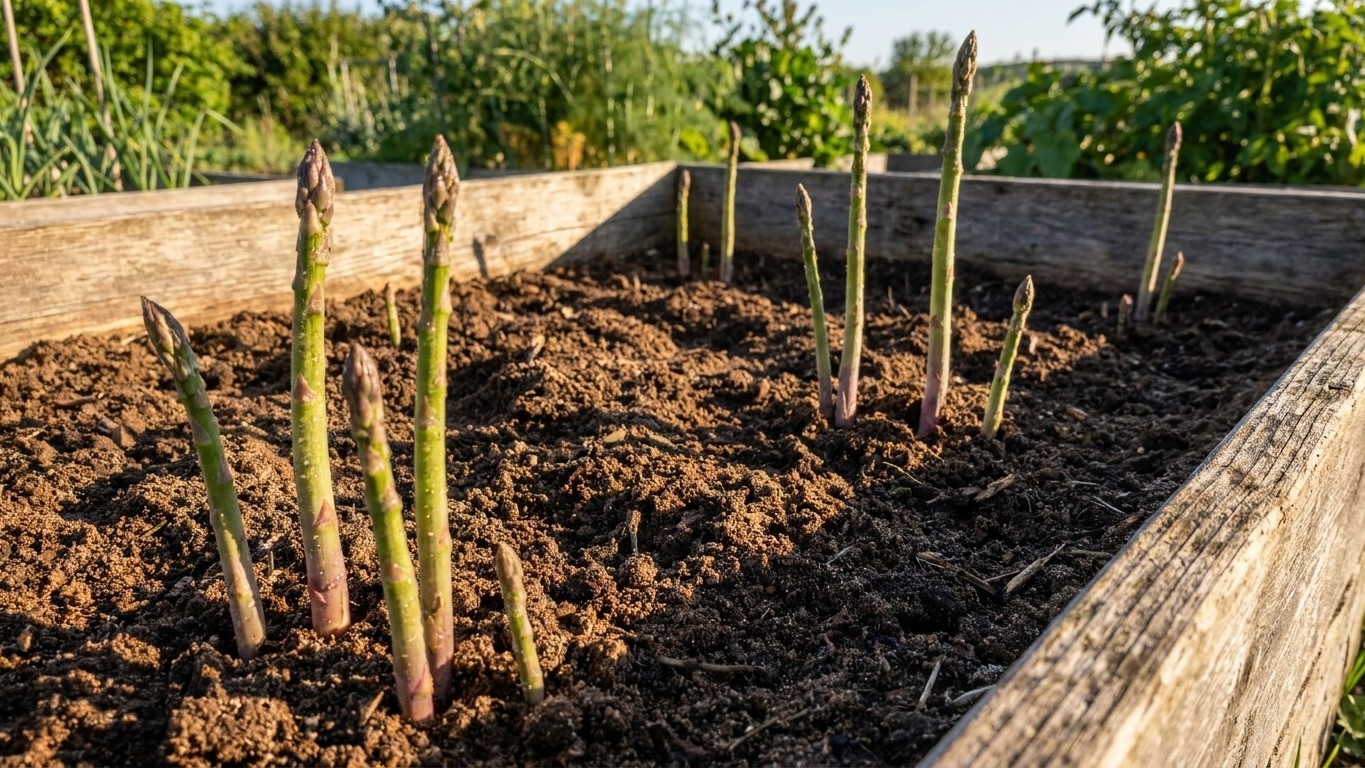
A bed planted this spring is a bed you will still be dealing with in a decade. Crowns go into 8-inch furrows, nothing is harvested until year 3, and then the planting produces for 10 to 15 years. The one soil requirement Utah State University Extension states is that the ground drains. Most soils will do, provided they do.
Louisiana’s state soil, the Ruston series, passes that test. USDA lists it as well drained, and the texture explains why: the surface layer runs 65 percent sand, 11 percent clay and 24 percent silt. Water moves through a mix like that fast. Ruston is also an Ultisol, an old, heavily weathered and leached soil that is naturally acid and low in nutrients. Its surface pH is about 5.5 (slightly acid) and its organic matter about 1.8 percent. The asparagus source says nothing about pH, so there is no target number here. Your own soil test is where that figure comes from.
Where the state soil stops applying
Ruston represents Louisiana. It is not the dirt in every yard. The state spans hundreds of soil series, and river bottoms, low ground near a bayou, and any lot a builder has scraped or filled can behave nothing like it. The numbers above are representative values for the surface layer of the mapped soil, not a reading from a worked garden bed. Treat them as what the region’s ground tends to do (shed water, run acid, go short on nutrients), then confirm with a test of your own plot.
With most vegetables, a heavy soil is an annual nuisance you amend each season and move on. Here it is a decision you can’t undo. A trench makes the problem worse, because an 8-inch furrow in slow-draining ground can turn into a bathtub around the crowns. If water lingers in a test hole dug after a heavy rain, the honest options are a different spot in the yard or a bed built up above the surrounding grade. Both are my practical suggestions rather than anything the extension source spells out. For a fuller look at the 15-year question, see Will Louisiana Soil Hold an Asparagus Bed for Fifteen Years?
Sandy ground has its own cost. It drains well, but it holds little water and little organic matter, which matters a great deal once summer arrives.
Will the summer here water it for you?
The bed wants 1 to 2 inches of water every other week for its first two years, then every three weeks after that. Set against a Louisiana summer, the arithmetic looks generous at first, and the details then complicate it. Here is how to read it.
- Start with the target. Over the roughly 13 weeks of June through August, a schedule of 1 to 2 inches every other week adds up to about 6.5 to 13 inches.
- Compare it with what falls. NOAA’s most recent 30-year normals for the south Louisiana reference station show about 21.3 inches across those three months: 7.62 in June, 6.79 in July (the driest of the three) and 6.91 in August. The full year comes to 63.4 inches. On paper, an average summer delivers more than the bed asks for.
- Correct for the soil. A sandy surface lets rain through within the day. A clay one would hold it for a week. On Ruston-type ground, a wet summer can still leave the bed dry between storms, because the water was there and then gone.
- Correct for heat and storm style. Hot days drive evaporation, and rain that comes as one big thunderstorm mostly runs off instead of soaking in. The same total spread over gentle showers would serve the bed better.
- Add the difference. Whenever two weeks pass without roughly 1 to 2 inches of rain, make up the gap with a slow, deep soak. In a typical stretch the gardener adds little. In a dry spell the gardener adds the full dose.
What settles it for your plot
These are normals for one reference station, not a forecast and not a measurement of your yard. A slope, a city heat island or a stretch of tree cover changes what actually lands on your bed. A cheap rain gauge set next to the planting tells you more than any regional table. Log what it catches, and water only for the shortfall.
After year 2, the schedule relaxes to every three weeks. That is easy to forget in a state where afternoon storms feel like a guarantee. Keep checking the gauge.
When to put the crowns in
Crowns go in during early spring. In south Louisiana, the last 32°F freeze arrives around January 18 to February 8, according to NOAA NCEI climate normals, which count that as the 30 to 70 percent probability band. So early-spring planting here lands around or shortly after that window, well ahead of when most of the country is even thinking about gardens. Treat the dates as an average. Some years the last freeze comes earlier, and some years it comes later.
This is not a normal planting calendar, and frost is the wrong thing to build it around. A 32°F freeze occurs in only 86.8 percent of years at this station, so roughly one year in seven has no freeze at all. The fall window straddles the New Year. The limiting factor in south Louisiana is summer heat, not winter cold. North Louisiana freezes far more reliably, but the figures I hold are for the southern station only, so I won’t invent a northern date. For the full timing discussion, see When to Plant Asparagus Crowns in Louisiana.
The seed route, and what happens after planting
Starting from seed is the alternative to crowns. The sources used here give no sowing dates or seedling timelines, so I won’t pretend to a calendar. What the extension source does give is the bed’s rhythm once crowns are in. The furrow is not filled in on day one. It is backfilled gradually across the year, about 2 inches every other month, until it is level.
Then comes the wait. There is no harvest until year 3, and no softening that into “just a few spears.” The first harvest runs 4 weeks, the next year 6 weeks, and after that 8 weeks. Stop when most spears come up thinner than a pencil. That is the signal, not a week number on the calendar.
Common questions
Does anything in these sources say which pests eat asparagus in Louisiana?
No. The Utah State University Extension guide used here covers planting, bed life and harvest, not insects or animals, and no pest dates for Louisiana are published in these facts. For a pest question, take a photo of the damage to a local extension office rather than relying on a list I couldn’t source.
When can we first eat what we grow?
Not until year 3. The harvest window is then 4 weeks, followed by 6 weeks the next season and 8 weeks after that. End each season when most spears are thinner than a pencil.
Which variety should we plant?
Four are named in the source, listed only by sex. Jersey Giant and Jersey Knight are all-male. UC 157 F1 and Purple Passion are male and female. No flavor, yield or reason to prefer one is published, so I can’t rank them. Buy whichever you can find from a source you trust.
How do we keep the spears once they are cut?
The window is narrow, and both edges bite. UC Davis Postharvest puts the optimum at 32°F to 35.6°F with 95 to 100 percent relative humidity. Above 50°F the spears toughen quickly. At about 30.9°F or lower they suffer freezing injury and go extremely soft. In a home kitchen, stand the cut ends in water or wrap them damp, since spears lose moisture through the butt faster than anywhere else.