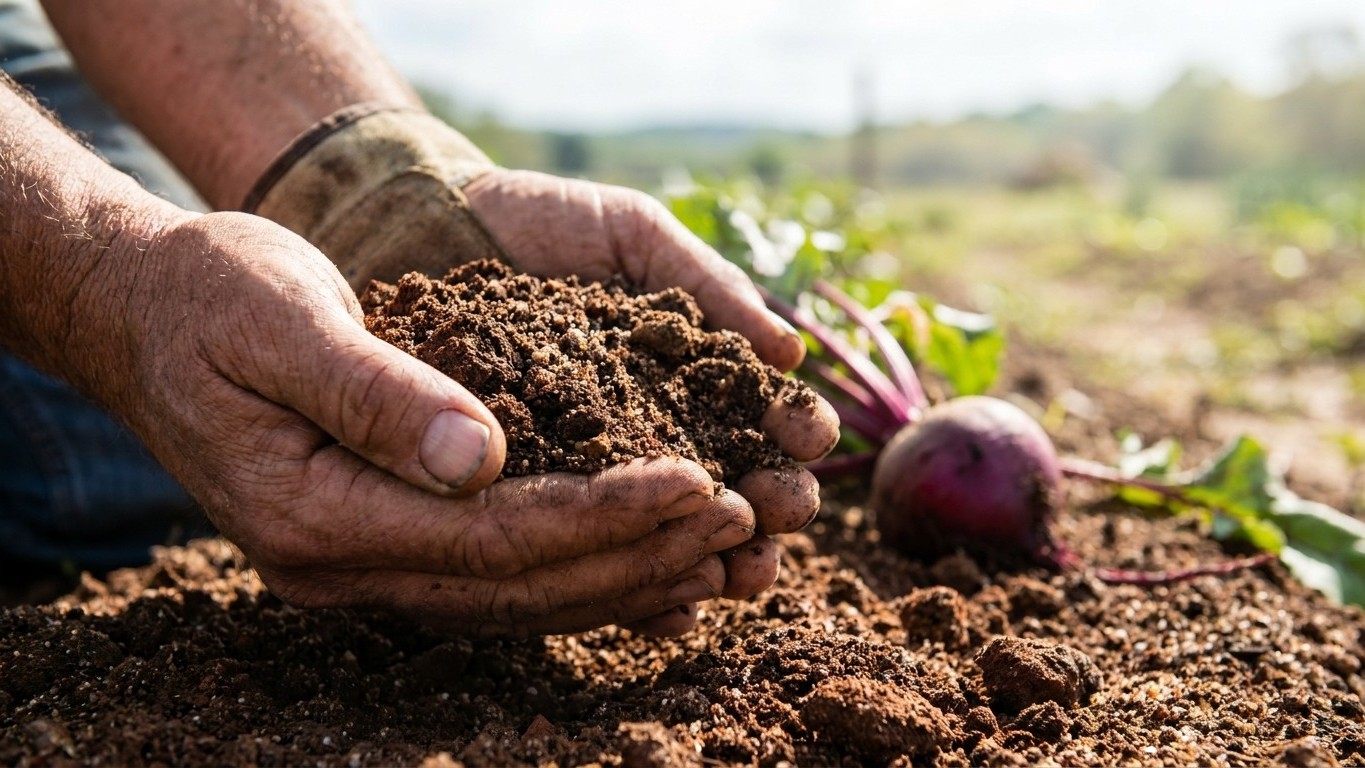

In Louisiana, a beet root drops into acidic, sandy, well-drained soil that fits the crop’s texture needs but comes up short on organic matter and pH. The bigger obstacle isn’t the ground, though. It’s the calendar: an unreliable frost date and a long, hot summer that turns stress into a woody root long before soil chemistry becomes the limiting factor. Get the timing right and the state’s typical soil will carry a beet crop with modest amendment.
The short answer
The USDA lists the Ruston series as representative of Louisiana ground, and the numbers behind that listing tell a specific story. Surface soil sampled across 371 mapped components runs 65 percent sand, 11 percent clay and 24 percent silt, with organic matter sitting around 1.8 percent and drainage classed as well drained. Surface pH averages about 5.5, slightly acid.
For a beet, sandy and well drained checks the first box. Utah State University Extension’s guidance for the crop calls for deep, sandy, well-drained soil rich in organic matter, and Ruston’s texture matches that description on the drainage side: the mix isn’t the kind of dense clay that squeezes root shape or leaves beets sitting in standing water after a wet spring. A taproot pushes down through this kind of profile without much resistance.
Two numbers work against it. Organic matter at 1.8 percent is thin for a crop that same guidance says needs a real organic component, and the fix, according to that source, is capped rather than open-ended: no more than 1 inch of composted organic matter worked into every 100 square feet. Go past that and the balance can tip toward leafy top growth instead of root development. The pH matters too. At 5.5, Ruston soil sits a notch below neutral, and while beets tolerate a range of acidity, nutrient availability shifts as the soil gets more acid, which means a bed built on this base starts already behind rather than at neutral.
Heat is the variable soil chemistry can’t fix
Utah State University Extension’s guidance is specific about temperature too: readings above 85 F combined with water stress make a beet root go woody. Louisiana spends long stretches of most summers past that mark. No day-count for a specific reference station above 90 F is published in the sourcing behind this page, so no number is given here, but the practical pattern gardeners run into across the Gulf South is a summer window where beets aren’t a realistic crop at all, soil aside.
None of this describes every yard in the state. Louisiana spans hundreds of mapped soil series, and river-bottom ground, hill country in the north, and any lot a builder has cut, filled or graded will read nothing like Ruston’s numbers. Treat this series as the state’s default answer, not a stand-in for a soil test on a particular plot.
The six weeks that decide it here
Beets go into the ground by direct seed, never as a transplant, and the standard advice is to sow 2 to 3 weeks before the last frost. In Louisiana that instruction runs into a complication most planting calendars don’t account for. NOAA NCEI’s 1991-2020 climate normals put the state’s last-frost window between January 18 and February 8, and even that window isn’t a sure thing: a 32 F freeze shows up in only 86.8 percent of years at the reference station behind that data. Roughly one year in seven never delivers a freeze at all, and the matching fall-side probability window slides across the New Year rather than sitting cleanly in autumn.
Sow 2 to 3 weeks ahead of that January-to-February window and the first six weeks of a beet crop’s life land in the coldest, and often wettest, stretch of the Louisiana calendar rather than a conventional spring. That timing matters because Utah State University Extension is specific about what damages beets early: water stress during the first six weeks after sowing causes premature flowering, known as bolting, and a bolted plant stops putting energy into a usable root.
What that means depends on which half of the state a garden sits in. North Louisiana freezes with more regularity, closer to a conventional winter-into-spring transition, so sowing ahead of that frost window there tends to land in cooler, generally damper soil where early thirst is less of a threat. South Louisiana is the harder read. With freeze itself unreliable and the window straddling January and February, a six-week establishment period there can land in a dry, mild stretch as easily as a wet one, and no single seasonal pattern published in the sourcing behind this page says which is more common in a given year.
The practical habit that follows isn’t a fixed date, it’s discipline: whatever the soil looks like on sowing day, don’t assume rain will carry the first six weeks. Bolting risk in Louisiana isn’t tied to a hard freeze the way it is farther north. It’s tied to whether that early stretch, wherever it falls on the calendar, stays consistently moist.
What goes wrong here
Layer Ruston’s soil numbers over Louisiana’s climate and a short list of predictable failures emerges, each with a fix that fits the state’s own soil and weather rather than a generic garden guide.
- Bolting from an early dry spell. If the six weeks after sowing stay dry, whether that’s a rare no-freeze winter or a mild swing inside the frost window, beets read the thirst as a signal to flower rather than build a root. Water on a regular schedule from the day seed goes in rather than waiting for visible wilting, since by then the plant has often already committed to bolting.
- Woody roots from summer heat. Once temperatures push past 85 F, any water stress on top of that heat turns a beet’s flesh tough and fibrous. Because beets run 60 to 80 days from seeding to harvest, the sowing date has to sit far enough back that maturity falls before the hottest stretch of the year, not during it.
- Thin, stunted roots from low organic matter. At roughly 1.8 percent organic matter, Ruston’s surface horizon doesn’t hold the nutrient reserve a beet crop draws on over two-plus months in the ground. Work in up to 1 inch of composted organic matter per 100 square feet before sowing, no more, since overdoing it pushes growth into leaves at the root’s expense.
- Slow, uneven emergence in loose sand. Sand this open, 65 percent by the Ruston numbers, drains fast enough that the surface inch can dry out between waterings even while deeper soil stays damp, leaving some seed to germinate late or not at all. Keep the seedbed surface consistently moist through germination rather than watering on a fixed schedule.
- Nutrient lockup from acid soil. A surface pH near 5.5 changes how available some nutrients are to a beet’s roots. A basic soil test before planting shows whether lime or another amendment is worth the effort on a specific plot, rather than working from the state’s average number.
Common questions
Does Louisiana’s Ruston soil need lime before growing beets?
The series averages a surface pH near 5.5, slightly acid. That’s a starting point, not a diagnosis for any one yard; a soil test on the actual bed shows whether lime is worth adding, since a garden built on fill, river-bottom soil or a different mapped series can sit well away from that average.
How long do beets take to mature once seeded in Louisiana?
Beets are direct-seeded, not transplanted, and typically reach harvest 60 to 80 days after sowing. Because that clock starts at seeding, the sowing date needs to be set far enough ahead of Louisiana’s hot stretch that maturity lands before, not during, the period when temperatures regularly push past 85 F.
Is Louisiana’s frost date reliable enough to plan a sowing date around?
Only loosely. NOAA NCEI’s 1991-2020 normals put the last-frost window at January 18 to February 8, but a 32 F freeze occurs in just 86.8 percent of years at the reference station behind that figure, meaning about one year in seven has no freeze at all. South Louisiana in particular should be treated as a guide rather than a guarantee.
What’s the bigger risk for beets in Louisiana, cold or heat?
Heat. The state’s frost is unreliable and mild to begin with, while summer temperatures routinely exceed the 85 F threshold that, combined with water stress, turns beet roots woody. Planning around the hot season matters more here than planning around the last freeze.