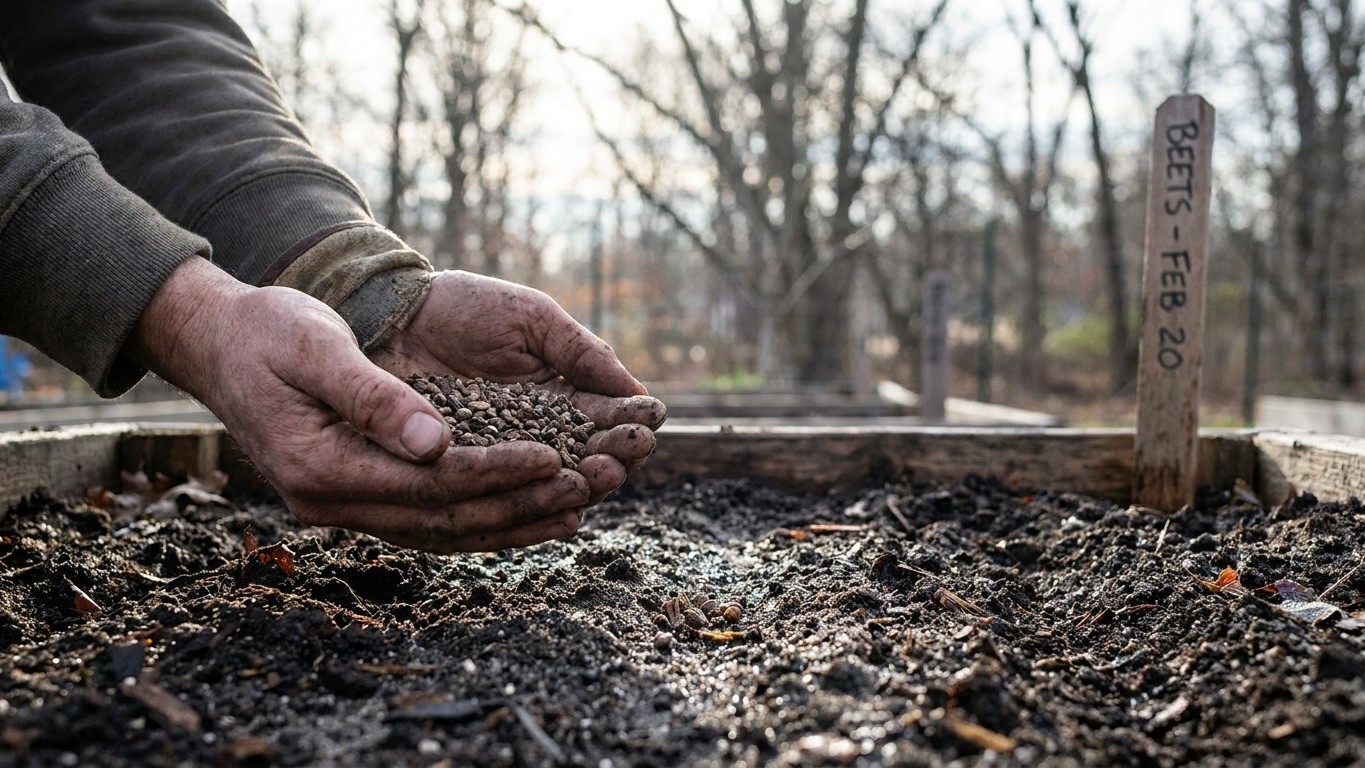

Beets in Louisiana go in the ground twice: a late-winter sowing timed to finish before summer heat sets in, and a fall sowing once that heat finally breaks. In the northern parishes, that means seed down roughly two to three weeks before the last freeze, typically mid-January into early February. In the Gulf-facing south, where freezes are unreliable, the fall window matters just as much as the spring one.
The short answer
Louisiana’s representative soil, the Ruston series, is an Ultisol: an old, heavily weathered and leached soil that runs naturally acid and short on nutrients. USDA NRCS records put the surface horizon at a pH near 5.5 (slightly acid), with a sandy texture of 65 percent sand, 11 percent clay and 24 percent silt, organic matter around 1.8 percent, and well-drained characteristics across 371 sampled components. That’s a starting point, not a verdict on any one garden. A state spans hundreds of soil series, and river bottoms, hill country, and any yard a builder has cut and filled will read completely differently from the mapped Ruston profile.
Still, the Ruston numbers tell a beet grower something useful. Beets want deep, sandy, well-drained soil rich in organic matter, according to Utah State University Extension, and Ruston’s drainage and sand fraction line up reasonably well with that preference. The organic matter figure doesn’t. At 1.8 percent, this soil is thin on the very thing beet roots need to bulk up properly, which is exactly why the same extension guidance caps amendment at no more than 1 inch of composted organic matter per 100 square feet worked into the bed before sowing. Overdo it and you risk forked, hairy roots instead of the smooth taproot you’re after.
Heat is the other half of the equation, and here Louisiana asks more of a beet than most northern states do. Utah State’s research is specific on the mechanism: sustained heat above 85°F combined with water stress is what turns a beet root woody and unpalatable. The exact count of days a year Louisiana spends above 90°F isn’t a figure published in the data behind this page, but the practical reality doesn’t need that number to make sense. Louisiana’s growing season pushes past the 85°F mark for stretches measured in months, not days, every single summer. A beet sown too late in spring, or one whose roots are still thickening when that heat arrives, is a beet headed toward a woody, unpleasant harvest. That’s the real clock this state runs on, more than any single sowing date.
The six weeks that decide it here
Sowing 2 to 3 weeks before the last frost puts a beet’s first six weeks, the window where its fate as a crop is more or less decided, squarely inside Louisiana’s late-winter and early-spring stretch. According to NOAA NCEI’s 1991-2020 Climate Normals, the last spring freeze at the reference station falls somewhere between January 18 and February 8. That’s an unusually early window compared to most of the country, and it comes with a caveat worth sitting with: a 32°F freeze occurs in only 86.8 percent of years at that station. Roughly one year in seven, south Louisiana never freezes at all. North Louisiana freezes far more reliably, so the calendar math shifts noticeably depending on which end of the state a garden sits in.
What that means for the six weeks after sowing is that a Louisiana beet’s early growth phase lands in a spring that’s already prone to swinging. Gulf moisture can deliver soaking spells in the same month a dry, breezy stretch dries the top few inches of a sandy Ruston-type bed in a matter of days. That inconsistency is the actual risk, more than any specific date on a calendar. Utah State University Extension is clear that water stress in a beet’s first six weeks is what triggers premature flowering, or bolting, before the root has had any real chance to size up. A dry spell that would barely register in a heavier clay soil hits harder in a sandy, well-drained profile like Ruston, because that soil sheds water quickly by design.
Bolting from early thirst and woodiness from later heat are two separate failures with two separate causes, and it’s worth keeping them apart. The first is a spring problem: uneven moisture in those first six weeks after seeding. The second is a summer problem: heat overlapping with the root-thickening stage weeks later. A grower who only remembers “keep it watered” and treats both failures as one problem will keep making the same mistake in a different season.
What goes wrong here
- Bolting from a dry spell in the first six weeks. A sandy, well-drained Ruston-type bed dries fast, and even a short rain-free stretch in a normally wet Louisiana spring can trigger premature flowering before the root sizes up. The remedy is consistent moisture from the day of sowing through week six, not just occasional deep watering, since Utah State University Extension ties this specific failure to early water stress rather than total rainfall for the season.
- Woody roots from heat arriving before harvest. Beets sown too late for a spring crop run straight into the 85°F-plus stretch that toughens the root, per Utah State University Extension. The remedy is backing the sowing date up enough that the root finishes bulking before that heat sets in, and treating the fall window as the safer bet for a full-size harvest in warmer parishes.
- Low organic matter limiting root size. At roughly 1.8 percent organic matter, the mapped Ruston surface is thinner on organic content than beets prefer. The remedy is working in up to 1 inch of composted organic matter per 100 square feet before sowing, per Utah State University Extension, without exceeding that amount, since oversized applications can distort root shape rather than improve it.
- Planning around a single “last frost date” in a state where frost is unreliable. South Louisiana skips a 32°F freeze entirely in roughly one year out of seven, per NOAA NCEI, so a rigid calendar built around frost risk misses the point in the southern parishes. The remedy is planning both a late-winter sowing and a fall sowing rather than treating spring as the only chance, especially south of the state’s mid-section where freezes can’t be counted on.
- Assuming the mapped soil matches the actual garden bed. Ruston is the series USDA lists as representative of Louisiana, not a guarantee of what’s under any one yard, particularly where fill dirt, heavy clay bottomland, or disturbed construction soil is involved. The remedy is a basic soil test before amending, so compost and any other input responds to the bed’s actual texture and organic matter rather than the statewide average.
Common questions
Can beets grow year-round in south Louisiana?
Not comfortably. Even where freezes are rare, the summer heat that turns roots woody still shows up every year, so a continuous planting scheme runs into the same 85°F-plus problem Utah State University Extension flags for water-stressed roots. Two distinct windows, late winter and fall, work better than trying to stretch one long season through the hottest months.
How many days does it take beets to mature from seed in Louisiana?
The days-to-maturity clock for beets runs from the day seed goes into the ground, since beets are direct-sown rather than transplanted. Utah State University Extension’s guidance treats the growing window as starting at seeding, which matters here specifically because it’s the sowing date, not any later transplant date, that has to be timed against both the frost window and the summer heat.
Should I add lime to Ruston-type soil before sowing beets?
That’s not a figure this page’s sources address directly. What is documented is that the Ruston series runs slightly acid at the surface and low in organic matter, and that beets respond to added compost up to 1 inch per 100 square feet, per Utah State University Extension. A soil test is the reliable way to know whether a specific bed needs more than that.
What’s the actual difference between bolting and a woody root?
Bolting happens early, when water stress in the first six weeks after sowing pushes the plant to flower before the root has developed. Woodiness happens later, when sustained heat above 85°F overlaps with the root’s thickening stage. Utah State University Extension identifies these as two distinct mechanisms, not two names for the same problem, which is why the fix for one (steady early watering) doesn’t solve the other (timing the harvest ahead of summer heat).