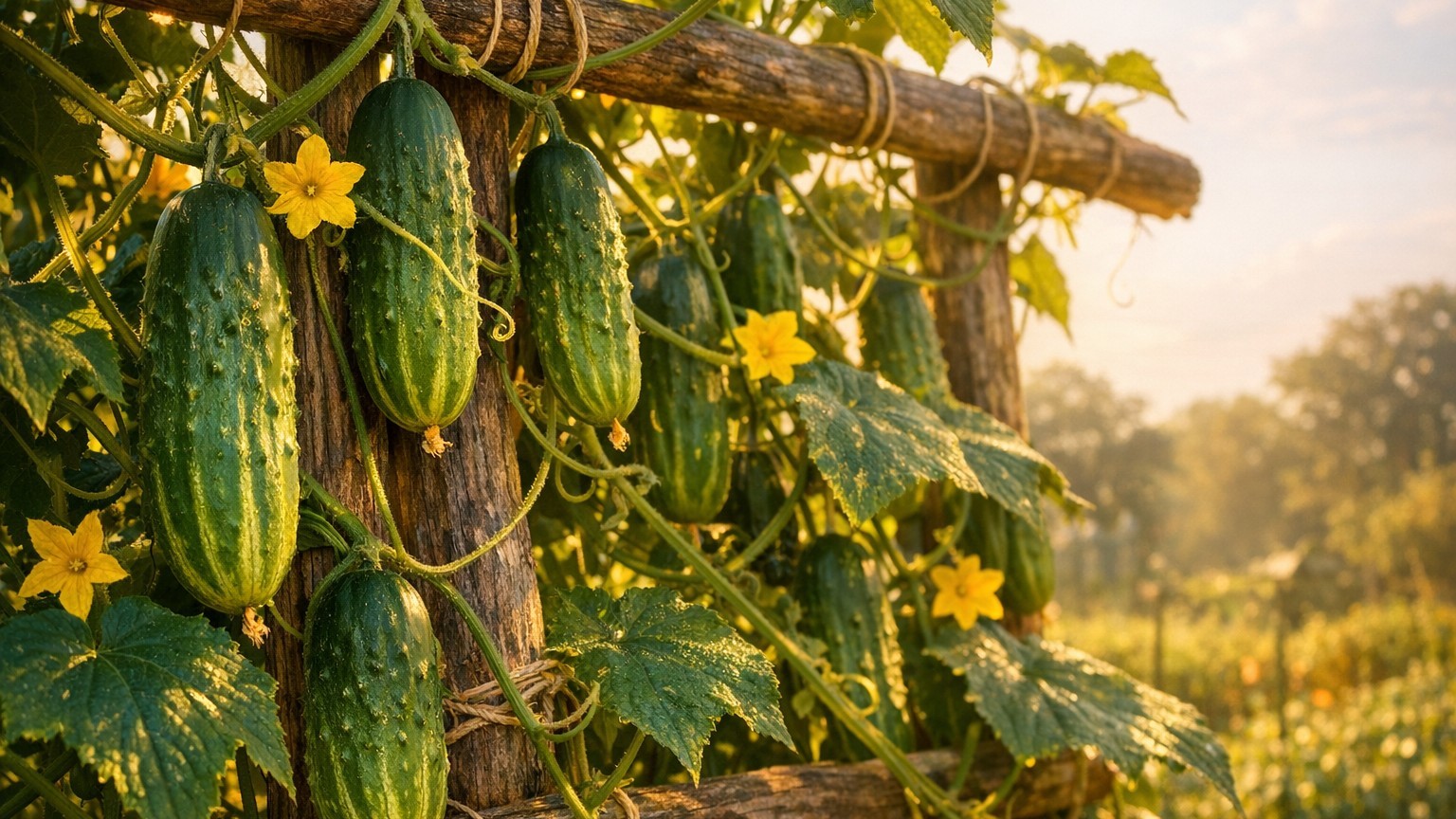

Cucumbers in Louisiana succeed or fail based on heat tolerance, not frost dates. With more than 70 days a year above 90°F and humidity that never really lets up, the winning approach is heat-tolerant vining or bush types trained off the ground, planted early enough to fruit before peak summer, with a second round going in as that heat breaks.
The short answer for Louisiana
Louisiana’s frost dates barely matter for cucumbers. Last spring frost runs January 18 to February 8, and first fall frost doesn’t show up again until December 17 to January 8 — and in south Louisiana, a 32°F freeze only happens in 86.8 percent of years, meaning roughly one winter in seven skips freezing entirely. That’s not a typical planting calendar problem. It’s a heat problem, because the summer stretch that separates those two frost windows includes an average of 70.7 days a year at or above 90°F.
That single number, 70.7 days, should drive the variety decision more than anything else on a seed rack. A cucumber that needs a long, mild, forgiving stretch to size up will spend weeks of its life cycle sitting in triple-digit heat index conditions, and the plant responds by aborting flowers, producing bitter or hollow fruit, or simply shutting down. The types that hold up best here are vigorous vining slicers and pickling cucumbers bred or selected for heat and disease tolerance, plus fast-maturing bush types for containers or small raised beds where space, not vigor, is the constraint.
Two windows, not one
Because the frost-free stretch is so long, Louisiana gardeners effectively get two cucumber seasons out of one calendar year. A spring crop goes in once soil has warmed reliably after the last-frost window, aiming to finish fruiting before the worst of the mid-summer heat load shuts plants down. A second, fall crop goes in as August heat starts easing, timed to mature well ahead of the December-to-January frost window — which, again, may not even arrive in south Louisiana.
Within that structure, the practical type choices break down like this:
- Vining slicing cucumbers bred for disease resistance, trellised vertically to keep foliage dry and fruit off wet soil.
- Pickling types, which tend to mature quickly and produce a concentrated harvest well suited to the shorter fall window.
- Burpless/Asian-style slicers, often more heat-tolerant and less prone to bitterness under stress.
- Bush cucumbers for containers, patios, or anywhere trellis space isn’t available.
- Parthenocarpic types, which set fruit without needing pollinator visits — useful during heat spikes when bee activity drops off.
None of these are variety names to hunt for on a seed rack blind. They’re categories, and the specific cultivars proven to perform in a given Louisiana parish are exactly what the LSU AgCenter’s local guidance and trial data are for.
What will not work here

Long-season types bred with a mild, temperate summer in mind are the first casualty. A cucumber that expects a slow, steady climb to maturity runs straight into that 70.7-day stretch of 90°F-plus weather, and the result is stalled growth, dropped blossoms, and fruit that turns bitter under heat stress well before it reaches useful size. This isn’t a minor yield dip — it’s often a full crop failure in the hottest weeks of July and August, which not coincidentally is also the driest summer month, averaging 6.79 inches of rain against June’s 7.62 and August’s 6.91.
Weekly watering schedules fail here too, and the math explains why. Roughly 21.3 inches of rain falls across June, July and August combined, which sounds generous until you account for how it arrives: as concentrated thunderstorms rather than steady soaking rain. Combined with 70.7 days of 90°F-plus evaporation demand, a single weekly watering leaves cucumber roots dry for days at a stretch, right as heat stress is already pushing the plant toward blossom drop. Cucumbers are shallow-rooted and thirsty; in this climate, that usually means checking soil moisture every couple of days during peak summer, not once a week.
Ground-level spacing and humidity
The other consistent failure point is letting vines sprawl on the ground in tight rows. Louisiana’s humidity, stacked on top of that summer rainfall pattern, creates ideal conditions for downy mildew and other fungal disease to move through a planting fast once foliage stays damp. Cucumbers grown flat on the soil, leaf against leaf, dry out slowly after rain or dew and give fungal spores exactly the window they need. Vertical trellising solves most of this by opening airflow around the leaves and keeping fruit and foliage away from splashing soil — it’s less about saving space and more about survival in a humid climate.
One more mismatch worth naming: gardeners transplanting habits from drier, cooler states often plant a single spring crop and stop, assuming the season ends there. In Louisiana, that means missing the fall window entirely and leaving a productive stretch of the calendar unused while the plant that struggled through July gets blamed for the whole season.
What changes across Louisiana
Louisiana spans USDA Hardiness Zones 8a to 10a, and that spread, built on average annual extreme minimum temperature under the USDA Plant Hardiness Zone Map system, means there is no single answer that fits the whole state. North Louisiana, generally toward zone 8a, freezes far more reliably each winter than the coastal south. The reference station behind the frost and heat figures cited here sits near New Orleans, which runs warmer and toward the 9b-10a end of that range.
That difference changes how a gardener should treat the shoulder seasons. In north Louisiana, both the spring planting date and the fall cutoff deserve real attention, because a hard freeze is a dependable annual event, not a coin flip. Further south, where a 32°F freeze skips roughly one year in seven, the fall crop often has room to keep producing well past what a standard calendar would suggest, and some seasons never see a frost that would end it at all.
Heat load likely runs high across most of the state’s cucumber-growing regions, but humidity and rainfall patterns aren’t uniform either — coastal parishes tend to run more humid than the interior, which shifts the disease-pressure math even where the frost dates look similar. A gardener in the northern part of the state and one near the coast are, in practical terms, gardening in different climates that happen to share a state line. Neither this page nor any state-level source can say which zone applies to a specific address; that’s what the USDA hardiness zone map itself is for, checked by ZIP code.
Where to check this for your own county
The LSU AgCenter, Louisiana’s land-grant extension service, is the source built to answer which specific cucumber varieties have actually been trialed and performed well in a given parish, and what planting calendar that parish’s extension agents recommend based on local conditions.
Two things are worth pulling from that resource specifically. First, the local planting calendar for vegetables, which will translate the statewide frost-and-heat pattern described above into dates that fit a specific parish’s microclimate, whether that’s the earlier, more reliable frost pattern of the north or the extended, frost-optional window closer to the coast. Second, the list of cucumber varieties the AgCenter has trialed and recommends for Louisiana conditions, which is exactly where the type recommendations above (heat-tolerant slicers, pickling types, disease-resistant vining varieties) turn into actual named cultivars a gardener can buy with confidence.
A county-level recommendation will always beat a state-level one, because it accounts for local soil, local disease pressure, and microclimate variation that a statewide page like this one can’t see. This page describes the pattern across Louisiana as a whole; the AgCenter’s county-specific guidance describes one garden’s actual conditions. When the two disagree on timing or variety, trust the local source. It’s built on trial data from that specific region, not a statewide average.
Checking this against your own garden
Every date and figure on this page is a statewide average built from decades of climate records, not a forecast for one particular yard. The most reliable signal a gardener has is what’s actually happening in their own soil and on their own plants, and three things are worth watching closely before trusting any calendar over direct observation.
Soil warmth by feel comes first. Cucumbers germinate poorly and sit stalled in cool soil, so before transplanting or direct-seeding, pressing a hand into the top few inches of bed soil in the morning tells more than a calendar date does. Soil that still feels cool or damp-cold to the touch, even after the calendar says it’s time, usually means waiting another week pays off in faster, more even germination.
The first flush of male flowers is the second signal. Cucumbers typically produce male blossoms before female ones, and a healthy early flush suggests the plant has settled in and is building toward fruit set. If that flush is sparse, slow to appear, or drops without female flowers following, it’s often a sign of heat or moisture stress worth addressing with shade cloth or a closer eye on watering, rather than a variety problem.
First true leaves, the leaves that emerge after the initial seedling leaves, are the third check. Their size, color, and speed of emergence say a lot about whether a spot gets the sun and drainage a cucumber actually needs. Small, pale, or slow-to-develop true leaves in an otherwise warm bed usually point to a light or drainage issue specific to that exact spot, not something any statewide planting guide could have predicted.