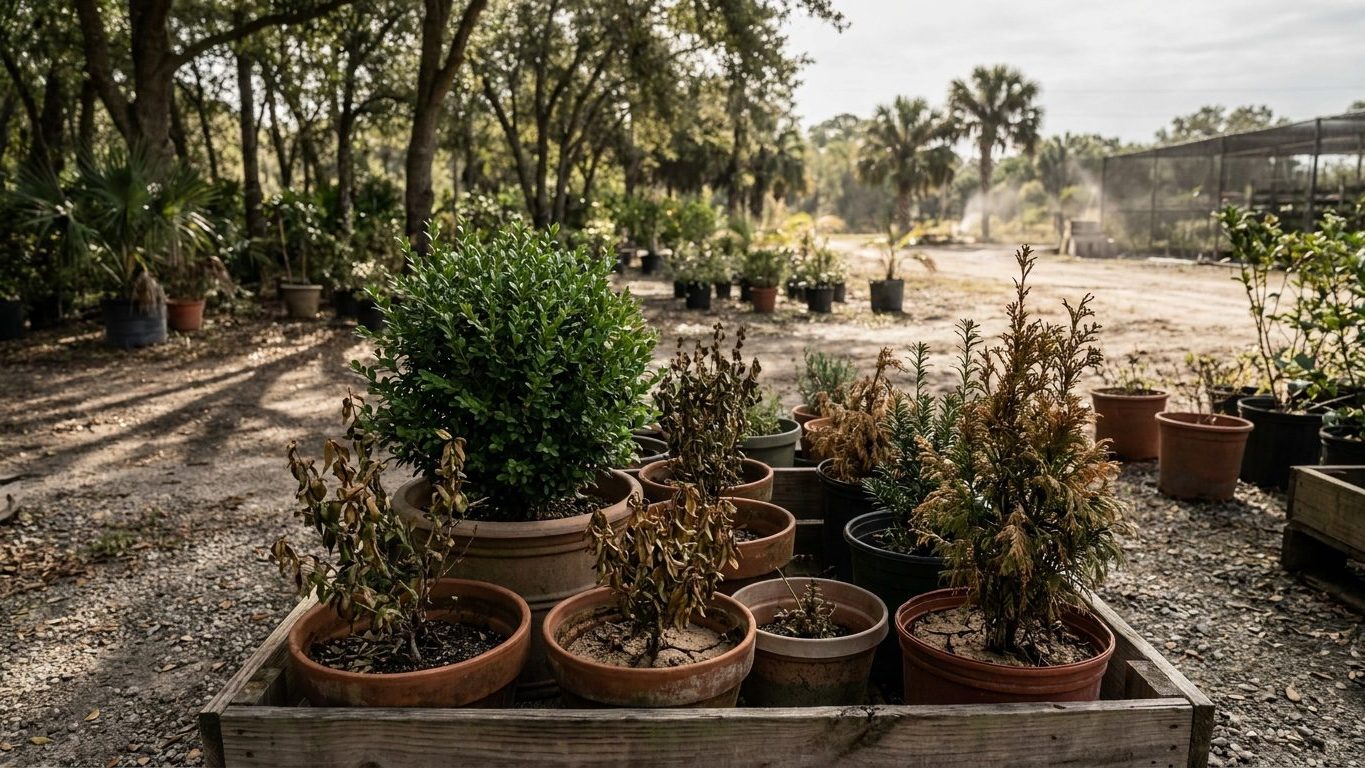

Of the 12 hedge species documented on this site, only one survives across all of Louisiana, which runs from zone 8a to 10a on the USDA hardiness map: Leyland cypress. Seven work in part of the state only. Four fail everywhere: common privet, Anglo-Japanese yew, eastern arborvitae and eastern hemlock. The map names the zones, but the fine print is what decides whether a hedge lasts or dies.
What actually holds in Louisiana
Start with the four that won’t. Ligustrum vulgare (common privet), Taxus x media (Anglo-Japanese yew), Thuja occidentalis (eastern arborvitae) and Tsuga canadensis (eastern hemlock) are not rated for any zone in the state, according to NC State Extension’s Plant Toolbox ranges, which this page compares against Louisiana’s own USDA range. These are staples of northern hedge photos and catalogs. Plant them here and the failure tends to come in the first or second summer, not the first winter.
That points at the real constraint. The USDA zone system rests on one number, the average annual extreme minimum temperature. It says nothing about heat. In Louisiana the limiting factor is the summer, not the cold. One south Louisiana station in NOAA’s 1991-2020 normals sees a 32°F freeze in only 86.8 percent of years, so roughly one year in seven has no freeze at all. The upper end of a plant’s range is often a heat limit, and “holds” in this article means survives, not thrives.
Seven plants that cover part of the state
Between “everywhere” and “nowhere” sits a middle bucket that needs zone names, not a yes or a no. Three plants reach only 8a and 8b, the cooler end of Louisiana’s range: boxwood, cherry laurel and arrowwood viburnum. Four go as far as 9b: American hornbeam, inkberry holly, winterberry holly and eastern red cedar. None of the seven is listed for 10a. In that zone, the warm fringe of the state, Leyland cypress is the only documented option. It survives there, but that is a lower bar than doing well.
| Plant | Zones in Louisiana | Growth a year | Height | Regrows from old wood |
|---|---|---|---|---|
| Boxwood (Buxus sempervirens) | 8a, 8b | 3 to 6 inches | 2 to 6 feet as a hedge | Yes |
| Cherry laurel (Prunus laurocerasus) | 8a, 8b | 1 to 2 feet | 6 to 15 feet as a hedge | Yes |
| Arrowwood viburnum (Viburnum dentatum) | 8a, 8b | 12 to 24 inches | 6 to 10 feet as a hedge | Yes |
| American hornbeam (Carpinus caroliniana) | 8a to 9b | 12 inches | 6 to 15 feet as a hedge | Yes |
| Inkberry holly (Ilex glabra) | 8a to 9b | 6 to 12 inches | 5 to 15 feet as a hedge | Yes |
| Winterberry holly (Ilex verticillata) | 8a to 9b | 6 to 12 inches | 5 to 15 feet as a hedge | Yes |
| Eastern red cedar (Juniperus virginiana) | 8a to 9b | 12 to 24 inches | 8 to 20 feet as a screen | No |
| Leyland cypress (x Hesperotropsis leylandii) | 8a to 10a | 3 to 4 feet | 15 to 25 feet as a screen | No |
Texas shares much of this geography, and its list reshuffles because the state is so much bigger. The Hedge Plants for Texas: What Holds, and What Only Looks Hardy page shows the same exercise on a different map. For the wider picture of shaping and planting, start at Hedges.
The hedges you can never cut back down
The last column of that table is the one to read twice. Two plants, eastern red cedar and Leyland cypress, do not regrow from old wood. Cut into the bare, brown interior and nothing sprouts. The hole stays a hole.
Leyland is the trap because it is the only plant here that survives in every zone, and it grows 3 to 4 feet a year. A row planted as a quick screen reaches 15 to 25 feet before most owners have decided how tall they want it. Trim it late spring to midsummer, and only from the green growth. Once it outgrows the space, the choices are to live with it or to pull it out. A hard prune will not fix it.
Eastern red cedar behaves the same way at a slower pace, 12 to 24 inches a year, and it wants light cuts only, in late winter. Heavy renovation is off the table for both plants. If a hedge might ever need to come down to waist height, neither belongs in that spot.
The other six forgive mistakes. Their pruning windows, though, differ enough that one weekend of shearing for everything will cost you something:
- Boxwood: late spring, after the last frost.
- Cherry laurel: late spring, after flowering.
- Arrowwood viburnum: right after flowering.
- American hornbeam: midsummer, after the first flush.
- Inkberry and winterberry holly: late winter, while dormant.
Late winter is where Louisiana’s odd frost calendar matters. At the NOAA station used here, the last spring freeze falls between January 18 and February 8 (the 30 to 70 percent probability band), and the first fall freeze between December 17 and January 8. That fall window straddles the New Year. In south Louisiana “late winter” overlaps the tail of freeze season, so a holly pruned in mid-January can be nipped by a later cold snap. North Louisiana freezes more reliably, and the same calendar shifts. Those dates come from one south Louisiana station, so don’t treat them as a statewide rule.
Matching the plant to the job
A hedge is a job, not a species. The first question is height. A knee-high edge along a walkway and a 20-foot wall against the neighbor’s window are different projects, and they draw from different parts of the table.
For low, formal work, boxwood is the only entry that stays small, at 2 to 6 feet and 3 to 6 inches of growth a year. That slow pace makes it easy to keep tidy, and it means a gap takes years to fill. It also covers only 8a and 8b. Below that line, formal low hedging has no documented option on this list, which is a real gap in the state’s warmer half.
For a mid-height living fence of 5 to 15 feet, the hollies and hornbeam do the work. Inkberry is evergreen and winterberry loses its leaves in winter. If the point is winter privacy, that distinction decides it: a bare winterberry hedge in January screens nothing. Hornbeam gets 6 to 15 feet at 12 inches a year and reaches 9b, and cherry laurel gets to the same height in 8a and 8b at 1 to 2 feet a year, so laurel fills faster where it holds.
Tall screens are the risky category. Leyland cypress delivers height fastest and crosses every zone. Eastern red cedar is slower, tops out at 8 to 20 feet, and stops at 9b. Both are one-way plantings, since neither can be cut back later. Plan the spacing and the final height before the first shovel goes in. A screen planted too close to a house or a property line will need removing, not trimming.
Arrowwood viburnum fits the middle: 6 to 10 feet as a hedge, 12 to 24 inches a year, and it wants pruning right after flowering. That timing is tight, since cutting late removes next year’s bloom. It suits a gardener who will actually watch the calendar.
The ground you are planting into
USDA lists the Ruston series, an Ultisol, as representative of Louisiana. It is an old, heavily weathered, leached soil, naturally acid and low in nutrients. The surface horizon averages a pH of about 5.5, or slightly acid. It is 65 percent sand, 24 percent silt and 11 percent clay, with about 1.8 percent organic matter, and it drains well. That comes from USDA NRCS Soil Data Access, queried August 29, 2026, as representative values for the surface layer of the mapped series. It is not a measurement of your bed.
Read it as a tendency. Ground like this sheds water quickly and holds few nutrients, so a new hedge planted in it dries out fast in a Louisiana summer. That is when watering a young plant matters most, and it is also when a plant near its heat limit is under the most stress. Organic matter of 1.8 percent is thin. Compost worked into the planting bed helps hold moisture and nutrients, though it does not change the underlying texture.
The statewide soil is not the soil in your yard. Louisiana has river bottoms, hill country, coastal ground and lots of lots where a builder scraped off the topsoil or trucked in fill, and each behaves differently. A clay-heavy river-bottom bed can hold water long enough to drown roots that Ruston-type sand would have drained. A pH of 5.5 for the state’s representative soil does not tell you your pH.
The fix costs little. The LSU AgCenter, the state’s extension service (lsuagcenter.com), handles soil testing, and a test before planting gives you a real number for your own bed. Do it before buying 40 feet of plants, not after they start to yellow.
Common questions
Can I still plant privet, yew, arborvitae or hemlock in Louisiana?
You can put them in the ground, but none of the four is rated for any Louisiana zone. Expect trouble in the first hot summers, not the first winter. Substitute a plant that holds in your zone from the table above.
Which hedge is safest across the whole state?
Leyland cypress is the only plant of the 12 documented here that survives from zone 8a to 10a. It cannot regrow from old wood, so it can never be cut back to size later. “Survives” also does not promise it will thrive in your yard.
When should I prune a hedge?
It depends on the plant. Boxwood gets pruned in late spring after the last frost, arrowwood viburnum right after flowering, hornbeam in midsummer after the first flush, and the hollies in late winter while dormant. Cherry laurel goes in late spring after it flowers.
Does the frost date matter for planting a hedge here?
Less than in the North. At the south Louisiana station used for these normals, a 32°F freeze happens in only 86.8 percent of years, so about one year in seven has no freeze at all. Summer heat is the constraint to plan around, and north Louisiana freezes more reliably than the south.