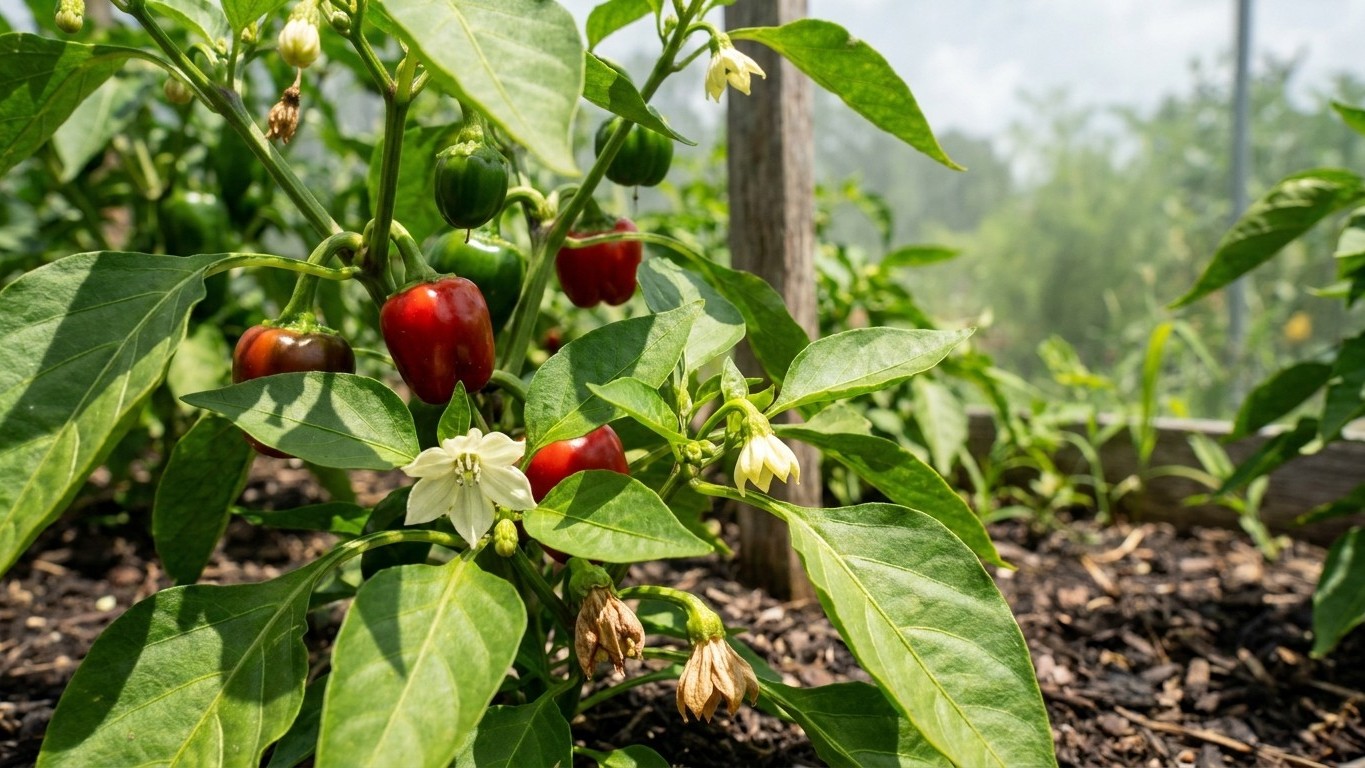

South Louisiana pepper growers fight heat, not cold. New Orleans averages 70.7 days a year at or above 90 F, and that heat load is exactly what shuts down fruit set on a pepper plant. Frost barely matters here. The real calendar question is When to Start Pepper Seed in Louisiana so transplants are already fruiting before the worst of the heat arrives, and when to protect blossoms once August settles in.
The short answer

Start with the number that actually runs this climate: 70.7 days a year at or above 90 F, averaged at the New Orleans reference station over 1991-2020. That is not a handful of scorching afternoons. That is more than two full months of the year sitting at or past the threshold where pepper flowers stop setting fruit and start dropping instead. A pepper plant can survive 90-degree days just fine as a plant. It just won’t reliably turn its flowers into peppers while the heat holds, and understanding Why Peppers Fail to Set Fruit in Louisiana makes clear why. So the practical reading of that 70.7-day figure is this: whatever fruit a Louisiana pepper plant is going to set, it needs to set a good share of it before the heat load piles up, and again once it eases off in fall.
That is one end of the failure window. The other end is just as real and gets ignored far more often, because gardeners assume a Gulf Coast climate has no cool-night problem at all. It does. Pepper flowers also refuse to set fruit when nights drop below 55 F, and that threshold has nothing to do with frost. A night can sit well above freezing, comfortable enough that nobody thinks to worry, and still be cold enough to abort blossoms if it dips under 55 F. Early spring and late fall in Louisiana can both produce nights in that range even when the days are warm and pleasant.
Here is the part that matters for how you plan: this site tracks days at or above 90 F for Louisiana, but it does not carry summer night minimum temperatures for this or any territory. There is no published figure here to hand you for how many nights in your county drop below 55 F, and no shortcut that lets you guess it from where you sit on the map. A location’s distance from the Gulf, its elevation, whether it sits in a river bottom or on a ridge, all of that shifts night temperatures in ways that latitude alone does not predict. The only reliable move is to watch your own overnight lows during the weeks you expect flowering, rather than assume a number based on how far south or north you happen to be.
Put those two thresholds together and the shape of a Louisiana pepper season becomes clear. There is a window in mid-spring, after nights reliably clear 55 F but before the days pile up past 90 F, when fruit set runs cleanest. There is a second, shorter window in fall as the 90-degree days taper off, before night temperatures fall back through that same 55 F floor, and choosing Pepper Varieties That Ripen in a Louisiana Season to match those two windows matters as much as timing the plantinh 55 F. Everything in between, the plant may bloom and hold, or it may drop flowers and wait it out.
When to start seed here
The arithmetic runs backward from your transplant date, and in Louisiana the transplant date itself is set less by frost than by soil temperature and by how soon you want fruit set finished before summer heat piles up. Here is how to work it out for your own county.
- Locate your last spring freeze window. For the New Orleans reference station, the 32 F freeze probability band runs January 18 to February 8. That sounds early, and it is, but there is a catch worth sitting with: a 32 F freeze at that station only occurs in 86.8 percent of years. Roughly one year in seven, south Louisiana gets no freeze at all, and in those years the whole idea of a “last spring frost” doesn’t apply because there was never a frost to be last. North Louisiana freezes far more reliably than the coast, so a grower in the northern part of the state should expect a more conventional frost-driven calendar than someone near the Gulf.
- Wait for 60 F soil, not just a frost-free date. Pepper transplants need soil at 60 F to go into the ground without stalling. In much of south Louisiana that soil temperature often arrives before the calendar would suggest, given how mild the winters run, but it still needs checking with a soil thermometer rather than assumed from the date on a seed packet.
- Count back 8 to 10 weeks from that transplant date. If soil is hitting 60 F and frost risk has passed by early to mid-February in your part of the state, counting back 8 to 10 weeks lands seed-starting somewhere in early to mid-December. That is an unusually early indoor start compared to most of the country, and it is a direct consequence of how mild and short Louisiana’s cool season runs.
- Recheck the arithmetic against your own county’s freeze history, not the state average. A grower in north Louisiana, where freezes are dependable and later-arriving than the coast, should push both the transplant date and the seed-start date later to match. The same 8-to-10-week rule holds, but the date it counts back from moves.
What goes wrong here
- Blossom drop in a hot spell. Once daytime highs push past 90 F for a run of days, a pepper plant will keep flowering but shed a share of those flowers unfertilized. With 70.7 such days a year on average, this is not a rare event in south Louisiana, it is a recurring feature of the season. There is no fix for the heat itself once it arrives, but timing the bulk of fruit set to finish before the hottest stretch, and again once it eases in fall, keeps a plant productive around the worst weeks rather than through them.
- Blossom drop in a cool night. The same failure shows up at the other end, whenever nights fall under 55 F, and Louisiana’s spring and fall both carry stretches where that happens even with warm days. Because this site does not track summer night minimums, the only real remedy is watching your own overnight lows during the weeks a plant is flowering and not assuming the coast is automatically warm enough at night just because the days are hot.
- Sunscald. Where Louisiana sun is strong and a plant loses foliage cover, either from pruning, disease, or a plant that never filled out, exposed fruit can develop pale, papery patches on the sun-facing side. Keeping foliage full enough to shade developing peppers, and not stripping leaves for the sake of appearance, avoids most of it.
- Blossom-end rot. A dark, sunken patch at the fruit’s blossom end usually points to uneven watering rather than a soil nutrient shortage on its own. Louisiana’s heavy summer downpours followed by dry stretches make this an easy trap. Keeping soil moisture steady, with mulch to buffer the swings, does more than any additive poured on after the fact.
Checking this against your own county
Everything above is built on state and regional averages, and Louisiana is not one climate. A grower outside New Orleans sits in a different heat and freeze pattern than a grower in the northern parishes, and only local extension data can close that gap. The LSU AgCenter maintains county-level guidance on frost timing, soil temperature trends, and pepper variety performance across the state’s parishes, and that is the resource to check before locking in a seed-starting date.
Treat the figures here as the framework, the days-above-90 count, the freeze probability window, the 55 F and 90 F fruit-set thresholds. Treat your own county’s extension bulletin as the correction, especially if you’re farther north than the coastal reference station this data is drawn from, or if your site runs noticeably warmer or cooler than the surrounding area because of elevation, tree cover, or proximity to water.
Common questions
Do peppers stop producing in a Louisiana summer?
They don’t stop growing, but fruit set slows or halts during the hottest stretches, especially once daytime highs push past 90 F repeatedly. Plants typically resume setting fruit once the heat eases in fall, provided they’re kept alive and healthy through the slow stretch.
Is frost really not a concern for south Louisiana peppers?
It’s a minor concern at most. The 32 F freeze window at the New Orleans reference station runs January 18 to February 8, and even then a freeze only shows up in 86.8 percent of years. Heat, not frost, is the limiting factor for pepper growing in that part of the state.
Why did my pepper flowers drop even though it wasn’t that hot?
Check your overnight temperatures. Fruit set fails below 55 F just as it fails above 90 F, and a cool night can undercut a plant even when the daytime weather looks fine.
How early should I start pepper seeds indoors in Louisiana?
Count back 8 to 10 weeks from your expected transplant date, which is set by 60 F soil and the passing of frost risk. In much of south Louisiana that arithmetic often lands seed-starting in December, earlier than most of the country.