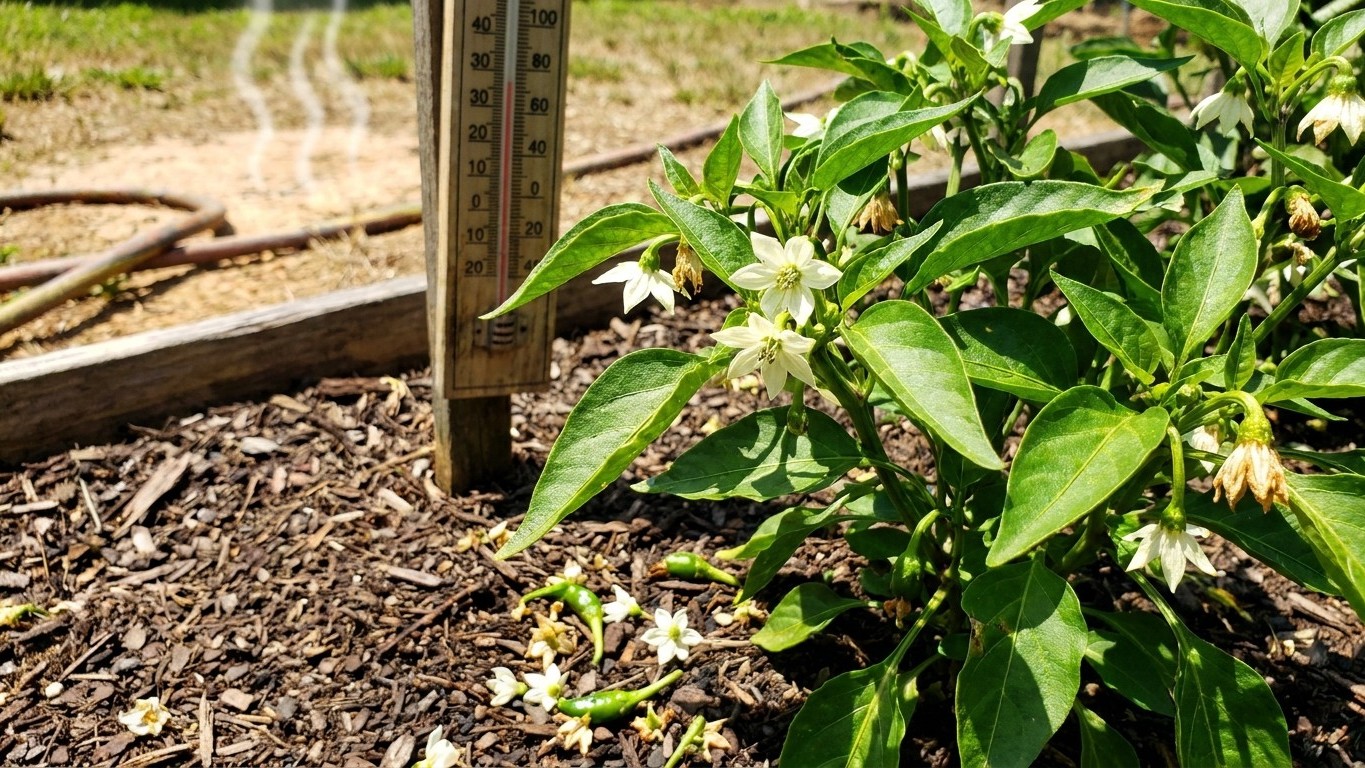

Peppers stall in Louisiana gardens for one of two reasons: the air gets too hot or the night gets too cool, and both push blossoms to drop before they ever turn into fruit. In the southern half of the state, heat is the bigger culprit, with dozens of days each summer climbing past 90 F. Farther north, spring nights can still dip low enough to stop pollen from forming. Neither problem shows up as a diagnosis on the plant itself, just an absence of peppers where flowers used to be.
The short answer
New Orleans averages 70.7 days a year at or above 90 F, according to NOAA’s 1991-2020 Climate Normals. That’s not a single July heat wave, that’s roughly ten weeks scattered across the growing season, and it’s the number that decides whether a pepper plant sets fruit or just sits there flowering without result. Pepper pollen loses viability once temperatures push past 90 F, especially paired with a dry afternoon. Even a healthy, well-fed plant loaded with flowers will drop them at the stem after a hot stretch, and no amount of fertilizer fixes that. It’s a temperature switch, not a nutrition problem.
Those days above 90 F don’t cluster into one bad month. In most of the state they spread from May through September, so the hot side of the equation isn’t a single event to plan around, it’s a recurring risk through most of the season. South Louisiana parishes routinely see stretches in July and August where daytime highs sit above 90 F for a week or more, and that’s exactly the window where a plant carrying young flower buds can lose the whole batch overnight. Fruit already set usually survives; new blossoms opening during that stretch tend not to.
The other end of the pepper’s temperature window is nights below 55 F, and that threshold matters just as much as the heat one. Cool nights slow pollen germination and can stop fruit set even when the daytime weather looks ideal. This site tracks the heat side of Louisiana’s climate in detail, the days-above-90 count above, but it does not carry summer night-time lows for this territory. That gap is worth naming rather than guessing around: a gardener near Shreveport and a gardener near Houma can see very different overnight patterns in the same week, and nothing about a location’s latitude or its coldest winter month tells you what a June or July night will do. The only reliable fix is watching your own thermometer through flowering season and noting whether overnight lows are sitting persistently under 55 F. If they are, expect flower drop no matter how good the days look.
When to start seed here
Working backward from Louisiana’s frost calendar isn’t as simple as it is farther north, because a large share of the state barely freezes at all. Building a personal schedule works better than copying a generic planting chart.
- Find your last spring frost window. NOAA’s 1991-2020 Climate Normals place the 32 F freeze probability for south Louisiana between January 18 and February 8. That’s the window in which a freeze is likely, not guaranteed.
- Understand how unreliable that freeze actually is. A 32 F freeze occurs in only 86.8 percent of years at the reference station, meaning roughly one winter in seven brings no freeze at all to this part of the state. North Louisiana freezes far more reliably than the south, so a grower there is working from a firmer date.
- Wait for 60 F soil, not just the calendar date. Utah State University Extension recommends transplanting peppers only after frost danger has passed and soil temperature reaches 60 F. Push a soil thermometer four inches down rather than trusting the date alone.
- Count backward 8 to 10 weeks from that transplant date. That’s how long pepper seedlings need indoors before they’re sturdy enough for the ground. If soil in your area typically reaches 60 F by early March, start seed indoors sometime between late December and early January.
- Adjust for your own parish. A grower near Shreveport, working from a firmer frost date, can plan that math on a fixed calendar. A grower in the southern parishes, where frost is inconsistent and soil warms earlier, may find soil hits 60 F before the “typical” frost window even closes, so let soil temperature override the calendar whenever the two disagree.
- Keep the fall crop in mind. Because freeze isn’t guaranteed most years, many south Louisiana gardeners run a second planting for a fall harvest, with that timing window straddling the New Year on the back end. It’s a separate schedule built off the first fall frost rather than the spring one, but the same 8 to 10 week indoor rule and the 60 F soil test still apply.
What goes wrong here
Most pepper failures in Louisiana trace back to one of three problems, and all three connect directly to the state’s heat load and humidity swings.
- Blossom drop from a hot spell or a cool night. Flowers open, then fall off the stem within a day or two, leaving no fruit behind. This happens on either side of the plant’s comfort range: daytime highs pushing past 90 F on one end, nights dropping below 55 F on the other. Since this site tracks only the hot side for Louisiana (70.7 days a year at or above 90 F at the New Orleans reference station), the fix on the cool side is to monitor overnight temperatures directly rather than assume them from the season. When a heat spell is forecast, some gardeners add afternoon shade cloth over young flowering plants to blunt the worst of the midday sun.
- Sunscald on exposed fruit. Louisiana’s summer sun is intense enough that peppers left uncovered by foliage develop soft, pale, sunken patches on the side facing the afternoon sun. This usually follows heavy pruning, disease-driven leaf loss, or a naturally sparse plant. Keeping the canopy full, and avoiding aggressive pruning during the hottest stretch of summer, keeps fruit shaded by its own leaves. Light shade cloth over exposed rows helps in gardens with unbroken afternoon sun.
- Blossom-end rot on the fruit itself. A dark, leathery patch on the bottom of the pepper signals a calcium delivery problem inside the plant, usually triggered by uneven watering rather than a true calcium shortage in the soil. Louisiana’s pattern of heavy rain followed by dry, hot stretches is a common trigger, since a plant can’t move calcium steadily when the soil swings between soaked and parched. Mulching to hold moisture even, and watering on a set schedule rather than waiting for the plant to look thirsty, keeps that calcium flow steady.
Common questions
Can peppers set fruit all summer long in Louisiana?
Not reliably through the hottest stretches. With 70.7 days a year averaging 90 F or higher at the New Orleans reference station, most south Louisiana gardens hit at least one multi-week stretch where daytime heat stalls new flowering. Fruit already on the plant usually keeps ripening; it’s the new flowers opening during that window that stop turning into fruit.
Why are my pepper flowers falling off without producing anything?
That’s blossom drop, and in this state it’s driven by temperature extremes on either end: hot afternoons above 90 F or nights that fall below 55 F. Since summer night lows aren’t tracked here by territory, check your own thermometer overnight during flowering to see which side of the problem applies.
Is south Louisiana’s mild winter an advantage for pepper growing?
It cuts both ways. A 32 F freeze happens in only 86.8 percent of years at the reference station, so frost is far less of a constraint than it is farther north, and some gardeners use the gap to run a second, fall planting. But that same mild winter arrives paired with a long, intense summer heat load, which is the bigger obstacle to fruit set here than frost ever is.
Should I Start Pepper Seed differently in north versus south Louisiana?
Yes. North Louisiana freezes more reliably, giving growers there a firmer frost date to count backward from. In the south, where frost is inconsistent, soil temperature reaching 60 F is the more trustworthy signal, and it can arrive before the “typical” frost window even closes.