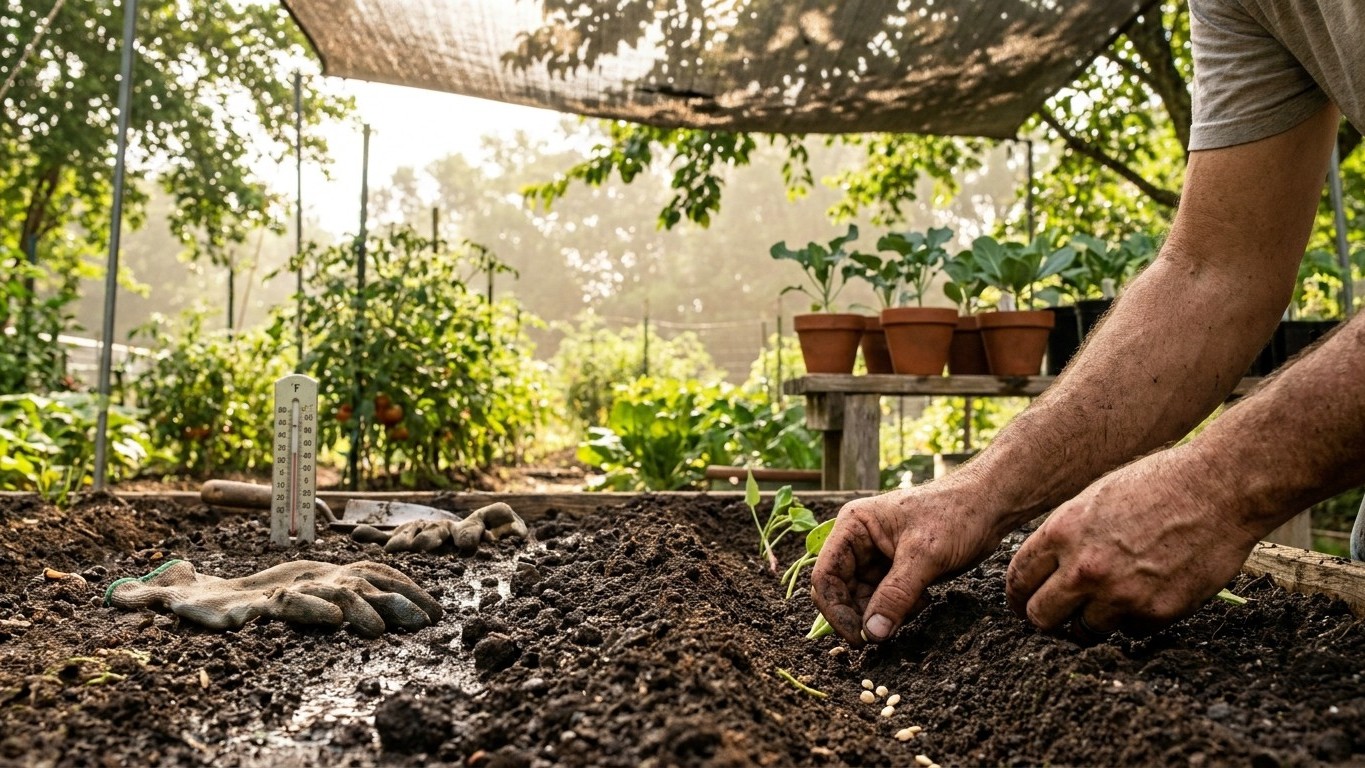

July in Louisiana is a heat month, not a frost month. Direct-sow okra, southern peas, sweet potato slips and heat-tolerant beans now, and use the shade to start fall broccoli and cabbage seed indoors. Tomatoes and peppers largely wait. The real work this month is keeping soil moisture steady and scouting for the pests that thrive in this weather.
What goes in the ground in July

Frost has nothing to do with this month’s decisions. Louisiana’s fall frost window runs December 17 to January 8, and the spring window runs January 18 to February 8, according to NOAA’s 1991-2020 Climate Normals for 32F freeze probability. That’s five to six months away in either direction. The limiting factor in July is soil temperature running well into the 80s and air temperature that stalls fruit set on plenty of common vegetables long before any freeze is a concern.
That heat actually opens a short list of crops that shrug off conditions most garden vegetables can’t handle. Okra is the clearest example: it germinates fastest in hot soil and produces through the worst of the summer. Southern peas (cowpeas, black-eyed peas, crowder types) are bred for exactly this climate and can go into the ground as a direct seed with no fuss. Sweet potato slips root quickly in warm soil and need the long, hot stretch ahead of them to bulk up roots before fall. Malabar spinach and yard-long beans, both heat-loving vining crops, also do well started now.
The gamble crops are the ones gardeners keep trying anyway: tomatoes, snap beans, and most peppers. Flowers on these plants commonly abort when nights stay warm and days climb into the 90s, a pattern that shows up across Louisiana through most of July. Transplants set out now often survive but produce little until temperatures ease later in the season. If you want tomatoes from a July planting, treat it as a fall-harvest gamble rather than a summer one, and expect the plant to spend the next couple months surviving more than fruiting.
Soil that’s been baked hard by weeks of sun can also resist a new seed row. Water a bed deeply the evening before direct-sowing anything, and you’ll get better, faster germination than sowing into dust-dry ground and hoping the first watering catches up.
What to start under cover
This is the month for trays, not garden beds, when it comes to the fall cole crop lineup. Broccoli, cabbage, cauliflower and collards need roughly six to eight weeks from seed to a transplant-ready size, and they need to go into the garden once soil has cooled enough for roots to establish without stress. Counting backward from a fall transplant window that typically falls in early-to-mid fall in Louisiana, seed started indoors or under shade cloth now lines up correctly. The trick is keeping trays out of direct afternoon sun and off hot concrete, since July temperatures can cook a seed tray faster than they’d cook a garden bed with more soil mass to buffer the heat.
The two ways this goes wrong both come down to timing. Start too early, indoors under lights or in a shaded corner, and by the time outdoor temperatures are fit for transplanting the seedlings have gone rootbound and leggy, stretching for light and wasting energy on stem instead of roots. Start too late, waiting for the first hint of cooler weather to sow, and the plants won’t reach transplant size before the fall window closes and the crop runs out of growing season before the December-through-January frost arrives.
A simple middle path: sow in cell trays under 30 to 50 percent shade cloth, water them daily since July heat dries small containers fast, and pot up to a slightly larger cell once true leaves appear rather than letting roots circle in a cell that’s already too small. That one step, sizing up before the roots get cramped, is what keeps a July-started tray from turning into a stunted transplant by the time it’s ready for the garden.
What is ready to pick
Harvest in July leans on the same heat-tolerant crops doing the planting. Okra pods grow fast in this weather and turn woody within a couple of days of reaching full size, so check plants every day or two and cut pods at two to three inches for the most tender eating. Southern peas can be picked at the green shell stage for fresh eating or left to dry down on the vine for storage peas, and a light finger-press on the pod will tell you which stage you’re at.
Summer squash and cucumbers are still coming in for most gardeners, though squash vine borer damage often starts cutting production short by mid-summer. Eggplant holds up well in the heat and keeps producing glossy fruit as long as it’s picked regularly, which also keeps the plant setting new flowers instead of putting energy into oversized, seedy fruit. Watermelon reaches ripeness around this time for spring-planted vines; the classic tests are a dull thump rather than a hollow ring, and a yellowing (not white) spot where the melon rests on the ground.
Tomatoes planted in spring are often winding down production as blossom drop sets in with the heat, though fruit already set will keep ripening. Blueberries are typically finishing their run, and early figs can start coloring up depending on variety. None of this is a long list, but it’s a real one, and picking consistently through the heat is what keeps plants like okra and eggplant producing instead of shutting down.
The jobs that matter this month
Mulch is the single job that pays off most in a Louisiana July. A three-to-four-inch layer over bare soil cuts moisture loss dramatically and keeps root zones several degrees cooler, which matters directly for anything still trying to set fruit in the heat. Skipping it now means fighting a losing battle against evaporation for the rest of summer.
Watering rhythm matters more than watering volume. Deep, infrequent watering early in the morning encourages roots to grow downward looking for moisture, while light daily sprinkling trains roots to stay shallow and vulnerable to the next hot, dry stretch. Morning watering also gives foliage time to dry before evening, which cuts down on the fungal issues that thrive in warm, humid nights.
Staking and trellising are jobs that get harder every week they’re delayed. Okra plants get tall and top-heavy fast in this weather, and vining southern peas or yard-long beans left unsupported sprawl into a tangle that’s harder to harvest and more attractive to pests hiding in the foliage.
Succession sowing keeps okra and southern peas producing steadily instead of dumping one big harvest and then stopping. A new short row every two to three weeks through the month spreads out the picking and hedges against any one planting getting hit hard by pests.
Pest scouting is worth doing on a set schedule rather than only when damage is obvious. Squash vine borer moths lay eggs at the base of squash stems, and catching the tell-tale frass before the stem is hollowed out is the difference between saving a plant and losing it. Stink bugs and leaf-footed bugs build up fast on southern peas and tomatoes in July heat, and aphid colonies can explode on new growth within days if left unchecked.
What not to do in July
The most common mistake is setting out tomato or pepper transplants expecting a summer harvest. Plants that go in now will likely survive, but flowers dropped in the heat mean little or no fruit until temperatures ease later in the season, and the transplant spends weeks just holding ground instead of growing. If tomatoes are the goal, it’s more realistic to treat July plantings as the start of a fall crop rather than an extension of summer’s.
Feeding high-nitrogen fertilizer during a heat stretch is another common misstep. Nitrogen pushes soft, leafy growth right when plants are already struggling to manage water loss through their leaves, and that soft growth is exactly what aphids and stink bugs prefer. A balanced or lower-nitrogen feed, applied at the base rather than on foliage, is a gentler choice while heat stress is high.
Watering at midday feels productive but wastes a large share of the water to evaporation before it ever reaches the roots, and wetting foliage in full sun can scorch leaves. Shallow, frequent watering does the same disservice as skipping mulch: it trains roots to stay near the surface where they’re most exposed to heat.
Ignoring the first signs of squash vine borer or blossom drop and assuming the plant will “come back” once it’s a bit cooler often means losing the plant or the harvest entirely. Acting on the first wilted leaf or the first empty flower is cheaper than waiting to see if the problem gets worse.
Checking this against your own county
A statewide month is a starting point, not an instruction. Louisiana’s hardiness range spans USDA zones 8a to 10a on the USDA Plant Hardiness Zone Map, and the difference between the state’s northern parishes and its coastal south shifts both heat intensity and the length of the growing season by weeks. South Louisiana rarely freezes at all, with a 32F freeze occurring in only 86.8 percent of years at one long-term monitoring station, while the north sees more reliable winter cold. For guidance tuned to your parish, the LSU AgCenter maintains the state’s extension planting resources and county-level contacts.
Common questions
Can I still plant tomatoes in Louisiana in July?
You can, but expect the plant to spend the next several weeks surviving heat rather than setting fruit. Flowers commonly drop when nights stay warm and days push into the 90s, a pattern typical across Louisiana in July, so treat a July tomato planting as the start of a fall crop rather than a summer one.
Why is okra such a reliable July crop in Louisiana?
Okra germinates best in hot soil and keeps producing through the peak of summer heat that stalls out most other garden vegetables. It’s one of the few crops where July’s soil and air temperatures work in its favor rather than against it.
When should I start fall broccoli and cabbage seed?
Start seed in trays under shade cloth roughly six to eight weeks before your local fall transplant window. In Louisiana that timing generally lands in July, since the crops need enough size to establish before the soil cools further into fall.
Does Louisiana really not need to worry about frost in July?
Correct. The state’s fall frost window runs December 17 to January 8 and the spring window runs January 18 to February 8, based on NOAA’s 1991-2020 Climate Normals. July sits months away from either, so heat and moisture management, not frost protection, drive every decision this month.