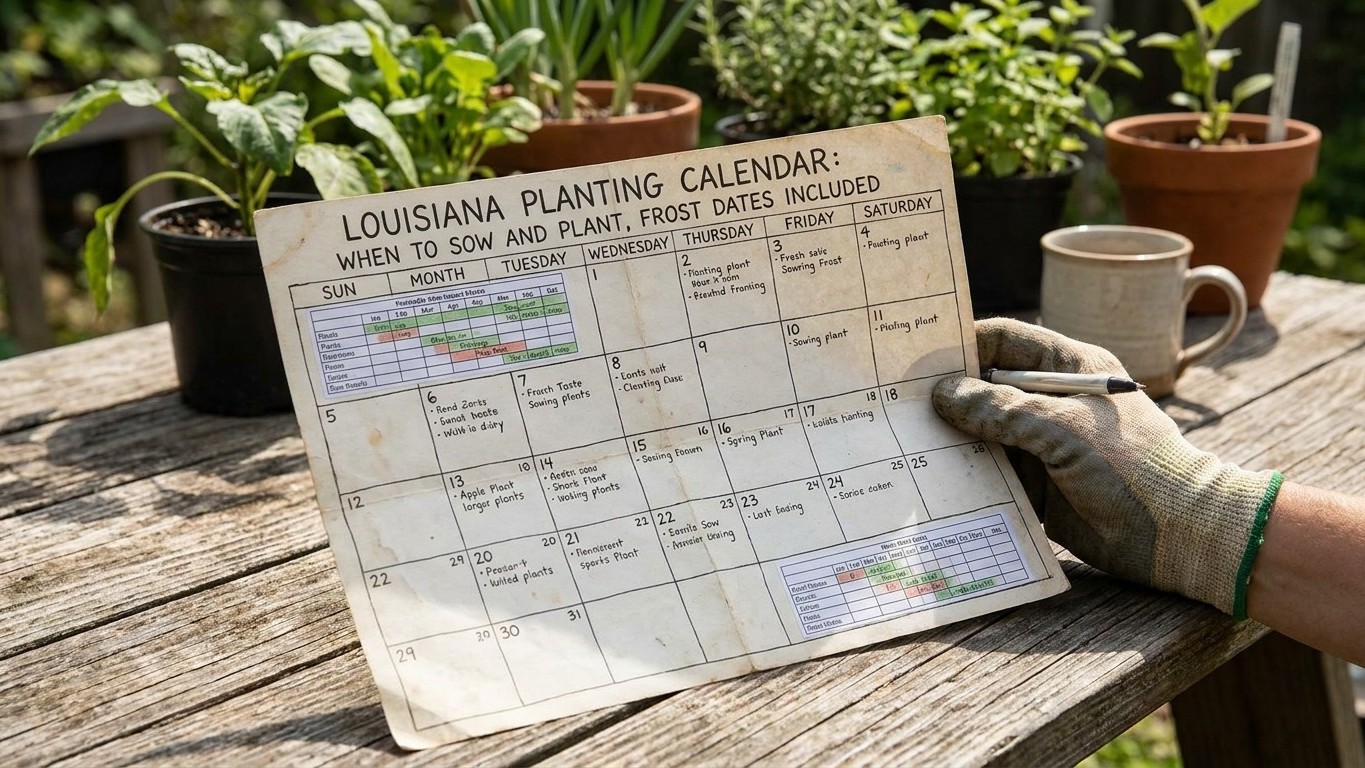

Louisiana’s last-freeze window runs January 18 to February 8 near New Orleans, and some years it never freezes at all — so the calendar isn’t really your guide here, heat is. Once summer temperatures climb, that’s what shuts tomatoes, lettuce, and peppers down, not a stray cold morning in spring. So instead of counting days to a frost date, walk outside and check your soil temperature before setting out warm-season transplants — that single number tells you more about timing here than any date on a chart ever will.
The frost window in Louisiana

At New Orleans, NOAA’s National Centers for Environmental Information (NCEI) 1991-2020 Climate Normals put the last spring freeze somewhere between January 18 and February 8, and the first freeze of fall somewhere between December 17 and January 8. Those are 30 to 70 percent probability windows, not fixed dates, so treat them as the range in which a 32°F morning becomes likely rather than a day to circle on the calendar.
A 32°F freeze only occurs in 86.8 percent of years at this station, which trips up gardeners who moved here from anywhere with a normal winter. That means roughly one year in seven, New Orleans sees no freeze at all, and the fall frost window actually straddles the new year, running from mid-December into early January. In a mild year, tender crops can carry straight through winter without losing a leaf.
This is not how most of the country gardens. In much of the Midwest or the mountain West, frost is the single hard boundary that ends the season. In south Louisiana, frost behaves more like background noise. What actually shuts down growth here is summer heat: tomatoes stop setting fruit, lettuce bolts, and peppers drop blossoms long before any frost date matters again — which is exactly why knowing What to Plant in Louisiana in March, What to Plant in Louisiana in June, What to Plant in Louisiana in July and What to Plant in Louisiana in August matters as much as tracking any frost window.
North Louisiana runs a different climate entirely. Freezes there arrive earlier in fall, linger later in spring, and happen far more reliably than at the coast. If you garden anywhere from Shreveport north through the hill parishes, treat the New Orleans-based dates above as a southern boundary, not your own, and expect a shorter frost-free season with a harder cutoff at both ends — which makes knowing What to Plant in Louisiana in September and What to Plant in Louisiana in November and What to Plant in Louisiana in May especially useful as that transitional window between spring’s last frosts and summer’s heat approaches.
The practical result of this pattern is a growing season measured in months, not weeks. Because these are probability ranges rather than hard cutoffs, a cautious gardener plants tender crops toward the back end of the window, in early-to-mid February rather than mid-January, and accepts a slightly later start in exchange for a lower chance of losing a flat of seedlings to a late cold — which is why checking What to Plant in Louisiana in February is a useful next step before setting anything out — and knowing What to Plant in Louisiana in December helps make sense of the other end of that window, when the first fall freeze looms — a long season that later means knowing What to Plant in Louisiana in October is just as important as timing that first spring planting snap. For those getting an early start on the season, it helps to first check a guide on What to Plant in Louisiana in January before moving on to what April allows. By the time April arrives, the risk of frost has essentially disappeared, and it’s worth checking a guide on What to Plant in Louisiana in April to plan the next wave of plantings.
Cool-season crops
Peas, spinach, lettuce, the brassicas, and root crops like carrots and beets all tolerate a light frost, which is exactly why they go in the ground before the last-frost window closes rather than after it. A 32°F morning bruises a tomato seedling but barely slows down a row of spinach.
In the New Orleans area, where NOAA’s normals put the last spring freeze between January 18 and February 8, cool-season crops can go in through the back half of fall and continue right through the mild winter that follows. Because a freeze fails to show up at all in roughly one year out of seven at this station, gardeners near the coast sometimes carry lettuce and greens through an entire winter without a single hard stop. Gardeners farther north get a wider cushion for these same crops, since the colder, more reliable freezes there hold summer heat off longer into spring.
Timing these crops off a calendar date is the wrong approach anywhere in Louisiana, but especially here. What matters is where you sit relative to the frost window itself:
- Sow spinach, lettuce, and mustard greens through the weeks leading into the last-frost window, since a light freeze improves flavor rather than damaging the leaf.
- Set out broccoli, cabbage, and cauliflower transplants early enough that they size up before the frost window closes, since they stall out once summer heat arrives.
- Direct-sow carrots, beets, and turnips on the same schedule as leafy greens. Their tops tolerate cold, and the roots underground are even better insulated.
- Get English peas and snap peas in early. They germinate in cool soil and stop producing once daytime highs climb into summer territory.
The bigger risk for cool-season crops in Louisiana is not frost at all. It’s running out of cool weather before the crop matures. Because the frost-free season here stretches so long and heat builds so fast afterward, a brassica transplant set out too late spends its whole life racing a clock set by rising temperatures, not by the last freeze. Get cool-season crops in early enough that they mature before that heat arrives, and the frost date becomes almost irrelevant to their success.
Warm-season crops

Tomatoes, peppers, squash, beans, and corn all die back at 32°F, so the last-frost window matters for them in a way it doesn’t for spinach or peas. But frost alone isn’t the deciding factor here. Soil temperature is what actually determines when these crops can go in the ground, and in a state where frost hovers between January 18 and February 8 at New Orleans, per NOAA’s normals, the soil often warms up well before the frost date fully clears.
Corn germinates poorly in cold soil and can rot before it sprouts. Beans do the same. Squash and cucumber seed sown too early just sits, waiting for warmth, and often succumbs to soil fungus before it ever gets there. None of this shows up on a frost-date calendar, which is why relying on the frost window alone leads gardeners to plant warm-season crops on schedule and then wonder why nothing came up.
Counting back from transplant to seed-starting
Tomato varieties list their days to maturity from the transplant date, not from seed. To work out when to start seed indoors, take that number and add the roughly six to eight weeks a tomato seedling typically needs to reach transplant size, then count backward from your intended set-out date.
For the New Orleans area, that set-out date typically falls in the early-to-late February window, once the last-frost range of January 18 to February 8 has mostly passed. A handful of catalogue varieties show how the arithmetic plays out from there:
| Variety | Days to maturity (from transplant) | Type | Set-out window | First ripe fruit |
|---|---|---|---|---|
| Sakura | 55 | Indeterminate | Early Feb to late Feb | Mid April |
| Sun Gold | 57 | Indeterminate | Early Feb to late Feb | Mid April |
| Supersweet 100 | 60 | Indeterminate | Early Feb to late Feb | Late April |
| Cherokee Purple | 72 | Indeterminate | Early Feb to late Feb | Early May |
| Celebrity Plus | 78 | Determinate | Early Feb to late Feb | Mid May |
| San Marzano II | 78 | Indeterminate | Early Feb to late Feb | Mid May |
Catalogue days-to-maturity figures are counted under average conditions and can shift by a week or two depending on the season, so treat “mid April” or “mid May” as a target rather than a guarantee. What the table does show clearly is the margin: even the slowest variety here, Celebrity Plus or San Marzano II at 78 days, still leaves roughly 220 days of growing season before the first fall frost arrives in the December 17 to January 8 window at New Orleans. That margin is the real advantage of gardening this far south, and it’s wide enough to plant a second round of tomatoes in midsummer for a fall crop if the first one struggles in the August heat.
Peppers follow roughly the same logic as tomatoes, needing warm soil and a similar set-out timing. Squash, beans, and corn are usually direct-sown once the soil has had time to warm past the point where seed just sits, which in most of Louisiana comes shortly after the last-frost window closes rather than on the frost date itself.
The fall planting window
Fall planting in Louisiana works backward from the first freeze rather than forward from summer’s end. At New Orleans, NOAA’s 1991-2020 normals put that first fall frost somewhere between December 17 and January 8, a window so late that it crosses into the new year across part of its range. That gives fall crops an unusually long runway compared to almost anywhere else in the country.
The arithmetic for fall crops starts from that frost window and works backward. Take the days to maturity listed for a variety, add a couple of weeks to account for the slower growth that comes with shortening daylight and cooling soil in October and November, and count back from the earliest date in the frost window rather than the latest. That gives a safety margin instead of a best-case guess.
Because the New Orleans fall frost window sits so late, and because roughly one year in seven sees no damaging freeze at all, per NOAA, gardeners here can often push a fall planting later than the arithmetic strictly requires and still bring in a full harvest. That is not true in north Louisiana, where colder air arrives on schedule most years and a late fall crop runs a real risk of getting caught out.
Crops that improve after a light frost
Several fall crops actually taste better once cold weather touches them. Cold exposure converts stored starches to sugars in a number of vegetables, which is why gardeners deliberately leave certain crops in the ground rather than rushing to harvest before the first frost arrives.
- Collards and kale sweeten noticeably after a frost and hold in the garden through a mild Louisiana winter.
- Carrots and turnips left in the ground develop more sugar in the roots once the soil cools.
- Brussels sprouts, where they’re grown, are traditionally harvested after at least one frost for the same reason.
These crops are worth timing deliberately around the fall frost window rather than avoiding it. Everything else in a fall garden, from lettuce to broccoli, just needs to finish growing before the freeze arrives, with the extra margin built in from counting back off the earlier end of the range.
Reading a planting calendar properly
A statewide planting calendar, including this one, is built from data measured at a single station, in this case New Orleans. It is a starting point, not an instruction sheet for your specific yard. Elevation, distance from open water, and how much pavement surrounds your garden all shift your actual frost dates away from the regional average.
Compare Louisiana to a state where frost behaves more predictably. In Maryland’s planting calendar, the frost window is a genuine hard boundary that most of the state hits within a fairly narrow band each year. In South Dakota’s planting calendar, the frost-free season is short and unforgiving in every direction. Louisiana has closer to the opposite problem: the frost window is so loose, and so often skipped entirely near the coast, that treating any single date as reliable will mislead you more than help you.
A few things are worth watching in your own garden rather than trusting to a chart. A low spot that collects cold air overnight will frost before the rest of the yard, even in a mild winter. A garden near a lot of concrete or asphalt runs several degrees warmer on a cold night than an open field a mile away. A late cold snap can arrive well outside the 30 to 70 percent probability band that NOAA’s normals describe, since those percentages describe a range of typical years, not a guarantee for any single one.
The most useful thing a Louisiana gardener can do is keep a simple log of the date any frost actually damaged something in their own yard, year over year. After two or three seasons, that log tells you more about your real planting window than any regional average ever will.
Local help
The LSU AgCenter publishes county-level planting dates and offers soil testing that will tell you far more about your specific parish than a statewide frost window ever can. A soil test is worth doing before your first planting season, since Louisiana’s soils vary enormously between the alluvial delta parishes and the sandier hill country to the north. For more on gardening across the state’s different regions, see our full set of Louisiana guides.
Common questions
Can I plant tomatoes in south Louisiana as early as January?
Only if you’re willing to take a real risk. NOAA’s 1991-2020 normals put New Orleans’s last spring freeze between January 18 and February 8, which means a hard freeze is still plausible through early February in most years. Waiting until the later end of that window, or covering plants on cold nights, is the safer approach for tender crops like tomatoes and peppers.
Why does the fall frost date fall after New Year’s Day?
Because the first fall freeze at New Orleans, per NOAA’s normals, falls somewhere between December 17 and January 8, a window that straddles the calendar year. In roughly one year out of seven, no 32°F freeze shows up at all that season, which is why the range extends so far into what most gardeners think of as deep winter.
Does this calendar apply if I garden near Shreveport instead of New Orleans?
Not directly. These dates are measured at a New Orleans station, and north Louisiana runs a noticeably colder, more traditional frost pattern with earlier fall freezes and later spring ones. Check with the LSU AgCenter for county-level normals closer to your own parish before relying on this range.
What happens if I miss the fall planting window entirely?
You lose the harvest for that specific crop, but Louisiana’s mild winters near the coast sometimes allow a late planting to squeak through anyway, since the freeze that would normally end the season doesn’t show up in roughly one year out of seven. That said, this is a gamble, not a guarantee, and north Louisiana gardeners get far less forgiveness for a late planting.
Should I cover my plants when frost risk is only 30 percent?
It depends on what you’d lose if that 30 percent shows up. NOAA’s frost windows describe a probability band, not a certainty, so a 30 percent chance still means real risk for a frost-tender crop you’ve invested a season into. Covering costs little compared to replacing a bed of pepper seedlings.
Related guides
- Texas Planting Calendar: When to Sow and Plant, Frost Dates Included
- Arkansas Planting Calendar: When to Sow and Plant, Frost Dates Included
- Maryland Planting Calendar: When to Sow and Plant, Frost Dates Included