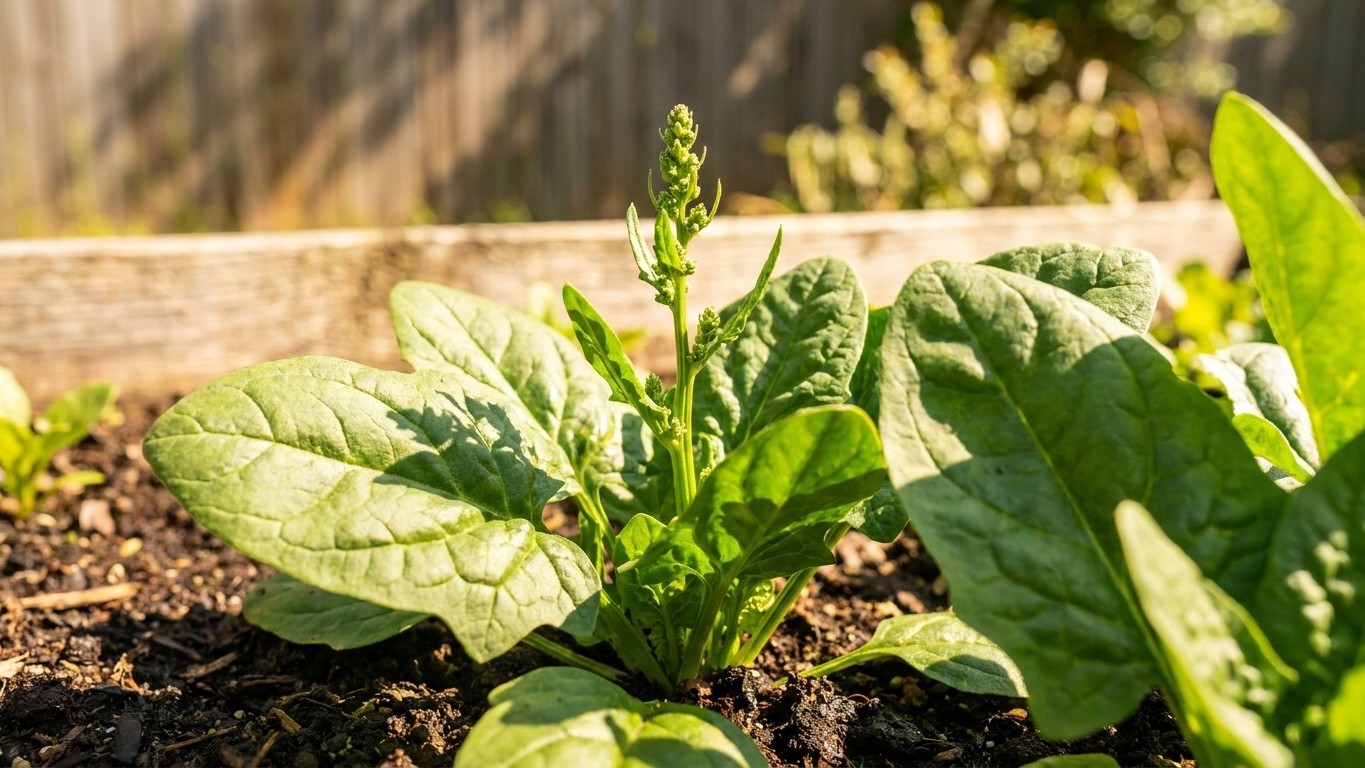

Yes, spinach bolts early almost everywhere in Louisiana, and here it’s heat that does most of the damage, not just long days. The state’s longest summer day runs 13 hours and 56 minutes at the reference station, long enough on its own to push spinach toward flowering, but Louisiana adds a second problem on top: 70.7 days a year at 90°F or hotter. That combination leaves growers with two short, awkward windows rather than one long spinach season.
The short answer
Start with the daylight number, because it explains why a mild Louisiana winter doesn’t translate into a long spinach season the way it might for a heat-tolerant crop. At 13 hours and 56 minutes on the longest day, this part of the Gulf South isn’t anywhere near the 14 to 16-hour range that some crops wait for, but it’s still firmly in the range that pushes spinach toward flowering. Spinach bolts under long days and warm temperatures together, and that pairing is baked into the plant’s biology: once daylight stretches out in spring, the plant starts preparing to flower whether or not the thermometer cooperates. A cool summer somewhere with the same day length wouldn’t rescue the crop either, because day length alone is enough to set the process in motion.
But daylight is only half the story here, and the smaller half. Louisiana’s real constraint is heat load, and 70.7 days a year at 90°F or above is a heavy number. Compare that to spinach’s stated growth ceiling of 75°F, a threshold that’s both a growth limit and a bitterness trigger, and it’s clear the plant runs into trouble long before the mercury hits 90. Air and soil temperatures climb past 75°F for sustained stretches well before summer officially arrives, which means the crop is fighting heat stress on top of the long-day signal telling it to flower. Put those two pressures together and the answer to whether spinach bolts early in Louisiana isn’t really about picking one culprit. It’s both, working in the same direction at the same time.
What that means practically: this isn’t a place where you plant spinach once in early spring and harvest for months. The window opens, closes fast, and reopens briefly in fall once the ground finally cools. Growers here are managing two short sprints, not a marathon, and success depends less on variety choice than on hitting each narrow window on time. Four spinach varieties commonly discussed for garden use, Bloomsdale, Melody, Teton, and Olympia, don’t have published data on bolt resistance or days to maturity from the source guiding this article, so there’s no shortcut through variety selection alone. Timing does the heavy lifting in Louisiana, more than it might in a cooler, shorter-summer state.
How long the spring window really is
Working out the spring window means starting from the frost date and moving forward, then checking where the heat ceiling cuts it off.
- Find the last spring frost. NOAA’s 1991-2020 climate normals put the last spring freeze at this station between January 18 and February 8, a strikingly early date compared to most of the country, and a reminder that south Louisiana barely freezes at all in some years.
- Back into a sowing date. Spinach goes in the ground two to three weeks before that last frost, which lands sowing somewhere around late December through mid-January depending on the year.
- Track the growth ceiling. Spinach grows best below 75°F and starts losing quality, then bolting, once temperatures push past that line for good. In a region logging 70.7 days a year at 90°F or hotter, the climb toward 75°F happens fast once real spring warmth arrives.
- Add it up. That leaves a spring window of roughly two months, sown in the dead of a mild Louisiana winter and finished before spring elsewhere in the country has even hit its stride. It’s a narrow run, and missing the early sowing date by even a couple of weeks eats directly into harvest time rather than shifting it.
The takeaway isn’t complicated: Louisiana’s spring spinach crop isn’t limited by cold, the way it would be farther north. It’s squeezed from both ends, a late-enough frost to allow sowing and an early-arriving heat ceiling that shuts things down, with not much room in between.
The autumn crop, and when the soil lets you sow
Fall Spinach in Louisiana runs into a different pair of obstacles, and neither one is really about cold weather.
Soil still too warm to germinate
Germination drops off once soil temperatures climb above 80°F, according to Utah State University Extension, and Louisiana soil holds heat well into what other states would call early fall. With 70.7 days a year reaching 90°F, the ground doesn’t cool quickly just because the calendar turns to September. Sowing too early means seed that simply won’t come up reliably, or comes up thin and stressed. The practical move is to wait for soil temperatures to actually drop below that 80°F line before putting seed in the ground, rather than sowing by date alone.
Counting back from harvest, and the frost that ends the season
The source behind these numbers doesn’t publish a specific days-to-maturity figure for spinach, only a general rule for fall crops: sow 50 to 75 days before the date you want to harvest. Louisiana’s first fall frost lands between December 17 and January 8, and that range comes with a big caveat: a 32°F freeze only shows up in about 86.8 percent of years at this station, so roughly one year in seven sees no hard freeze at all before the new year. That makes the fall frost date less of a hard stop than it would be farther north. A realistic harvest target sometime in early December, before the frost window even opens, counted back 50 to 75 days, points to a sowing date somewhere in mid-to-late October, right around when soil temperatures have finally dropped out of the danger zone above 80°F. The two obstacles effectively meet in the middle: wait too long and frost (or the holidays) cuts the harvest short; sow too early and warm soil keeps the seed from coming up at all.
Common questions
Can spinach survive a Louisiana summer at all?
Not really as a productive crop. Between the long summer daylight and 70.7 days a year at 90°F or hotter, spinach bolts and turns bitter well before summer peaks, so growers here treat spring and fall as the only two usable windows.
Does shade help stretch the spring window?
The source behind these figures doesn’t address shading strategies, so that isn’t a claim this article can back with data. What’s documented is the 75°F growth ceiling and the day-length trigger for bolting, and both of those are working against the crop regardless of light intensity.
Is fall or spring the better season for Louisiana spinach?
Fall generally offers a cleaner run, since the crop grows into cooling weather instead of racing rising heat, but it depends on hitting the soil-temperature window (below 80°F) before sowing, since sowing too early simply fails to germinate well.
Do Bloomsdale, Melody, Teton, or Olympia bolt slower than other varieties?
There’s no published data here on bolt resistance for any of these four varieties. They’re commonly named in general spinach guidance, but this source gives no performance figures to compare, so variety choice shouldn’t be treated as a substitute for correct timing.