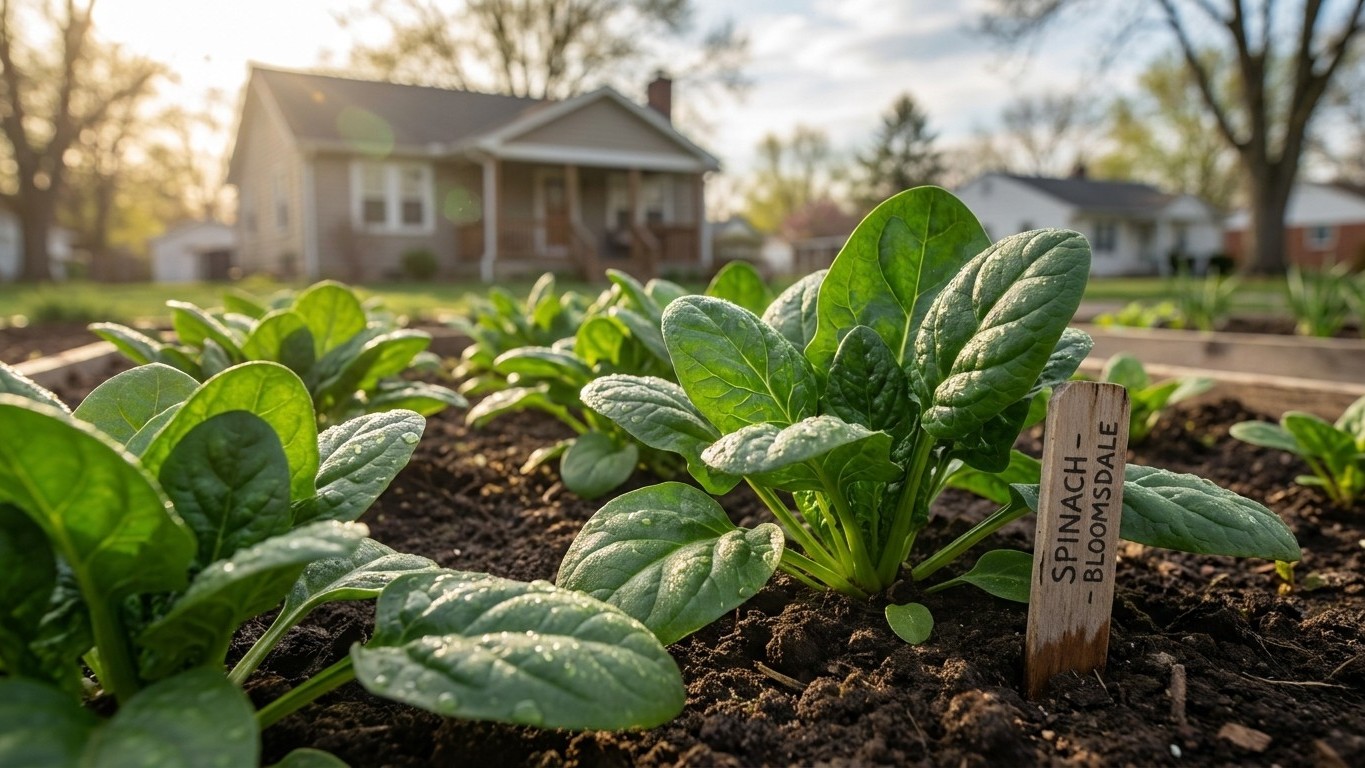

Spinach in Louisiana bolts fast, and it bolts for two reasons at once. In spring, lengthening days and rising heat arrive together, pushing plants to flower by the time other states are still harvesting. Will Spinach Bolt Early in Louisiana? Fall is the season that actually works here, but only once soil temperatures drop enough to let seed germinate, and only if you get the crop in before the state’s brief, unreliable frost season closes the door.
The short answer
At the reference city used for Louisiana’s climate normals, the longest day of the year brings 13 hours and 56 minutes of daylight. That number matters because spinach flowers in response to long days combined with warmth, and 13 hours 56 minutes is well past whatever point triggers that response. A gardener in a cooler northern state might hope a mild summer buys a few extra weeks before bolting sets in. That hope does not translate south. The days get just as long here as anywhere else at the same latitude band, and they arrive on top of a heat load that most of the country never sees.
That heat load is the other half of the story. The reference station used for these figures averages 70.7 days a year at 90 F or higher. Spinach grows best where temperatures stay under 75 F, a ceiling that is both a growth limit and the point where leaves start turning bitter. In a state where nearly ten weeks of the year top 90 degrees, the plant spends very little of the calendar inside its comfort zone.
So which is it, day length or heat? Here, both close the window, but they close it from different directions and at different times. Day length does its damage in spring, when the sun is climbing toward the solstice and the plant reads that lengthening signal even before the worst heat lands. Heat does its damage on both ends, warming the soil too much for fall seed to germinate and pushing spring temperatures past 75 F almost as soon as the plants are established. There is no season in Louisiana where spinach gets a long, easy run. There are only two short windows, each limited by a different mechanism, and neither one is forgiving.
That is the frame for everything below: spring is short because of day length stacked on heat, and fall is short because of soil temperature stacked against a frost season that barely exists in the southern half of the state. See When to Sow Autumn Spinach in Louisiana for how that fall window plays out in practice.
How long the spring window really is
Working out the spring window means starting from the one fixed point the climate record actually gives: the last spring frost.
- NOAA’s 1991-2020 climate normals put the last spring freeze for this station between January 18 and February 8. That is startlingly early compared to most of the country, and it reflects how mild south Louisiana winters run.
- Standard spinach sowing guidance calls for planting two to three weeks before that last frost date. Counting back from January 18 to February 8 lands sowing somewhere in the last days of December through the third week of January.
- From that sowing point, the clock is already running against two things at once: the calendar pushing daylight hours upward every single day, and afternoon temperatures climbing toward the 75 F ceiling as late winter turns into spring.
- In practice, that leaves a usable growing stretch of roughly six to eight weeks before the combination of day length and heat pushes plants to bolt. Some years run a little longer if a cool spell holds temperatures down into March, but the day-length side of the equation does not care about a cool spell. It keeps climbing regardless.
- By the time spring is in full swing, the spring spinach crop is generally finished, one way or another. Either it has been harvested, or it has bolted and turned bitter on the stalk.
The autumn crop, and when the soil lets you sow
Fall is where Louisiana spinach growers actually get their return, but the timing runs on a different logic than most planting calendars, because the limiting factor at the start of the season is soil temperature, not air temperature.
Waiting out the warm soil
Utah State University Extension notes that spinach seed germination drops off once soil temperature climbs above 80 F. In south Louisiana, soil holds heat well into autumn, often staying too warm for reliable germination through most of September. That means the fall sowing date is not set by when the calendar says “fall,” it is set by when the ground itself has actually cooled, which in practice tends to fall in early-to-mid October in much of the state, later in the far south.
The frost that closes the season
The other boundary is the first fall frost, and here the record is unusual. NOAA’s 1991-2020 climate normals put the first fall freeze for this station between December 17 and January 8, and a 32 F freeze occurs in only 86.8 percent of years at that station. Roughly one year in seven brings no freeze at all, and in those years the window simply drifts across the New Year with no hard stop.
The same source gives no fixed days-to-maturity figure for spinach; it only states a general rule of sowing 50 to 75 days before the date a gardener wants to harvest. Counting back from a realistic early-December harvest, that puts sowing somewhere between late September and mid-October, which lines up closely with when soil temperatures are actually falling out of that above-80 F danger zone. It names four spinach varieties, Bloomsdale, Melody, Teton, and Olympia, but publishes no data on days to maturity, heat tolerance, or bolt resistance for any of them, so there is nothing further to compare here beyond the names themselves.
Checking this against your own county
Louisiana’s climate is not uniform from the Arkansas line to the Gulf. North Louisiana freezes more reliably and for longer stretches than the coastal parishes, which shifts both the spring sowing window and the fall harvest deadline earlier in the north and later in the south. Soil warms and cools at different rates depending on drainage, tree cover, and whether a bed sits in full sun or afternoon shade, so the 80 F soil threshold can arrive weeks apart between two gardens a county over from each other.
The LSU AgCenter is the land-grant extension service for the state and publishes parish-level planting guidance that accounts for these local differences. Before locking in a sowing date based on statewide averages, it is worth checking their current recommendations for the specific parish in question, since local frost records and soil data will always beat a statewide average for fine-tuning the exact week to get seed in the ground.
Common questions
Can spinach survive a Louisiana summer at all?
Not reliably. Between the long summer days that trigger flowering and the roughly 70 days a year above 90 F, summer is the one season with no realistic spinach window in this state.
Does shade slow down bolting in spring?
Shade can lower leaf temperature somewhat, but it does not change day length, and day length is one of the two triggers pushing spinach toward flowering. Shade helps more with the heat side of the equation than the light side.
Is the fall crop more reliable than spring in Louisiana?
Generally yes, because fall sowing dodges the steep climb in day length that spring sowing runs straight into. The fall crop’s main obstacle is simply waiting for soil to cool below that 80 F germination threshold.
What happens if I sow before the soil cools below 80 F?
Germination rates drop, according to Utah State University Extension, so a portion of the seed may simply fail to come up, forcing a second sowing later once conditions improve.