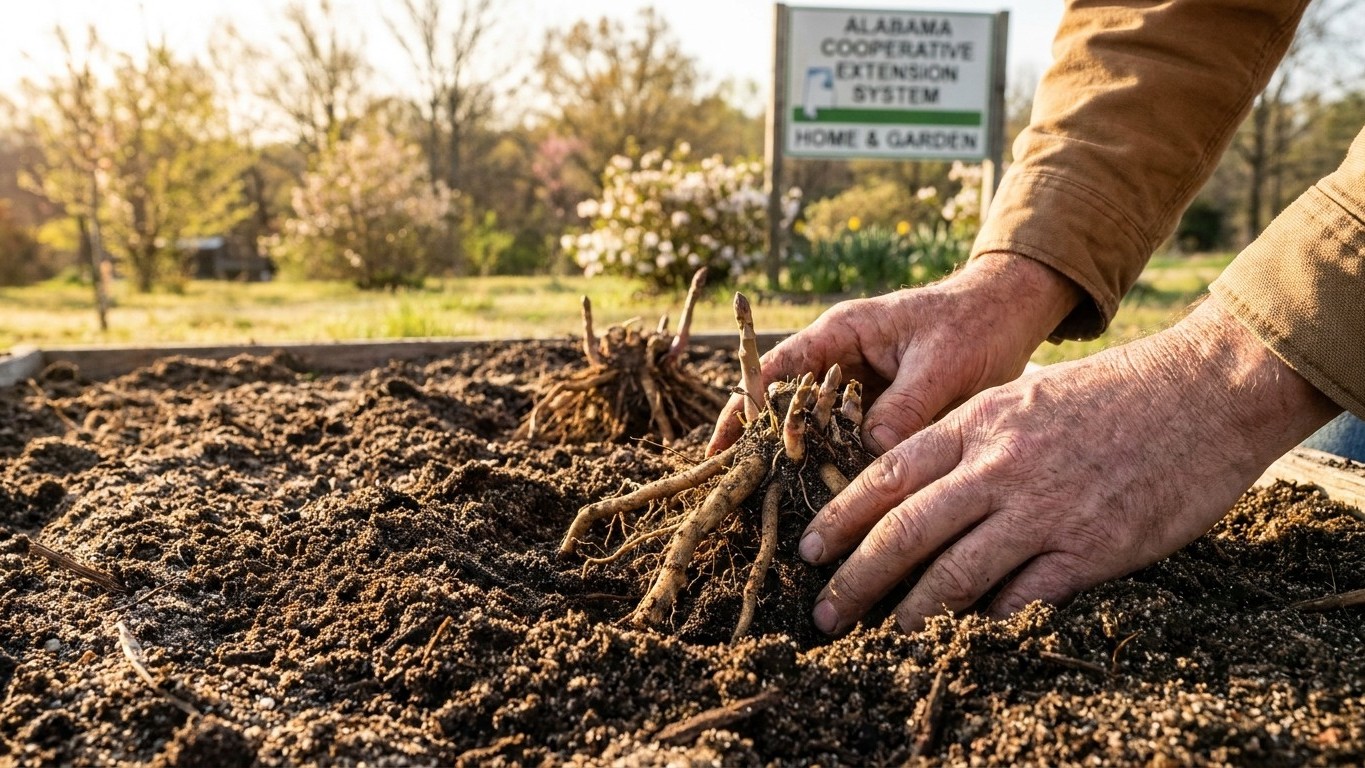

Plant Asparagus Crowns in Maine in early spring, once the ground has thawed and dried out enough to dig, timed loosely to the region’s last spring frost window. But a calendar date only answers half of this question. The other half is the ground itself, because an Asparagus Bed isn’t a season’s crop, it’s a fixture that stays in one spot for a decade or more before it’s ever dug up again.
The short answer
Asparagus, once planted as a crown, is not harvested until its third year in the ground, and then it keeps producing for 10 to 15 years after that. That single fact changes how a gardener should think about the spot chosen for it. A tomato bed can be moved next season if the soil turns out to be wrong. an Asparagus Bed can’t, not without giving up a decade of production and starting the three-year wait all over again. So before the question of when becomes urgent, the question of where has to be settled, and the only soil requirement published for asparagus is blunt: it wants ground that drains.
Maine’s official state soil, the Chesuncook series, gives a useful starting picture of what the region’s ground tends to do, even though it isn’t a diagnosis of any single backyard. Chesuncook is a sandy, acid, strongly leached soil typically found under conifer stands, with a surface pH around 5.1 and a texture that runs 35 percent sand, 12 percent clay and 53 percent silt, closer to a silt loam than a sand. USDA describes it as moderately well drained, not fully well drained. That distinction matters here. “Moderately well drained” means water does move through the profile, but slowly enough in places that it can sit for stretches after a heavy rain, particularly where the subsoil compacts. For a crop that will occupy the same trench for fifteen years, that’s a borderline result, not a clean pass.
One number from that same soil survey deserves a caution rather than a headline: the organic matter figure recorded for Chesuncook’s surface horizon runs around 53 percent, which is not what a cultivated garden bed looks like. A figure that high describes a natural forest litter layer, peat or duff sitting under trees, not soil that’s been turned, planted and weeded for years. A worked bed will read far lower. The pH figure carries the same limit, it describes the mapped series, not the reader’s own plot, and neither figure should be treated as a personal soil test result.
What this means in practice: before digging a furrow meant to last fifteen years, dig a test hole instead. Fill it with water and watch how long it takes to disappear. If it lingers for hours, the safer move is a raised bed or a mounded row, built up six to eight inches above grade, with compost or aged organic matter worked in to open the structure. A slight slope on the site helps water shed rather than pool. None of that is exotic work, but it’s worth doing once, correctly, rather than discovering a drainage problem in year four with a bed that’s already committed.
Will the summer here water it for you?
Once a crown is in the ground, the source is specific about water: 1 to 2 inches every other week for the first two growing seasons, tapering to every three weeks once the bed is established. Maine’s summer rainfall, measured at a reference station over the 1991-2020 period, doesn’t hand that over automatically. Here’s how the numbers line up against each other.
- June normal: 4.15 inches. The wettest of the three summer months, and close to what a two-week establishment cycle would ask for if it fell evenly, which rain rarely does.
- July normal: 3.43 inches. The driest month of the summer. This is the stretch most likely to leave a young bed short, especially if the rain arrives as one or two storms rather than steady soaking.
- August normal: 3.57 inches. A slight rebound from July, but still below June, and still no guarantee against a dry spell landing exactly when the roots need it most.
- Summer total: about 11.2 inches across June, July and August. Spread evenly, that’s close to the low end of what a first- or second-year bed needs. Spread unevenly, which is how rain actually falls, it leaves gaps.
- What to add: a rain gauge on the actual plot is what settles this, not the regional average. On a sandy or silty surface like the state’s dominant series, water moves through fast, so a dry week in July is the moment to run a hose rather than assume the sky will catch up later.
When to put the crowns in
Crowns go into the ground in early spring, set into furrows about 8 inches deep, as soon as the soil can be worked without turning to mud in the hand. In coastal Maine, the last spring frost falls around April 22 to May 1, based on the 1991-2020 freeze-probability record from the same reference station used above. That’s a mean date, not a promise, and it describes the milder, coastal edge of the state. Inland and northern Maine run substantially later in spring, so a gardener working further from the coast should expect the workable window to open later, not on the same week.
The furrow itself isn’t filled all at once. Crowns are set at the bottom, covered with a couple of inches of soil to start, and then the trench is backfilled gradually as the season goes on, roughly two more inches every other month, rather than buried to grade in a single afternoon. That gradual fill gives the emerging shoots room to push upward without being smothered early.
The alternative to buying crowns is starting from seed. That route asks for extra patience: seedlings need a full season of growth before they’re sturdy enough to move into the same 8-inch furrow described above, which pushes the whole timeline out by an additional year compared with planting crowns directly. For a crop that already asks for a three-year wait before the first harvest, most home gardeners choose the crown route simply to shave that year off the front end. Either path lands in the same place eventually: a trench, set around the region’s frost window, filled in stages, and left alone to do its slow work.
Common questions
Can I Plant Asparagus Crowns in Maine in fall instead of spring?
The planting method described here is specific to early spring, once the ground can be worked. No fall-planting timeline for crowns is published in this source. The seed route, which asks for an extra season of growth before transplanting, is the documented alternative rather than a fall crown planting.
How do I know if my own soil drains well enough for asparagus?
Dig a hole where the bed will go and fill it with water. If it drains within a few hours, the ground is likely suited to a fifteen-year bed. If water lingers, a raised or mounded bed with added organic matter is the safer route, since the region’s dominant soil series is only moderately well drained to begin with.
When can I actually harvest after planting crowns?
Not in the first year, and not in the second. The first harvest comes in year three, and even then it’s a short one, extending in later years as the crowns mature. Cutting early weakens the plant’s ability to build the root system that has to carry it for the next decade-plus.
Which asparagus variety should I plant?
Utah State University Extension names four: Jersey Giant and Jersey Knight, both all-male, and UC 157 F1 and Purple Passion, both male and female. No flavor, yield or preference between them is published in that source, so the choice comes down to whichever is available, not a documented performance difference.