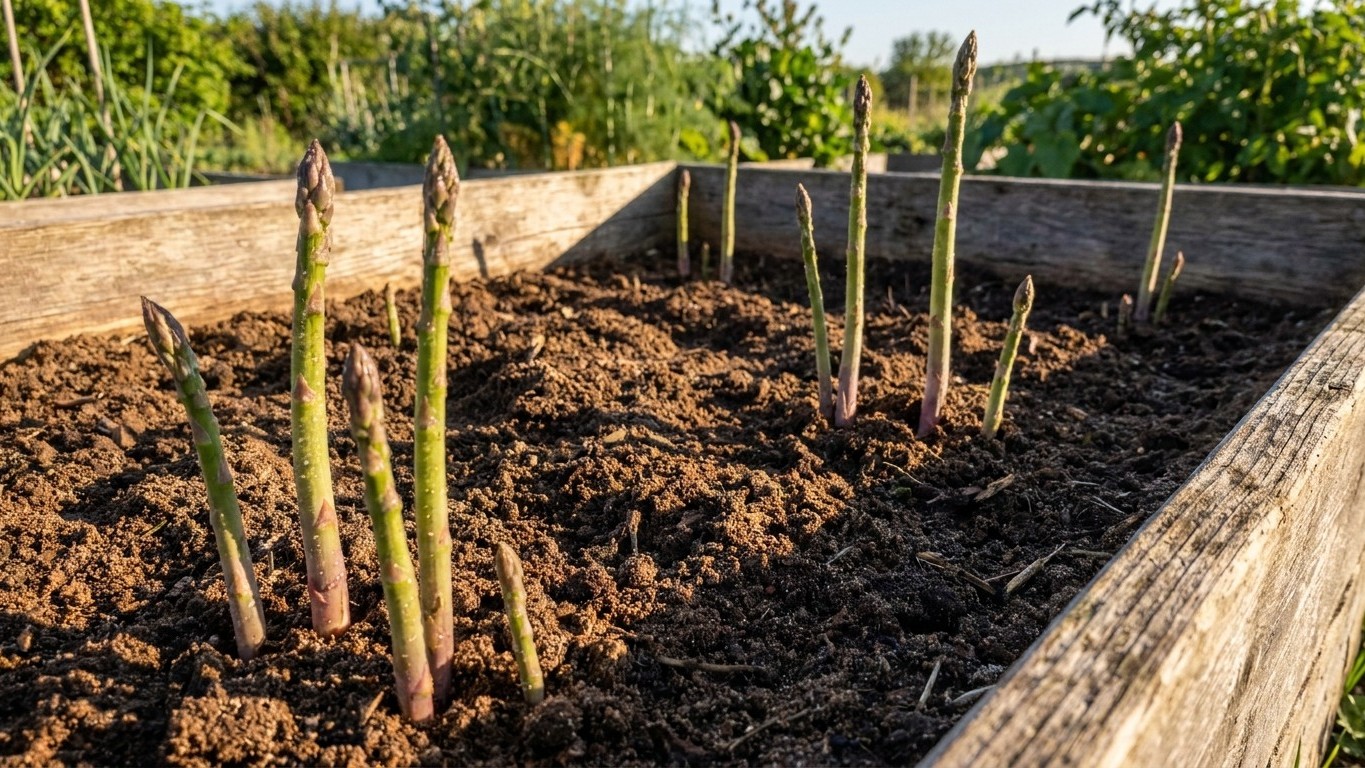

Yes, in most cases. Asparagus needs a decade or more in the same ground, and the only soil rule from Utah State University Extension is that it drains. Manitoba’s dominant soil, a Chernozem, is rich and workable but classed as imperfectly drained, so the fifteen-year question turns less on fertility than on how water moves through that particular patch of yard. A raised bed settles the doubt for almost anyone.
The short answer
Manitoba’s mapped agricultural land is dominated by Chernozem, the deep, dark grassland soil the prairies are known for, covering 41 percent of the surveyed surface (Gleysolic soils come next). The median surface sample runs alkaline at a pH near 7.6, with a loam-to-silt texture of roughly 45 percent sand, 24 percent clay and 31 percent silt, and organic matter around 5.5 percent. That is a soil built for wheat and canola: fertile, dark, easy to work. But the same survey classes it as imperfectly drained, and imperfect drainage is the one thing asparagus does not tolerate over a fifteen-year lease on a patch of yard.
Here is why that distinction matters more for this crop than almost any other on the site. An annual vegetable that sits in slow-draining ground for one bad season is a nuisance: amend the bed, rotate the crop, try again next year. Asparagus crowns planted this spring are still expected to be pushing spears in year twelve or thirteen. A furrow that stays soggy every spring will rot the crowns slowly, not dramatically, and the gardener may not connect three years of declining yield back to the drainage problem that was there from the start.
The fix is not complicated, and it does not require fighting the soil chemistry. The alkaline pH and the organic matter are both fine as they sit; nothing in the source calls for lowering pH or adding acid amendments. Drainage is the only variable to manage, and the standard answer is to raise the bed, even by 8 to 10 inches, and to work in coarse compost or aged manure through the top layer where the crowns will actually sit. A slope, a berm, or a mounded row accomplishes the same thing on a smaller scale. Gardeners on sandier pockets of the province, closer to that 45 percent sand figure or above it, may find their own ground drains well enough without any of this. The state-level number is a median across 2,535 sampled components, not a report card on one backyard, so a shovel test after a hard rain (watch whether water stands for more than an hour) tells a gardener more about their own plot than any provincial average can.
Will the summer here water it for you?
The published watering rule for a young asparagus bed is 1 to 2 inches every other week for its first two growing seasons, then a lighter 1 to 2 inches every three weeks once the crowns are established. Manitoba’s summer rainfall, drawn from the 1981-2010 normals at the Winnipeg Richardson station, averages about 9.7 inches across June, July and August combined, broken down like this:
- June: about 3.54 inches, typically the wettest of the three summer months.
- July: about 3.13 inches.
- August: about 3.03 inches, the driest month of the growing season and the one most likely to leave a new bed short.
Spread evenly, that works out to roughly 0.7 to 0.9 inch a week across the summer, which sits below the 0.5 to 1 inch a week the bed asks for in its first two years (1-2 inches every other week averages to that range) and can undershoot it further in August specifically. The gap is not dramatic, but it is real, and it grows in any week where the rain arrives as one heavy thunderstorm rather than a steady soak. On the Chernozem texture described above, with clay running near a quarter of the mix, a hard rain does soak in better than it would on pure sand, but a mounded or raised bed drains a bit faster too, which shifts some of that moisture advantage back the other way. A rain gauge staked next to the bed is the only way to know, week to week, whether the sky did the job or the hose needs to. Once the planting is past its second full season and only needs water every three weeks, Manitoba’s summer rainfall pattern covers most ordinary weeks on its own, with August again the month most worth checking first.
When to put the crowns in
Crowns go into the ground in early spring, as soon as the soil can be worked, and the anchor point for that in Manitoba is the mean last spring frost date of around May 23 at the Winnipeg Richardson station. That is a midpoint, not a guarantee: in roughly half of all years on record, frost arrives after that date, so treating May 23 as a hard planting deadline misreads what a mean actually is. Gardeners working slightly north or west of Winnipeg, or on any low-lying ground that holds cold air, should expect their own safe window to run later still.
The planting method itself is specific. Crowns are set into furrows about 8 inches deep, then the furrow is backfilled gradually across the season, roughly 2 inches of soil added back every other month, rather than filled in all at once at planting time. That gradual backfill lets the emerging spears keep reaching light while the crown itself sits progressively deeper and better protected. Seed is the other route in, for gardeners willing to trade a year of patience for a lower cost per plant; seed-started asparagus simply needs that extra season to reach crown size before it goes through the same furrow-and-backfill process.
Whichever way the bed starts, the harvest clock does not move. Nothing is cut in year one or year two, no matter how vigorous the spears look. Harvest begins in year three, and even then it is limited: about 4 weeks of cutting that first harvest year, extending to roughly 6 weeks the year after, and up to about 8 weeks once the bed is fully mature. The rule for when to stop cutting in any given season is not a date on the calendar but a signal from the plant itself: harvest ends once most of the spears coming up are thinner than a pencil, a sign the crown is running out of stored energy and needs to be left alone to grow ferns for the rest of the summer.
Variety choice, at least according to Utah State University Extension, comes down to one published trait: sex. All-male varieties, including Jersey Giant and Jersey Knight, put their energy into spear production rather than seed and tend to be the more common commercial recommendation for that reason. Male-and-female varieties, including UC 157 F1 and Purple Passion, are also available. The source does not publish flavor differences, yield comparisons, or a stated reason to prefer one group over the other, so that comparison stops at the table below.
| Variety | Sex |
|---|---|
| Jersey Giant | All-male |
| Jersey Knight | All-male |
| UC 157 F1 | Male and female |
| Purple Passion | Male and female |
Nothing in the source addresses winter chilling requirements or a target soil pH for the crop, so neither figure is offered here. Anyone weighing those questions for a specific spot should treat them as open, not settled by this source.
Common questions
Does Manitoba’s alkaline soil hurt asparagus?
The published soil requirement for asparagus is drainage, not a pH target. Manitoba’s median surface pH of about 7.6 is not flagged as a problem in the source, and no acid amendment is called for.
Can crowns go in before the mean frost date of May 23?
Crowns are planted in early spring once soil is workable, but May 23 is only a mean date from 1981-2010 normals, meaning frost falls later in roughly half of all years. Working the soil early is fine; exposing new growth to a hard frost is the risk to weigh.
Why does the furrow get backfilled slowly instead of all at once?
Adding about 2 inches of soil back every other month lets emerging spears keep reaching sunlight while the crown settles progressively deeper in the 8-inch furrow, a gradual process rather than a one-time fill.
How do I know when to stop cutting spears each season?
Watch the spears, not the calendar. Once most of what comes up is thinner than a pencil, that harvest window for the year is over, whether that lands at 4 weeks in year three, 6 weeks the following year, or up to 8 weeks once the bed is mature.