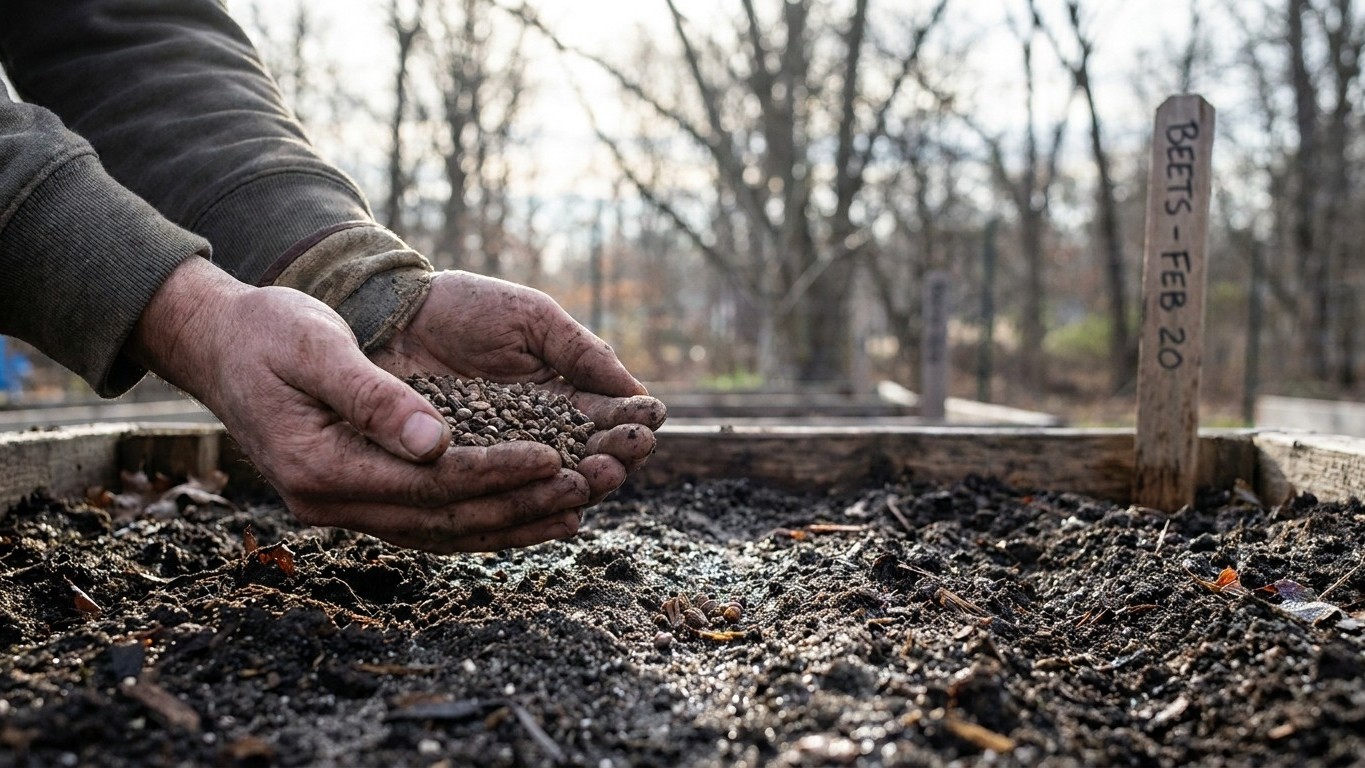

In coastal Maine, using the Portland area as the reference point, beets go into the ground from roughly early to mid-April, two to three weeks ahead of the region’s typical last spring frost, which falls between April 22 and May 1. Inland and northern Maine push that whole calendar back, sometimes by several weeks, so the coastal date is a floor, not a rule for the whole state.
The short answer
Maine’s official state soil, the Chesuncook series, gives a useful baseline for what “typical” ground here does to a beet crop. It’s a Spodosol, the kind of sandy, acid, strongly leached soil that forms under conifer forest, and its surface horizon runs 35 percent sand, 12 percent clay, and 53 percent silt, with a surface pH around 5.1, which is strongly acid. Drainage is rated moderately well drained. That’s a lot of numbers, but they translate into two plain facts a gardener can use.
First, the texture is closer to what a beet wants than a lot of gardeners assume. Utah State University Extension describes the ideal beet bed as deep, sandy, and well-drained, with organic matter worked in, no more than 1 inch of composted material per 100 square feet. A silt-and-sand mix like Chesuncook’s surface horizon drains reasonably well and doesn’t crust the way a heavy clay does, so germination and root elongation aren’t fighting compaction the way they would in denser ground.
Second, the acidity is a problem beets don’t tolerate well. A pH of 5.1 is well below what beets need to size up properly; most references for root vegetables put the comfortable range closer to neutral. Ground that mirrors the state soil’s chemistry will need lime, and probably more than a single light application, before beets perform there. The organic matter figure recorded for this series, around 53 percent, is not something to chase in a garden bed, either. That number reflects a natural forest floor layer, peat, muck, or leaf litter, not a worked vegetable bed, and it’s a reminder that these are representative values for the surface horizon of the series as mapped, not a measurement anyone should apply directly to a raised bed or a tilled row.
On the heat side, there’s no published figure here for how many days Portland or any other Maine location spends above 90 degrees Fahrenheit in a typical year, so that specific comparison can’t be made with confidence. What’s worth carrying forward instead is the threshold Utah State names directly: heat above 85 F combined with water stress is what turns a beet root woody. Maine’s growing season runs cooler than many places beets are grown commercially, which works in the crop’s favor here, but a home garden’s own microclimate, a south-facing bed against a wall, a spot with no afternoon shade, can still get hot enough to matter.
None of this substitutes for a soil test. Maine spans hundreds of mapped soil series, and a garden a few miles from the next one over can sit on entirely different ground, some sandy and fast-draining, some heavier and slow to warm. The Chesuncook figures describe a tendency for the region, not the dirt under any particular row of beets.
The six weeks that decide it here
Sowing beets two to three weeks before the last frost date puts the first six weeks of growth, the window Utah State Extension flags as the make-or-break period for water stress and premature flowering, squarely inside a known stretch of the Maine calendar: the back half of April into the first half of June for coastal areas, later for inland ground.
That stretch in Maine is not typically a dry one. Spring here tends to run cool and damp, with snowmelt and frequent rain keeping soil moisture up through what locals call mud season, the weeks when fields and gardens are often too wet to work rather than too dry to water. For beets, that’s a mixed blessing. The bolting risk Utah State ties directly to water stress in those first six weeks is lower by default in a spring that’s delivering moisture on its own, without a gardener having to run a hose.
But “typically wet” is not the same as “reliably wet every year,” and it doesn’t apply evenly across the state. A cool, damp spring can turn into a run of dry, breezy days with little warning, especially once the calendar tips into late May, and sandy ground like the Chesuncook-type surface described above sheds that moisture fast. A week or two of neglect during a dry snap in that six-week window is exactly the kind of gap that pushes a beet toward bolting rather than rooting. Inland and northern Maine, where the frost calendar runs later, may also see the tail end of that six-week window bump up against warmer, drier early-summer conditions before the plant has finished establishing.
The practical read: don’t treat Maine’s generally moist spring as a guarantee. Check the bed, not the forecast pattern from other years, and be ready to water through any dry stretch that lands inside those first six weeks after sowing, regardless of how reliably wet the season has been up to that point.
What goes wrong here
- Acidic native soil stunts root growth. Ground that resembles the state’s Chesuncook-type profile runs strongly acid, around pH 5.1, well below what beets need to size up. Test the bed before sowing and lime according to the test result rather than guessing; a single light application rarely corrects ground this acid.
- Sandy, fast-draining beds dry out during the critical first six weeks. The same texture that keeps beet roots from fighting compaction also lets moisture escape quickly. Water consistently through the first six weeks after sowing rather than relying on Maine’s typically damp spring to carry the crop, since dry snaps inside that window are what trigger premature flowering.
- Over-amending with organic matter backfires. Because the region’s natural soil carries a high organic-matter surface layer under forest cover, gardeners sometimes assume more compost is always better. Utah State Extension caps composted organic matter at 1 inch per 100 square feet; going well beyond that can leave the bed too loose or unbalanced for a root crop to anchor and size properly.
- Sowing too early into wet, cold ground. Maine’s mud season can leave beds saturated and cold well into what looks like a reasonable sowing window on a calendar. Seed sown into cold, waterlogged soil germinates unevenly or rots; wait until the bed has actually drained and warmed rather than sowing strictly by the two-to-three-week-before-frost rule if the ground is still soaked.
- Late sowing runs the root crop into heat before maturity. Beets take 60 to 80 days from seeding, not from a transplant, since they’re sown directly in place. Pushing the sowing date later to dodge a wet spring risks the root maturing during a hotter stretch, and heat above 85 F combined with any water stress is what makes a beet root woody.
Common questions
Can beets handle a late Maine frost after they’ve sprouted?
Beet seedlings tolerate cool conditions reasonably well, which is part of why sowing two to three weeks ahead of the last frost date works as a general timing rule. The specific cold tolerance of emerged beet seedlings isn’t detailed in the sources behind this page, so treat any frost after emergence as a risk to manage with row cover rather than something to ignore.
Does Maine’s acidic soil always need lime before sowing beets?
Not always, but ground that resembles the state’s representative Chesuncook profile, with a surface pH near 5.1, almost certainly does. A soil test is the only way to know what a particular bed needs, since garden soil can differ enormously from the mapped state series even a short distance away.
How long after sowing should I expect to harvest beets in Maine?
Utah State University Extension puts beet maturity at 60 to 80 days from seeding, since beets are sown directly where they’ll grow rather than started as transplants. In Maine, count that window from the actual sowing date, which shifts later the further inland or north the garden sits.
Is sandy soil in Maine bad for growing beets?
No, and it can actually help. Utah State Extension recommends deep, sandy, well-drained soil for beets specifically because it avoids the compaction that slows root development. The tradeoff is that sandy ground dries out faster, so the watering routine during the first six weeks after sowing matters more than it would in heavier soil.