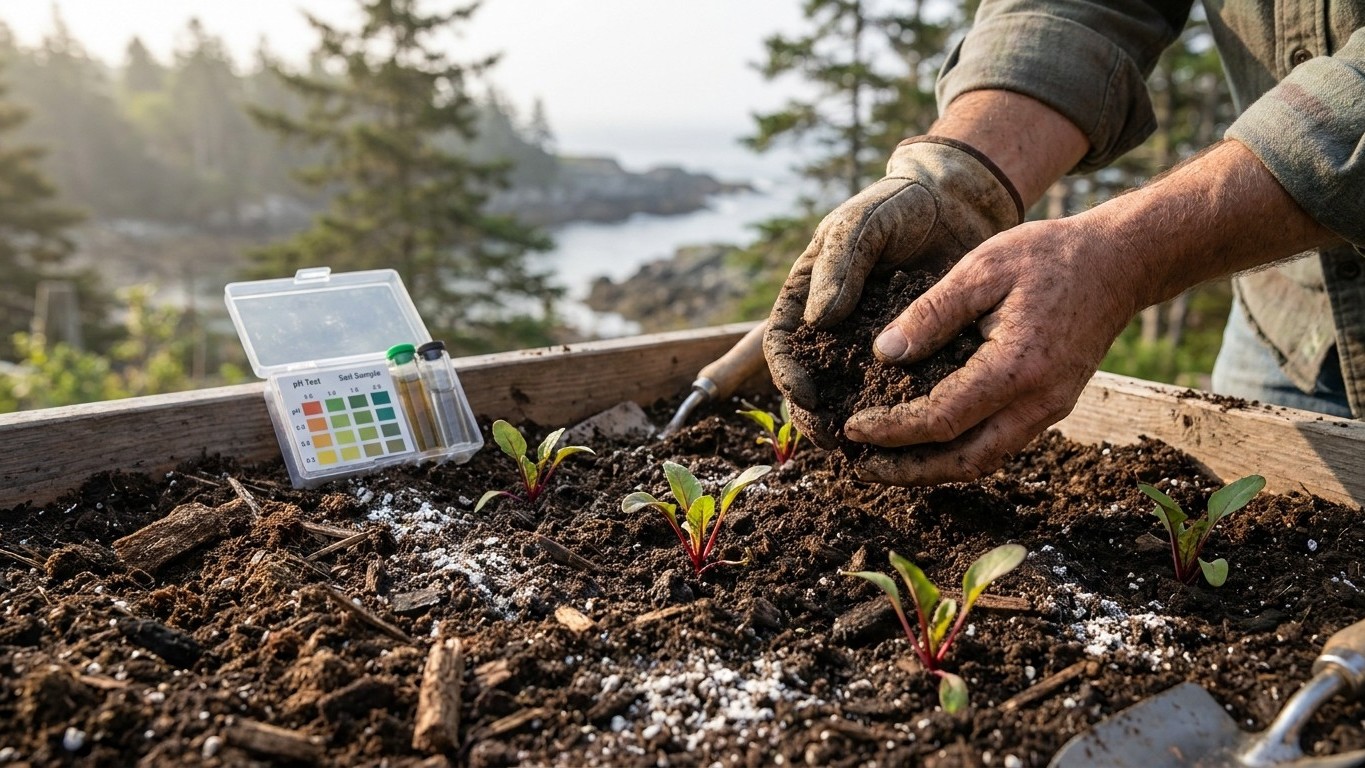

Maine’s official state soil, the Chesuncook series, is a sandy, strongly acid Spodosol that formed under conifer stands, not a tilled vegetable bed. For a beet grower, the takeaway is simpler than the soil science: this ground drains well, runs acidic, and needs real amendment before a root crop will thrive in it. Sowing timing and a cool coastal spring matter just as much as the dirt itself.
The short answer
The Chesuncook series carries a surface pH around 5.1, which is strongly acid, well below the neutral-to-slightly-acid range most root vegetables prefer. Its texture runs roughly 35 percent sand, 12 percent clay, and 53 percent silt, a loam-to-silt profile with a moderately well drained classification. Organic matter in the surface horizon averages about 53.0 percent, but that number reflects a natural forest floor, peat, muck, or leaf litter under conifers, not a worked garden bed. If your soil test comes back anywhere near that figure, you’re looking at undisturbed ground, not cultivated topsoil, and the number tells you almost nothing about how a tilled bed will behave.
None of this is a diagnosis of your yard. Maine spans hundreds of mapped soil series, and the state soil is a starting point for understanding regional tendencies, not a substitute for a soil test pulled from your own bed. What the Chesuncook profile does tell you is the general character of a lot of Beet Soil in Maine: sandy enough to drain rather than pool, acidic enough that liming is often worth considering, and naturally leached of nutrients after centuries under forest cover.
What sandy, acidic ground means for a beet root
Utah State University Extension is blunt about what beets want: deep, sandy, well-drained soil rich in organic matter, amended with no more than 1 inch of composted organic matter per 100 square feet. A Chesuncook-type profile checks the sand and drainage boxes reasonably well. The organic matter box is trickier, because the native forest-floor reading doesn’t carry over to a dug bed, and the acidity sits lower than beets generally tolerate, which is where a lime application based on an actual test result earns its keep.
On the heat side, Maine’s coastal climate rarely produces the kind of sustained 90-degree stretches that push beets toward woodiness on their own. The published NOAA climate normals for coastal Portland don’t itemize a count of 90-degree days here, so no specific figure gets stated. What the Utah State guidance does establish is the mechanism that matters: heat above 85 F combined with water stress is what toughens a root, and in a state where summers run cool by national standards, water stress is the variable a gardener actually controls.
The six weeks that decide it here
When to Sow Beets in Maine comes down to timing that window correctly: beets sown two to three weeks before the last frost land their first six weeks squarely inside Maine’s variable spring window. For coastal Portland, NOAA’s 1991-2020 climate normals place the last spring freeze probability between April 22 and May 1, based on the 30 to 70 percent probability band for 32 F. Sow beet seed directly in place around that window and the early growth period runs through late April into June, a stretch of Maine weather known for swinging rather than settling.
That inland and northern Maine run substantially later in both spring and fall than the coast is worth repeating, because a planting calendar built around the Portland date can be weeks off in Aroostook County or the western mountains. The coast is the mild end of the state, not the typical one.
Maine spring is not reliably dry and not reliably wet, it swings, sometimes a cold, sodden stretch through late April, sometimes a quick warm-up that dries surface soil out fast. That inconsistency is exactly what makes the first six weeks after sowing the highest-risk period for bolting. Utah State University Extension identifies water stress in this early window, not later heat, as the trigger for premature flowering. A beet bed that dries out for a week or two while seedlings are establishing can bolt regardless of how cool the summer turns out to be. Because beets are direct-seeded and never transplanted, there’s no head start from a nursery pot to buffer that early period. The 60 to 80 day maturity window that beet varieties typically carry counts from the day seed goes into the ground, not from any later transplant date, so the plant is exposed to Maine’s unsettled spring from its very first days of germination.
Practically, that means the six weeks right after sowing deserve closer irrigation attention than most gardeners give a root crop, even in a state that doesn’t feel like it needs supplemental watering. A dry week in early May, layered onto sandy, fast-draining Chesuncook-type ground, is enough to start the bolting process before a gardener notices the soil looks dry.
What goes wrong here
- Bolting from early dry spells. A beet bed that goes dry during the first six weeks after direct sowing, common in a Maine spring that swings between wet and dry stretches, triggers premature flowering per Utah State University Extension. The remedy is consistent moisture in that specific window: check soil moisture at seedling stage rather than waiting for visible wilt, and water before the bed dries fully rather than after.
- Acidic native soil left untested. Ground with Chesuncook-like characteristics runs strongly acid at the surface, around pH 5.1 in the mapped series. Beets generally prefer a less acidic range, and pulling a real soil test from your own bed, then liming based on the actual result rather than the state average, avoids stunted roots and poor color development.
- Over-amending with organic matter. Because the state soil’s organic matter reading looks high (about 53 percent in the surface horizon), a gardener might assume more compost is always better. Utah State’s guidance caps compost at 1 inch per 100 square feet; more than that can produce excess leaf growth at the root’s expense.
- Woodiness from combined heat and thirst later in the season. This is a separate failure from early bolting. Utah State University Extension notes that heat above 85 F paired with water stress toughens the root’s texture. Even in a state where sustained 90-degree stretches are uncommon on the coast, a hot, dry week in mid-to-late summer can still produce this effect if watering lapses.
- Fast drainage outrunning irrigation. The moderately well drained, sandy-to-silty texture of Chesuncook-type ground sheds water efficiently, which is good for avoiding rot but means moisture disappears faster than in denser clay soils. Mulching and more frequent, shallower watering checks compensate for that drainage speed.
Checking this against your own county
Everything above describes tendencies tied to one mapped soil series and one coastal weather station. Your actual garden, whether it sits on a river floodplain, a hillside, or fill dirt from a home build, may behave nothing like the Chesuncook profile, and if you’re inland or in northern Maine, your frost dates run later than Portland’s on both ends of the season. The University of Maine Cooperative Extension, reachable at extension.umaine.edu, offers soil testing and county-specific guidance that will tell you your actual pH, texture, and local frost timing rather than the state-level approximation used here. A ten-dollar soil test answers questions this article can’t.
Common questions
Can I fix acidic soil for beets in one season?
Liming takes time to shift soil pH, and a single application before planting won’t fully correct ground as acidic as the Chesuncook series’ 5.1 surface reading. Utah State University Extension doesn’t publish a specific liming rate here, so the practical step is a soil test through your local extension office to get an actual pH reading and a lime recommendation matched to it.
Does watering more always prevent bolting?
No. Consistent moisture during the first six weeks after sowing addresses the water-stress trigger Utah State identifies, but overwatering established beets doesn’t undo bolting once it’s started, and it does nothing for the separate heat-plus-thirst mechanism that causes woodiness later in the season. The two failures need different attention at different growth stages.
Is the state soil a good guide for my backyard?
Treat it as a regional tendency, not a personal result. Maine contains hundreds of distinct soil series, and Chesuncook represents forested, undisturbed ground rather than a typical cultivated vegetable bed. Use it to understand general drainage and acidity patterns, then confirm your own numbers with a test.
Do beet varieties differ in bolting risk in Maine?
Available sourcing here names varieties without attaching season, color, or bolting data to any specific one, so no variety-level claim can be made. The water-stress mechanism described by Utah State University Extension applies to direct-seeded beets generally, regardless of which variety goes in the ground.