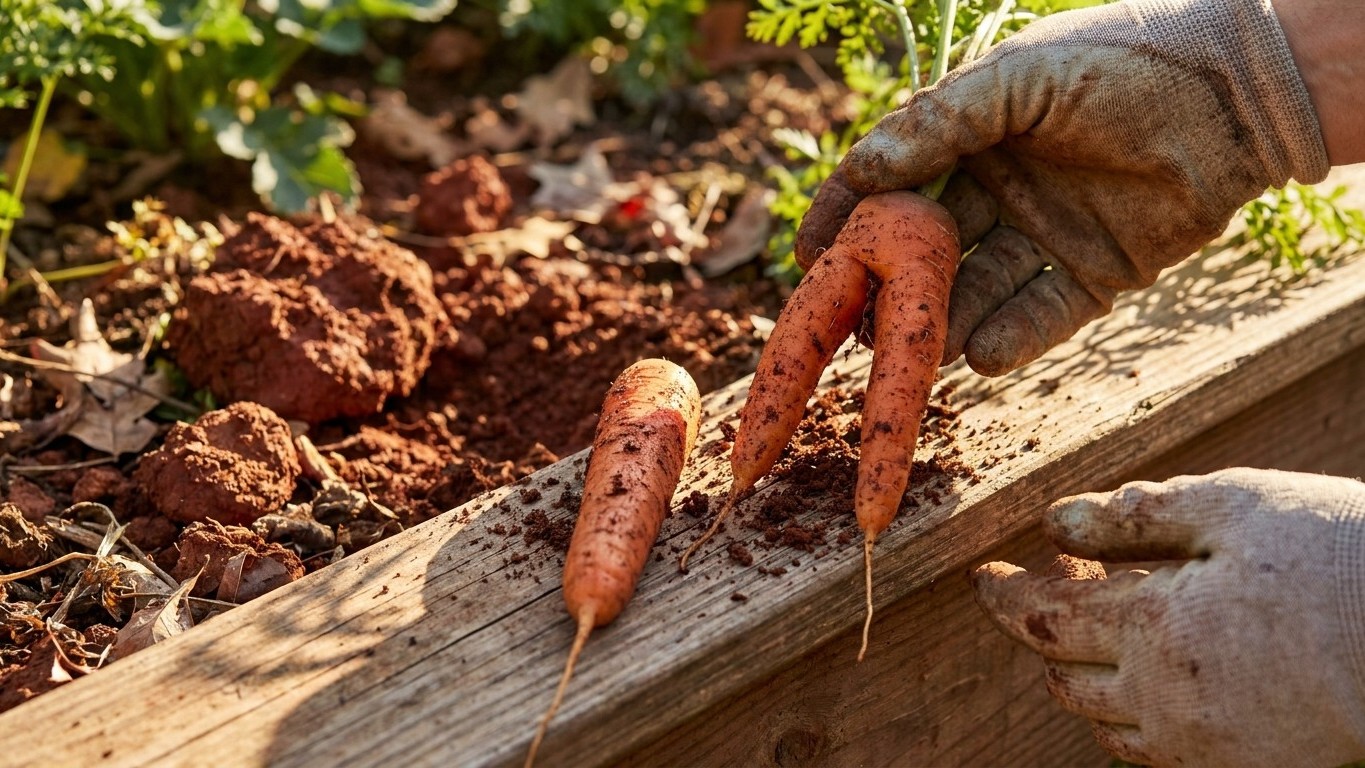

Carrots can absolutely fork in Maine soil, but not because of some blanket state condition. The soil that carries Maine’s name officially, the Chesuncook series, is a silt loam that drains only moderately well and runs strongly acid at the surface. That’s a different animal from the loose, sandy loam a carrot root wants to push through. Whether your own bed causes forking comes down to compost, double digging, or building up instead of digging down.
The short answer
The Chesuncook series became Maine’s official state soil under state law, and USDA’s soil survey data lays out what it actually looks like below the pine needles. At the surface, it runs about 35 percent sand, 12 percent clay, and 53 percent silt, a texture that lands solidly in silt loam territory. It’s classed as moderately well drained, meaning water moves through it, but not fast, and not evenly at every depth. The surface pH averages around 5.1, which is strongly acid, the kind of number you’d expect under a stand of conifers where needles have been dropping and breaking down for decades.
That last detail matters more than it looks. The organic matter content recorded for this soil’s surface runs around 53 percent, and that’s not a typo or a fertile garden bed’s dream number. A figure that high means the “surface” being measured is a natural organic layer, forest litter, duff, or a peaty mat, not a worked layer of topsoil a home gardener has ever turned a spade into. Nobody is planting carrot seed into undisturbed conifer duff. So that organic-matter number describes the forest floor, not what you’d find if you dug a bed in your yard.
Strip away the forest-floor context and what’s left is the texture and drainage class, and those two numbers do carry weight for a carrot grower. Carrots want deep, loose, well-drained ground. A silt loam with 12 percent clay and only moderate drainage isn’t hostile territory, but it’s heavier and slower-draining than the ideal. Combine that with any compaction, a plow layer, or buried rock, and a taproot pushing downward will hit resistance and split into two or three legs instead of growing straight. That’s forking, and it’s a mechanical problem, not a disease or a bad seed packet.
The fix Utah State University Extension gives for heavy ground is straightforward: work in plenty of compost and double dig the bed, breaking up and loosening the soil to a depth well beyond where the root will travel. Where the ground is shallow, rocky, or simply too much work to loosen by hand, a raised bed filled with a lighter mix sidesteps the problem entirely.
None of this should be read as a verdict on your particular yard. Maine, like every state, is mapped across hundreds of distinct soil series, and the Chesuncook profile represents a typical forested condition, not a garden bed, a river bottom, a hillside pasture, or the fill dirt a builder trucked in for a new subdivision. It’s a starting point for understanding what the region’s ground tends to do, not a diagnosis of the dirt under your tomato cages.
The test that settles it in your own garden
State-level soil data can only tell you what’s typical. Your own bed is the only thing that tells you what’s true. A short hands-on check, done before you commit a row to carrot seed, answers the fork question far better than any survey map.
- Dig a test hole. Go down about a foot in the spot you plan to plant. You’re looking for how far loose soil extends before you hit rock, a hardpan layer, or dense subsoil that resists the shovel.
- Check the depth and the stones. Note whether the loose layer runs deep and clean or whether you’re pulling out rocks and cobbles as you dig. Carrots need an unobstructed path straight down; a stone sitting where a root wants to grow is a guaranteed fork.
- Feel the texture. Grab a handful of moist soil and squeeze it. Sand feels gritty and falls apart. Clay feels sticky, smears between your fingers, and holds a shape when squeezed. Silt feels smooth, almost silky, and holds together loosely without the stickiness of clay. Most garden soil is some blend of the three, and that blend tells you how quickly a taproot can move through it.
- Watch how water drains. Pour water into the test hole and time how long it takes to disappear. Standing water that lingers points to a drainage problem that will also show up as stunted, misshapen roots. Water that vanishes quickly and evenly suggests the loose, well-aerated profile carrots prefer.
Run through these four checks in more than one spot in the bed if the yard has any slope, any obvious wet corner, or any area that was clearly disturbed by past construction. Soil can change character over a few feet, especially in a yard with mixed fill or an old foundation nearby. The test costs nothing but a shovel and twenty minutes, and it replaces guesswork with an actual answer about the ground you’re planting into.
What goes wrong here
Knowing the mechanism behind each failure makes the fix obvious instead of frustrating. These are the three problems a heavier, slower-draining soil profile tends to produce, along with what actually corrects them.
- Forking in heavy or compacted ground. A taproot meets a rock, a clay lens, or a compacted layer left by foot traffic or old tilling, and instead of pushing through it splits into two or three legs. The remedy is loosening the full planting depth with compost worked in and a double-dig pass, or skipping the native soil altogether with a raised bed filled with a lighter blend.
- Poor germination during a hot, dry stretch. Carrot seed is tiny and sits close to the surface, so it dries out fast once the top inch of soil bakes and crusts over. Keeping that surface consistently moist until seedlings emerge, with a light mulch or frequent shallow watering, keeps the seed from stalling out before it ever gets going.
- Splitting from uneven watering. A carrot spends 70 to 100 days in the ground from the day it’s seeded, since it’s sown directly and never transplanted. A long dry stretch followed by a heavy soak, or an irregular watering habit through that whole stretch, makes the root swell unevenly and crack. A steady, even watering rhythm from seeding straight through to harvest is the fix, not a variety change or a different bed.
Common questions
Does Maine’s official state soil mean my garden will grow forked carrots?
Not on its own. The Chesuncook series describes a typical forested profile mapped across the state, not the bed behind your house. Your yard could be sandier, rockier, or heavier depending on its history, so the dig-and-feel test matters more than the state-level number.
What’s the actual fix for heavy or clay-leaning soil before planting carrots?
Utah State University Extension recommends working in generous amounts of compost and double digging the bed to loosen it well below where the root will grow. Where the ground is too shallow, rocky, or compacted to loosen easily, building a raised bed with a lighter fill sidesteps the problem entirely.
How do I know if my soil is too rocky for straight carrots?
Dig a test hole about a foot deep in the planting area. If you’re pulling out stones or cobbles as you go, or if the shovel hits resistance well above a foot down, that rock or hardpan is exactly what will split a growing root.
Can a raised bed solve the problem instead of reworking my existing soil?
Yes. A raised bed filled with a loose, well-drained mix skips the native soil’s texture and drainage issues altogether, which is often less work than double digging a bed with heavy clay, deep rock, or a compacted subsoil layer.