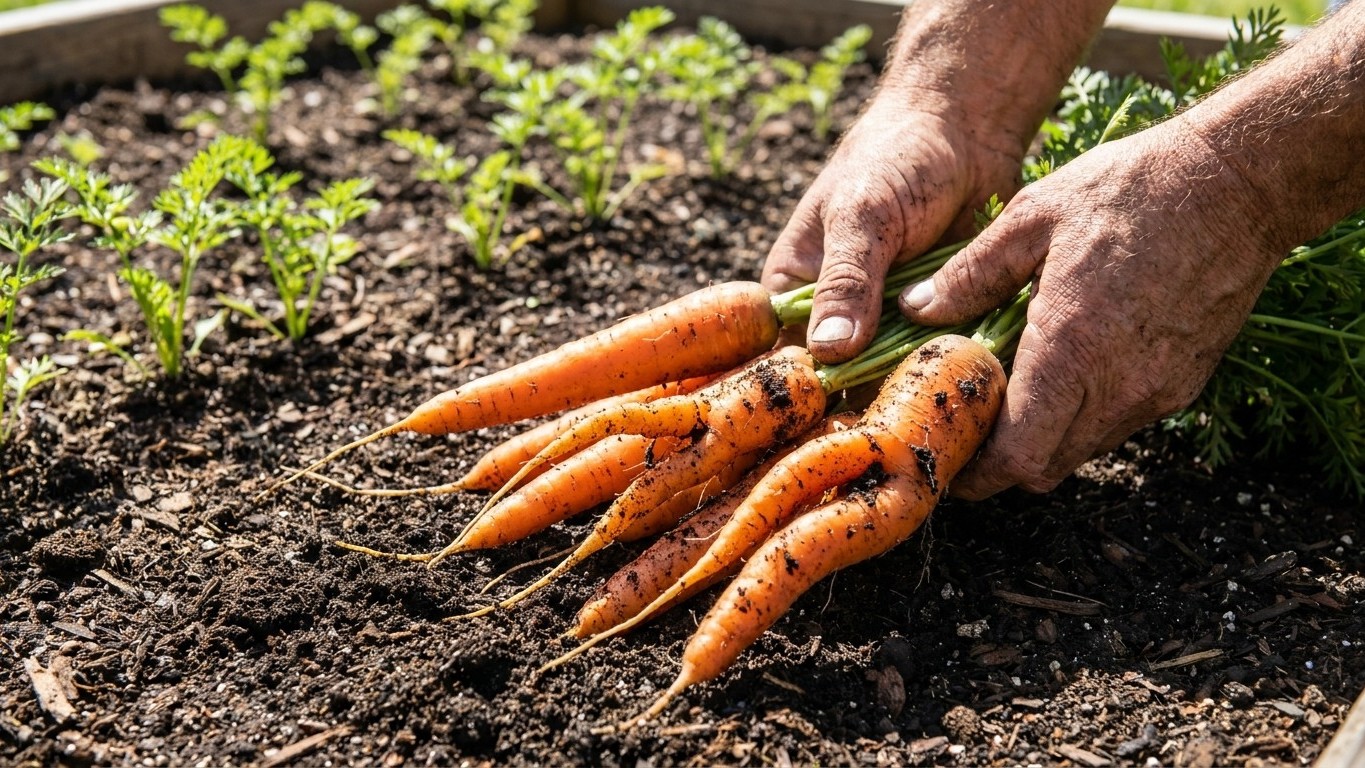

Carrots in Maine go into the ground by counting backward from your local last-frost date, since they’re direct-sown and don’t mind cool soil. But the frost date only tells you when to open the seed packet. What actually decides whether that carrot grows straight and sweet or comes up twisted and stunted is what’s under it: the state’s naturally sandy, acid, heavily leached ground, and whether your own garden bed matches that description at all.
The short answer
Maine’s official state soil is the Chesuncook series, a Spodosol, adopted into state law in 1999 through the USDA NRCS State Soils program. It formed under conifer stands, and the surface horizon that USDA records across 61 sampled components runs about 35 percent sand, 12 percent clay, and 53 percent silt, a texture that lands in silt loam territory. Surface pH averages about 5.1, which is strongly acid. Drainage is classed as moderately well drained, and organic matter in that surface layer averages roughly 53.0 percent.
That last number needs a pause before you read anything else into it. Organic matter above 20 percent in a surface horizon almost always means you’re looking at a natural forest floor layer, peat, needle litter, decomposed duff, not a worked garden bed. No cultivated vegetable plot carries that much organic material naturally. So the 53 percent figure describes undisturbed forest ground under the pines Chesuncook soils typically support, not what you’ll find when you push a spade into a backyard that’s been mowed and gardened for years.
Strip that number away and what’s left is more useful: a silt loam texture, moderately well drained, strongly acid. According to Utah State University Extension’s guidance on growing carrots, the crop wants deep, sandy, well-drained ground rich in organic matter, and heavy or rocky soil is what makes the root fork instead of growing straight down. A silt loam with only 12 percent clay isn’t heavy clay ground. It’s workable. The forking risk in Maine soils like this comes less from clay content and more from compaction, buried stones (common in glaciated New England ground), and a pH low enough to slow root development and nutrient uptake. Lime brought up toward a more neutral range, worked-in compost, and a season of loosening the topsoil address most of that.
Where the ground runs heavier or rockier than this profile, or drainage sits closer to poor than moderate, the fix Utah State Extension points to is still compost and double digging, or building a raised bed filled with looser mix entirely. None of that is optional if you want a carrot that comes out of the ground looking like a carrot instead of a Y.
All of this comes with a hard limit worth repeating: a single named soil series is a starting point, not a verdict on your yard. Maine spans hundreds of distinct soil series across its counties, from river-bottom silt to ledge-thin hill soil to whatever a builder trucked in and graded flat before a house went up. The Chesuncook profile tells you what the state’s representative ground tends to do. It says nothing certain about the twelve-by-twenty bed behind your own house.
The test that settles it in your own garden
State soil data can’t tell you what’s eighteen inches under your own carrot bed. Only digging will.
- Dig a test hole at least a foot deep in the spot you plan to seed. Note where the color changes, that line usually marks the bottom of the worked topsoil and the start of subsoil the carrot’s taproot will have to push through.
- Check that depth against a stick or ruler laid across the hole. Carrots need clear, unobstructed depth to grow straight; if you hit dense clay, hardpan, or a shelf of rock well before a foot down, that’s your forking answer right there.
- Pull stones out as you go and count them. A bed riddled with fist-sized rocks in the top foot will deflect roots no matter how good the texture is otherwise.
- Grab a handful of moist soil from that hole and rub it between your fingers. Gritty and loose suggests sand-heavy ground that drains fast and may need more organic matter for moisture holding. Slick, sticky, and hard to break apart suggests clay-heavy ground that holds water and resists root penetration, the kind Utah State Extension flags as needing compost and double digging.
- Fill that same hole with water and time how long it takes to drain fully. Water still standing after several hours points to poor drainage, the kind of condition that calls for raised beds rather than working around it in place.
None of these five checks needs a lab. They need a shovel, a bucket, and twenty minutes, and they’ll tell you more about your specific carrot bed than any state-level soil figure ever will.
What goes wrong here
- Forking in heavy or rocky ground. Roots hit a stone, a clay lens, or compacted subsoil and split rather than push through. Utah State University Extension’s answer is direct: work in generous compost and double dig the bed to loosen and enrich the full root zone, or skip the fight entirely and grow in a raised bed filled with looser soil.
- Poor germination during a hot, dry stretch. Carrot seed is small and sits near the surface, and a crust forming on drying topsoil can stop germination cold even when the seed itself is viable. Keeping the seedbed consistently damp through germination, with light, frequent watering rather than one heavy soak, is what gets a stand up evenly.
- Splitting from uneven watering. A root that grows through a dry stretch and then gets hit with a heavy soak (or a hard rain after weeks without one) can split along its length as it swells suddenly. Steady, even moisture through the growing season, rather than feast-or-famine watering, prevents the swings that cause it.
- Stunted growth in acid, low-fertility ground. Ground running strongly acid, similar to the roughly 5.1 pH of Maine’s representative state soil profile, can slow nutrient uptake and stunt root development even when texture and drainage are otherwise fine. Testing your own bed’s pH and adjusting with lime where needed addresses this directly rather than guessing.
Common questions
Do carrots need to be transplanted after starting indoors?
No. Carrots are sown directly in the ground where they’ll grow to harvest. There’s no transplanting step, and the 70 to 100 days carrots typically take to mature are counted from the seeding date, not from any transplant date, because there isn’t one.
Is Maine’s official state soil the same as what’s in my garden?
Not necessarily. The Chesuncook series is the soil named by state law as representative of Maine, based on USDA NRCS data, but the state contains hundreds of distinct soil series. Your own garden could sit on completely different ground, especially if it’s near a river, on a hillside, or on soil that was moved or graded during construction.
Does high organic matter in the state soil data mean Maine gardens are naturally rich in compost?
No. The roughly 53 percent organic matter figure recorded for the Chesuncook series surface horizon reflects an undisturbed forest floor layer, needle litter and decomposed duff under conifer stands, not a cultivated garden bed. A worked vegetable plot will not carry anywhere near that level of organic matter naturally.
What’s the actual fix for heavy or rocky soil before sowing carrots?
Utah State University Extension recommends working in plenty of compost and double digging the bed to loosen compacted or clay-heavy ground through the full depth a carrot root will travel. Where the ground stays too heavy, rocky, or poorly drained even after that work, a raised bed filled with a looser soil mix is the more reliable option.