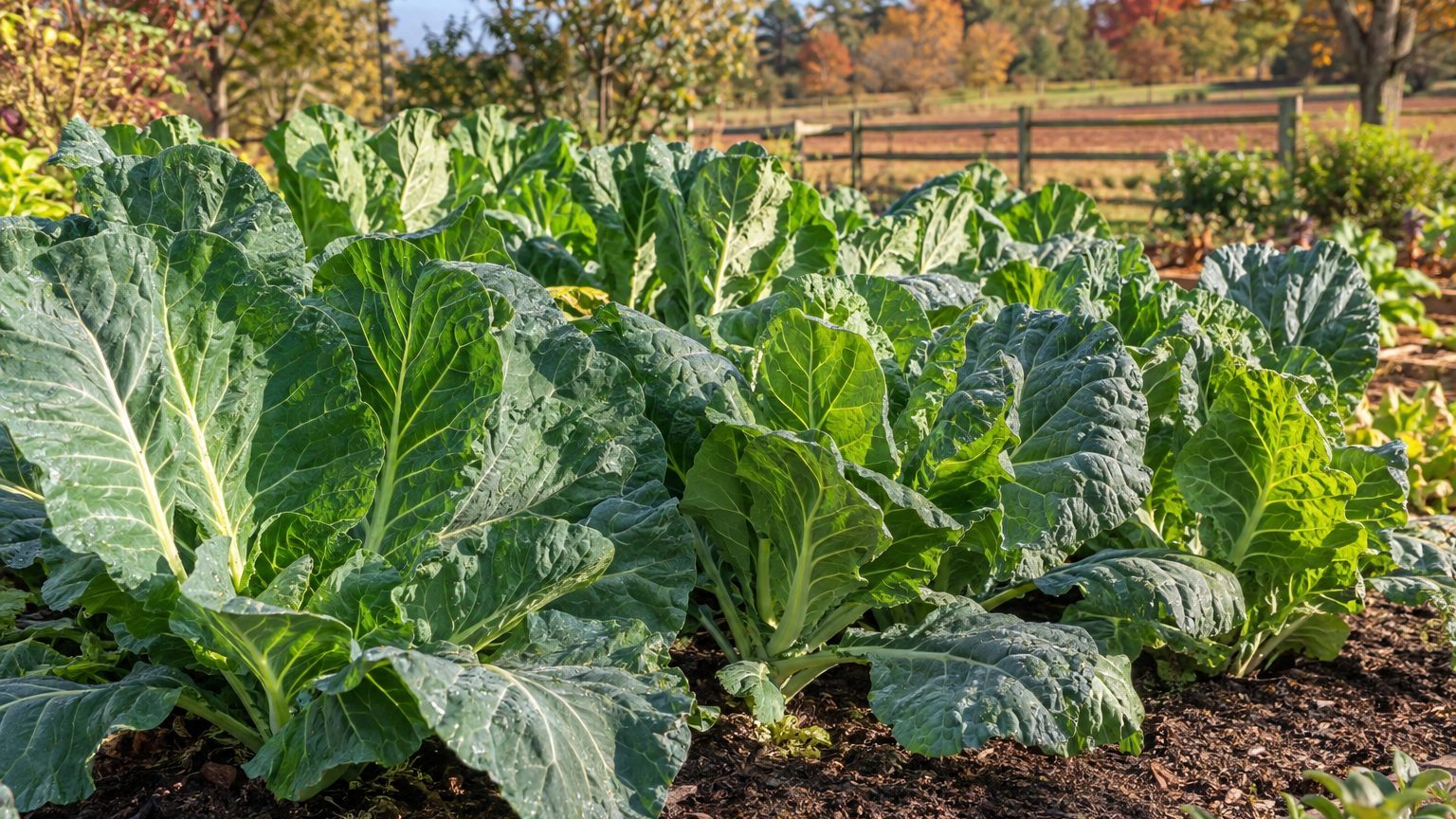

For Maine, choose compact, cold-tolerant collards such as Vates or Champion, start them indoors, and plant kale alongside for the weeks when Southern types fall short. The season is short and cool, and at Portland a 32°F freeze becomes a coin flip between October 9 and October 21. Collards shrug off light frost, so the goal is a full-sized plant by then. Basic culture is covered in Growing Collards in Maine.
The short answer for Maine
Those fall dates come from the 1991-2020 NOAA climate normals for Portland, and they describe a probability, not a deadline. The October 9 to October 21 band marks where the chance of a 32°F freeze sits between 30 and 70 percent. Spring works the same way: April 22 to May 1 is the band where a last freeze is still roughly even odds. Portland is also the mild end of the state. Inland and northern Maine start later in spring and freeze earlier in fall, so the gap between the two bands only shrinks as you move away from the coast.
That gap decides the variety. A collard needs weeks of steady growth before it gives a meaningful harvest, and a plant set out in mid-May has less runway than one set out in April in Georgia. Faster, more compact types make the most of it. Slow giants may still be half-grown when the first hard freeze arrives.
Choosing by type
| Type | Example varieties | Fit for Maine |
|---|---|---|
| Compact, open-leaf, cold-tolerant | Vates, Champion | Best first choice. Matures reasonably quickly and holds up in cool weather. |
| Tall heirloom Southern | Georgia Southern | Workable on the coast if transplanted early. Risky inland, where the season ends sooner. |
| Loose-heading | Morris Heading | Interesting for a cabbage-like leaf, but it needs more time than compact types. |
| Companion greens | Lacinato kale, Winterbor kale | Reliable backup. Kale tolerates cold at least as well as collards. |
Greens worth growing beside them
Kale is the natural partner. It handles cool springs and hard fall nights, so it fills the same kitchen role when a collard planting stalls. Mustard greens and turnip greens, the other staples of Southern cooking, mature quickly from direct sowing and fit the cool shoulder seasons. Swiss chard tolerates a bit more heat and gives picking all summer. Sowing dates for all of these are laid out in When to Plant Collards in Maine.
What will not work here
Direct-seeding collards in cold April soil is the first failure. Seed sits, rots, or sprouts unevenly, and the plants that do emerge start the race weeks behind a transplant. Starting seed indoors and setting out sturdy seedlings once the last-freeze window has passed, with row cover on hand for stragglers, avoids most of that.
The second is slow, tall varieties planted late. A collard that wants a long growing period gets cut short when the October freeze band arrives, and the harvest amounts to a few small leaves. Because that band comes sooner inland and in the north, the problem gets worse the farther you are from Portland.
Counting on winter survival
The mean daily minimum of the coldest month at Portland is 15.6°F. That is an average, so many nights run colder, and a collard in an open bed is not a dependable perennial at those temperatures. Plants often survive a mild stretch under deep snow cover, but a southern gardener’s habit of picking all winter does not transfer here. Treat collards as an annual crop: harvest through the cold-sweetened fall, and anything that lives through winter is a bonus.
Planting too early, spacing too tight
Setting transplants out before the April 22 to May 1 window has closed gambles on a freeze that still has real odds of showing up. Hardened-off collards take light frost, but young, tender seedlings may not, and a cold snap with wind can stunt them badly. Crowding is the other mistake. Maine’s cool, damp stretches, especially near the coast, keep leaves wet longer, and tight rows favor fungal and bacterial leaf problems. Cabbage worms and flea beetles also thrive in dense foliage. Spacing plants generously for air movement and checking leaf undersides weekly does more than any spray.
Last, a pattern borrowed from hot-summer states: sowing in midsummer to harvest in winter. In Maine, that timing gives plants too little time before hard cold. A late-summer sowing works only for fast greens, such as mustard or turnip tops, not for collards.
What changes across Maine
Maine spans USDA hardiness zones 3b to 6a (USDA Plant Hardiness Zone Map 2023, built on 1991-2020 normals). That spread is wide for one state, and the zone number tracks only one thing: the average annual extreme minimum temperature. There is no single answer for the whole state. The Portland dates above fit the coastal strip, not the Aroostook County potato fields, the western mountains, or the Highlands.
A gardener in the north or at elevation should shift three things. Start seed indoors a little later than a coastal gardener would, since the ground thaws later, but keep the goal of setting out sturdy transplants after local freezes taper off. Favor the fastest, most compact types on the list, so Vates and Champion over Georgia Southern. And think of kale as the main crop and collards as the experiment, since kale tolerates the earlier, harder fall that comes with higher latitude and elevation.
On the coast and in the southern counties, there is more room. Early transplanting under row cover, a second planting for fall, and a try at a tall heirloom are all reasonable. Even then, the Portland dates describe the mild end of the range, so expect later springs and earlier autumns anywhere inland.
To find your own zone, check the USDA Plant Hardiness Zone Map and look up your ZIP code rather than assuming a number from a neighbor or a seed packet.
Where to check this for your own county
University of Maine Cooperative Extension is the place to go next. It runs offices across the state, and its horticulture staff and Master Gardener volunteers see how crops perform in each county’s soils and weather. A statewide recommendation gives a sensible starting point, but a county recommendation beats it every time, because it reflects local frost pockets, elevation, and the growing records of nearby gardeners.
Look for two things in particular. First, a local planting calendar or frost-date guidance for your county, which tells you where your spring and fall windows fall compared with the Portland figures. Second, any listing of varieties that have been trialled in your county or region, especially for brassicas such as kale and collards. A variety that performed well in a nearby trial is worth more than any general ranking.
Extension offices also handle soil tests, which are inexpensive and tell you whether lime or fertilizer is needed. Collards and other brassicas prefer soil that is not too acidic, and much of Maine’s native soil runs acidic, so a test result can matter as much as the variety. Staff can also help identify pests such as cabbage root maggots or flea beetles if you bring in a sample.
Some extension materials are written for other crops or other parts of the country. When you read a calendar, make sure it covers the crop you are growing and a similar climate, because planting calendars from warmer regions run on entirely different timing.
Checking this against your own garden
Dates on paper give way to what the garden shows you. Three observations work better than any calendar, and none of them needs equipment.
- Soil warmth by feel. Push your hand into the bed in the morning. If it still feels cold enough to numb your fingers within a minute, the soil is not ready for tender seedlings. Beds that warm early (south-facing, raised, sandy) let you plant sooner than a shaded or clay bed.
- Early flowering of weeds and trees. When maples are leafing out and dandelions are flowering, the ground has generally lost its deep chill. Compare the timing year to year, and you learn whether your garden runs ahead or behind the neighbors’.
- First true leaves. On seedlings, the first true leaves (the ones after the rounded seed leaves) show whether plants are growing steadily. If they stall or purple in cool weather, the site is colder than you thought.
Write the dates down in a notebook. After two or three seasons, those notes are the most accurate calendar a garden can have.
Common questions
What is the best collard variety for a short season?
Compact, quick-growing types like Vates and Champion suit Maine best, since they make a usable plant in less time than tall heirlooms and tolerate cool weather well. Start them indoors and transplant after the last-freeze window.
Can collards survive a Maine winter?
Rarely, and not reliably. The coldest month’s average nightly low at Portland is 15.6°F, and many nights are colder. Plants may last under snow cover or a low tunnel in a mild winter, but plan on one season of growth.
Does frost hurt collards?
Light frost does not, and it often sweetens the leaves. Young seedlings are more vulnerable, which is why transplants should wait until the April 22 to May 1 band has passed or be covered on cold nights. Fall freezes in the October 9 to October 21 band at Portland are generally welcome for mature plants.
Is kale a better choice than collards in northern Maine?
Often, yes. Kale tolerates the shorter season and harder cold that come with higher latitude and elevation. Many northern gardeners grow kale as the main crop and a few fast collards on the side.