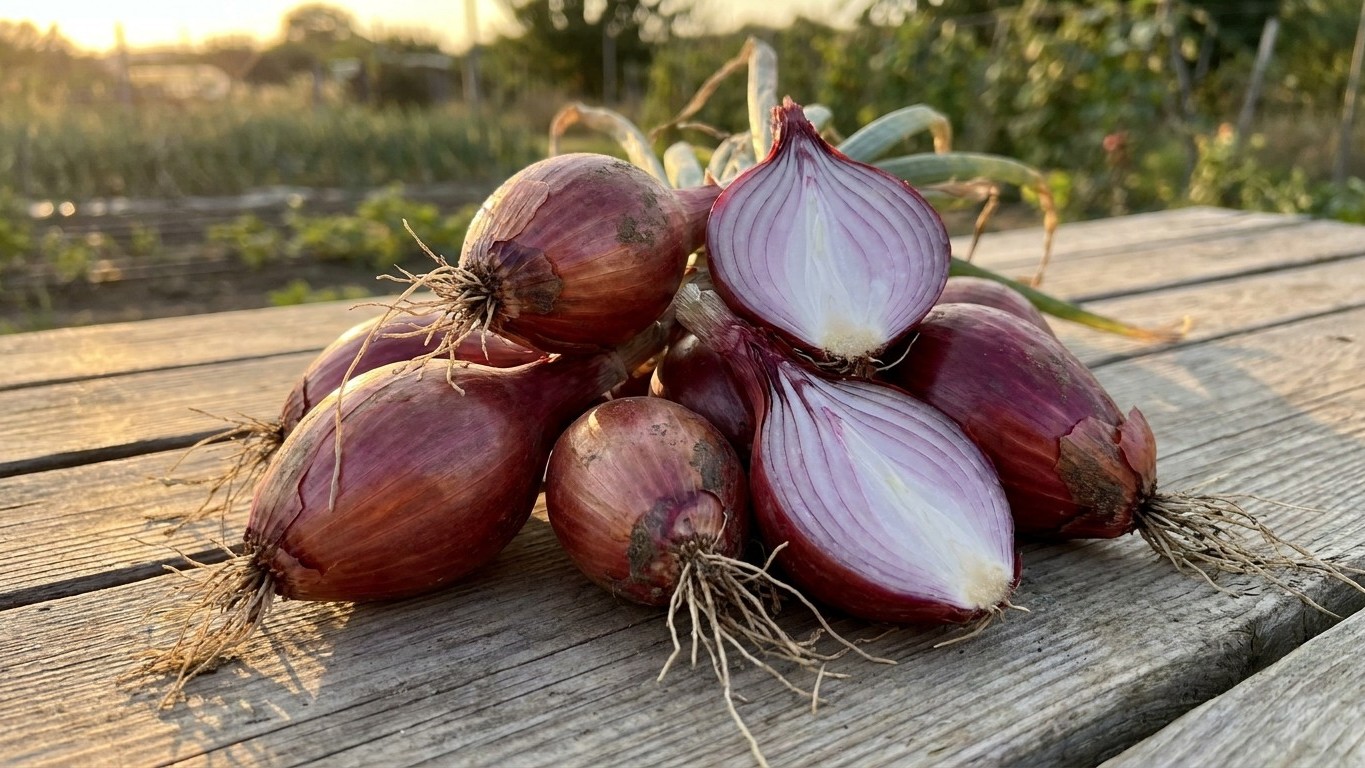

One insect on Maine’s official pest watchlist actually bites into an onion crop: seedcorn maggot. It doesn’t chew leaves or bore into bulbs like the pests gardeners usually picture. It works underground, in cold wet spring soil, going after the seed itself before a plant even gets a chance to grow. Everything else commonly flagged in Maine targets a different crop entirely.
Which pests attack onion in Maine
University of Maine Cooperative Extension tracks ten pests widespread enough across the state to document: Browntail moth (Euproctis chrysorrhoea), Cabbage maggot, Colorado potato beetle, Emerald ash borer, Lily leaf beetle (Lilioceris lilii), Seedcorn maggot (Delia platura), Spotted wing drosophila, Squash vine borer, Striped cucumber beetle, and Winter moth. That’s the whole list for the state. No padding needed, and none added here.
Run down that roster with an onion bed in mind and most of it falls away fast. Browntail moth caterpillars strip oak, apple, and other hardwoods, and their shed hairs cause a nasty skin rash, but they have zero interest in a vegetable row. Colorado potato beetle chews on potato, eggplant, and tomato foliage, all members of the nightshade family, which leaves alliums untouched. Emerald ash borer is a forestry problem, tunneling exclusively into ash trees. Winter moth caterpillars defoliate fruit trees and oaks early in spring, another tree-only pest. Spotted wing drosophila lays eggs in soft-skinned fruit like raspberries and cherries, nothing a root vegetable offers. Squash vine borer and striped cucumber beetle both stick to the cucurbit family, squash, cucumber, melon, and never wander into an onion patch.
Two names deserve a closer look because the confusion is understandable. Cabbage maggot targets the roots of brassicas, cabbage, broccoli, radish, and while it’s a close relative of the fly that actually damages onion, it’s not the species documented here for that job. Lily leaf beetle causes the most mix-ups of all, since it sounds like it should hit anything with “onion” in its family tree. It doesn’t. It strips true lilies and fritillaria, plants in the genus Lilium, which despite the shared old naming history is a different family from Allium, the onion group. The beetle leaves onion alone entirely.
That narrows it down fast. Of the ten, exactly one feeds on onion: seedcorn maggot. It’s not picky about onion alone either. It also attacks bean, corn, and pea seeds sitting in the same kind of cold, slow-draining soil, which is exactly the condition that draws it in.
When each one shows up, and what it does first
Seedcorn maggot adults are small flies that go looking for freshly disturbed, damp soil rich in decomposing organic matter, think ground recently turned with manure or a cover crop plowed under. That’s their cue to lay eggs. The larvae hatch and tunnel straight into a germinating onion seed or the base of a just-emerged seedling, and the first sign a gardener sees is usually a bare gap where seed should have sprouted, or a seedling that wilts and topples within days of coming up. There’s no chewed leaf to spot first. The damage happens below the surface, before the plant has much of anything visible to lose.
This window lines up with the earliest, coldest part of the planting season, which is exactly when Maine’s soil stays wet and slow to warm compared to states farther south. Direct-seeded onions and small sets are the most exposed, since they spend time as vulnerable seed or bare seedling right when the flies are most active. Transplants skip a chunk of that risk simply because they’ve already grown past the seed stage before they ever touch garden soil.
Once onions clear that early danger period, the calendar shifts in their favor for a different reason. Maine’s summer days stretch long, reaching 15 hours and 15 minutes of daylight on the longest day at the latitude of the state’s reference climate station (43.65 degrees north). That day length is what tells an onion plant to stop building leaves and start building a bulb, not the temperature. By the time that shift happens, seedcorn maggot’s spring window has typically closed, and the plant has moved on to a growth stage the fly isn’t drawn to. Gardens near the northern edge of the state get even more daylight than that figure suggests, since latitude climbs the farther north you go, so the exact timing of that shift will vary somewhat by location.
Telling the damage apart from everything else
A seedling that fails or collapses in early spring gets blamed on insects a lot faster than it should. Cold, wet soil causes plenty of trouble on its own, and so does a rough transplant. Sorting out which is which starts at the base of the plant, not the leaf.
| What you see | Likely cause | What separates it |
|---|---|---|
| Seed never sprouts, or seedling collapses within days | Seedcorn maggot | Digging at the base turns up a small, legless, cream-colored maggot tunneling into the seed or stem |
| Seedling wilts, but the base looks intact at first glance | Damping-off (a soil fungus) | The stem is soft and water-soaked, often pinched right at the soil line, with no maggot present |
| Older leaf tips yellow and dry out | Nutrient stress or normal aging | Progresses evenly across the whole bed rather than showing up in scattered, isolated plants |
| Whole rows droop right after transplanting | Transplant shock or drought stress | Roots pulled up are intact and white, and the plant often perks back up within a few days of watering |
The one move that actually separates these causes is simple: pull the plant and check the base before deciding what’s wrong. A maggot present at the seed or stem points to seedcorn maggot. A soft, collapsed stem with nothing living inside points to disease instead, and no insect control will fix that. This isn’t a call to make from a photo of the leaves alone, and a county extension office can confirm what a home gardener isn’t sure about.
What actually works here, and what is a waste of time
Timing beats almost everything else with this pest, because the larvae are only reachable before they’re inside the seed. Once a maggot has tunneled in, nothing sprayed on the surface afterward does much good, the damage is already done and the insect is already out of reach. That’s the main thing gardeners waste time on: treating a bed after seedlings have already started collapsing.
What works instead starts before planting. Avoid seeding onions directly into ground that was just turned over with fresh manure or a cover crop, since that decomposing material is exactly what draws egg-laying flies in the first place. Letting a bed sit and dry out a bit longer before planting, rather than rushing seed into cold, saturated soil, cuts down the conditions the fly needs. Using transplants or sets in the coldest, wettest fields also sidesteps a chunk of the risk, since the vulnerable seed stage happens somewhere else first. A floating row cover put down at the time of seeding physically blocks adult flies from reaching the soil to lay eggs at all, and that’s the single most reliable step available to a home gardener.
The real rule of thumb: cover the bed before adults can lay eggs, not after. Anything applied once wilting has already started is addressing a fly that’s long gone and larvae that are already protected inside the plant. As for anything chemical, what’s registered for use in Maine changes and isn’t something to guess at from a general gardening article, that’s a question for the people who track it locally.
Where to check this for your own county
University of Maine Cooperative Extension is the source for everything documented on this page, and it’s also the right place to go with a specific plant in hand. What’s common statewide doesn’t tell you what’s actually present in one particular garden, pest pressure shifts from one county to the next, and even from one field to a neighbor’s field, depending on soil, drainage, and what was planted there the year before.
A county office can look at an actual damaged seedling and say whether it’s seedcorn maggot, a disease, or something else entirely, which is more than any general list can do. If a bed is showing collapsed seedlings this spring, bring the whole plant, roots included, to the local extension office rather than guessing from a photo of just the leaves. That single step settles more diagnostic questions than anything else available to a home gardener.