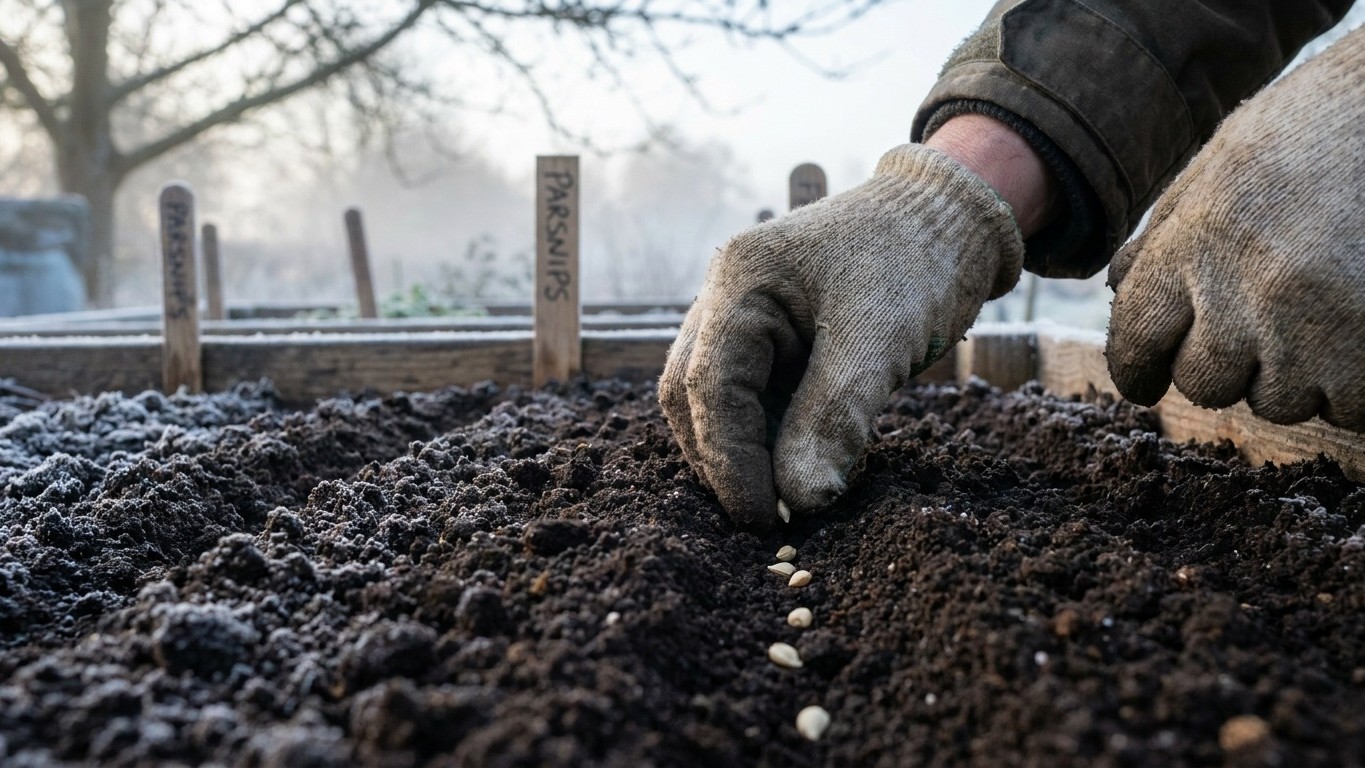

Sow parsnips in Maine two to three weeks before your last spring frost. Along the coast near Portland, that frost typically falls between April 22 and May 1, which puts seed in the ground from roughly April 1 to April 17. Inland and northern Maine growers push that window later, sometimes by several weeks, because spring arrives slower away from the coast.
The short answer
Here’s the question that actually decides whether Maine is good parsnip country: does this state deliver several weeks of hard, sustained frost before you dig? Because a parsnip doesn’t need a mild winter to grow well. It needs a cold one to taste good.
The mean daily minimum temperature during Maine’s coldest month, measured at the Portland reference station over the 1991-2020 period, sits at 15.6°F. That’s not a record low or some rare cold snap. That’s the average low, night after night, for the entire coldest month. Even at the mild, coastal edge of the state, winter arrives with real teeth.
That number matters because of how parsnips work biologically. According to Utah State University Extension, the roots store starch through the growing season, and it takes real cold exposure, several weeks of frosty conditions, to convert that starch into sugar. A parsnip pulled from warm soil in September tastes flat and a little bitter. The same root, left in the ground through repeated frosts, turns sweet and nutty. This is not a hardiness zone question. A zone rating tells you whether the plant survives; it says nothing about whether the cold actually arrives in the dose the crop wants.
Maine delivers that dose. With a coldest-month average minimum well below freezing, and the first fall frost typically settling in by mid-October, gardeners here get exactly the kind of prolonged, cold exposure this crop is built for. Compare that to a mild coastal region where winter lows hover just above freezing and rarely dip hard for more than a few days. There, a parsnip might grow to full size and never sweeten properly, because it never gets several consecutive frosty weeks to trigger the starch conversion.
So the short answer has two parts. Sow in early-to-mid April along the coast, later inland. And once the roots mature, don’t rush to harvest. Let Maine’s cold do its job. The state’s winter is exactly the kind of asset this crop needs, not a hurdle to work around.
Does the season fit?
Parsnips need 100 to 120 days from seeding to maturity, according to Utah State University Extension, and that clock starts the moment seed goes into the ground, not when seedlings emerge. Germination itself is slow, typically 14 to 21 days, so patience matters before you even see a row. Here’s how that math lines up against Maine’s frost calendar.
- Start with the frost window. Coastal Maine’s last spring frost, per NOAA NCEI 1991-2020 Climate Normals for the Portland reference station, falls between April 22 and May 1.
- Back up two to three weeks for sowing. That places seeding around April 1 to April 17, direct into the garden bed since parsnips don’t transplant well.
- Add the 14 to 21 day germination lag. Expect seedlings to show anywhere from mid to late April, depending on soil temperature and how early you sowed.
- Add the 100 to 120 day maturity window from the seeding date. Sown April 1, a parsnip reaches maturity somewhere between mid-July and late July. Sown April 17, that pushes to roughly early-to-mid August.
- Compare that to the first fall frost. NOAA NCEI data puts that date between October 9 and October 21 for the same coastal reference station.
- Count the total days available. From an April sowing to an October frost, coastal Maine offers somewhere around 180 to 190 days of growing season, well beyond the 100 to 120 the crop requires.
That’s a comfortable fit, not a tight squeeze. Even accounting for slow germination and a late sowing date, coastal Maine gardeners have roughly two extra months of buffer beyond what the crop needs to reach maturity, and that buffer is exactly what lets you leave roots in the ground through several fall frosts before digging. Inland and northern Maine compress that margin, since both the last spring frost and first fall frost shift toward a narrower middle window away from the coast’s moderating influence, but the fit generally still holds. It just leaves less room for a late sowing or a slow spring.
What goes wrong here
- Forked or twisted roots in heavy or stony ground. Maine soil runs rocky and clay-heavy in a lot of places, and a parsnip root pushing down through compacted or stone-studded earth will split around obstructions instead of growing straight. Utah State University Extension recommends deep, sandy soil for this crop, and where that’s not the native condition, double digging the bed 12 to 15 inches down and clearing stones before sowing solves most of it.
- Forked roots from overwatering. This is a separate cause from heavy soil, and it’s easy to confuse the two. Too much water, especially inconsistent watering that swings from soggy to dry, encourages the taproot to branch instead of growing as one clean spear. The fix is steady, moderate moisture rather than heavy soaking followed by drought.
- A season that runs out before maturity. This is more of a risk in inland and northern Maine, where the frost-free window is shorter, or for anyone who sows late into May instead of hitting the early-to-mid-April target. Sowing at the start of the recommended window, rather than the tail end, protects the full 100 to 120 days the crop needs.
- Harvesting before the cold has done its work. Maine’s winters are cold enough to sweeten parsnips reliably, but only if the roots stay in the ground long enough to get several weeks of frost exposure. Digging them up right after the first light frost, out of impatience, skips the sugar conversion entirely. Mulching the bed and waiting through multiple hard frosts, sometimes into November, produces the sweeter root this crop is known for.
Common questions
Can I sow parsnips directly after the last frost instead of before it?
You can, but you’ll shorten the growing season unnecessarily. Sowing two to three weeks before the last frost, as recommended by Utah State University Extension, takes advantage of the fact that parsnip seed tolerates cool soil and slow germination. Waiting until after frost risk passes just delays the 100 to 120 day clock without any real benefit to the plant.
Why is my parsnip germination so uneven?
Germination naturally runs 14 to 21 days and can be patchy even under good conditions, since parsnip seed loses viability quickly and doesn’t store well season to season. Fresh seed, consistent moisture, and patience matter more than any adjustment to sowing depth or timing.
Does inland Maine need a different sowing date than coastal Maine?
Yes. The frost dates cited here reflect the Portland reference station, which sits at the mild end of Maine’s climate range. Inland and northern parts of the state see a later last spring frost and an earlier first fall frost, which narrows the growing window and generally pushes the sowing date later into April or beyond.
Do I need to wait for a hard freeze before harvesting?
The available data doesn’t specify an exact frost threshold for peak sweetness, only that several weeks of frosty conditions are what convert stored starch to sugar. Rather than targeting a single freeze event, the practical approach is to leave roots in the ground through repeated fall frosts and harvest gradually as needed, checking flavor along the way.