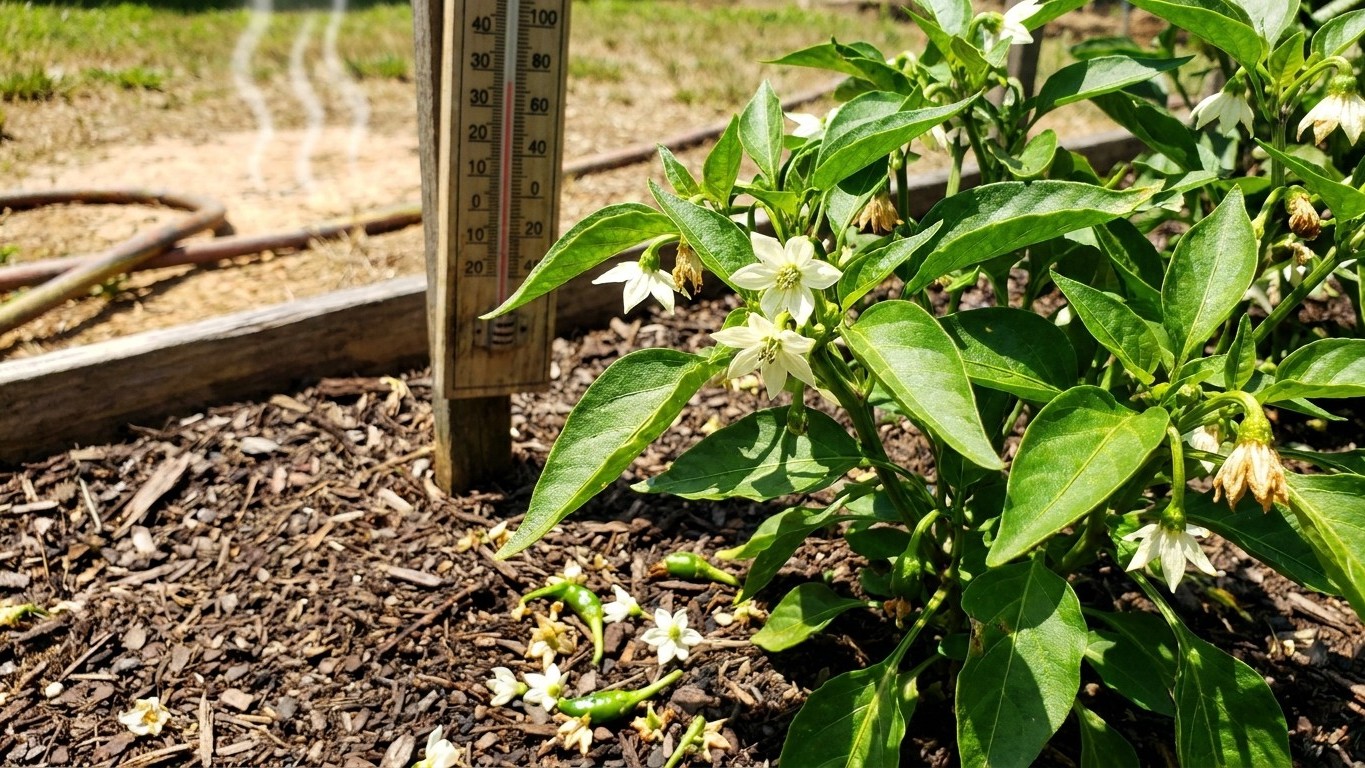

Peppers stop setting fruit in Maine mostly because of temperature, not soil or watering. The state rarely gets brutally hot (Portland averages just 3.8 days a year at or above 90 F), so heat-driven blossom drop is the rarer problem here. The more common culprit is the other end of the thermometer: nights that dip below 55 F, especially in late spring and again as fall closes in, which stall pollen viability and cause flowers to drop before they ever become fruit.
The short answer
Start with the number that actually describes a Maine summer: 3.8 days a year at or above 90 F, based on the NOAA NCEI Climate Normals for 1991-2020 at the Portland reference station. That’s a fraction of what growers deal with in the Mid-Atlantic or the Deep South, and it changes the whole conversation about pepper failure in this state. Extreme heat can still shut down fruit set on the handful of days it happens, since pepper flowers drop when daytime temperatures climb too high for pollen to stay viable. But because those days are so scarce here, heat is rarely the reason a Maine pepper patch comes up empty.
The heat side of the equation
On the rare 90-plus day, pollen can turn sterile and blossoms fall rather than setting fruit. If your plants drop flowers during one of those short heat spikes, that’s very likely the cause, and the fix is usually just patience: fruit set resumes once temperatures moderate again, which in Maine tends to happen quickly.
The cold side of the equation
The bigger risk runs the other direction. Pepper fruit set fails when nights fall below 55 F, according to Utah State University Extension, and Maine’s growing season is bookended by stretches where that threshold gets crossed regularly, both in early June and again in September. This site tracks daytime heat load by county, but it does not carry summer night minimum temperatures, and that’s a gap worth being honest about. Latitude alone won’t tell you what your nights actually do; a low-lying inland valley can run several degrees colder overnight than a coastal spot at the same latitude, and the reverse is true too. The only reliable move is to track your own overnight lows with a simple min-max thermometer in the bed where the peppers actually grow, rather than assuming a number based on where Maine sits on the map.
When to start seed here
Timing a pepper crop in Maine is really a subtraction problem, and it starts with two anchor points: the last spring frost and the 8 to 10 weeks peppers need indoors before they’re ready to go in the ground. Work backward from your local frost date and you get a seed-starting window that actually fits your county, rather than a generic date copied from a seed packet.
Do the math for your county
- Find your last spring frost date. For the Portland area, NOAA NCEI’s 1991-2020 climate normals put the 32 F freeze probability window at April 22 to May 1, which is the mildest stretch of the state.
- Add the requirement that soil, not just air, needs to reach 60 F before transplant, per Utah State University Extension. Cold, wet Maine soil in early May often lags well behind air temperature, so don’t transplant on the calendar date alone; check the soil with a probe thermometer first.
- Count backward 8 to 10 weeks from your expected transplant date to find your seed-starting window indoors. If soil hits 60 F around the third week of May in a coastal spot, that puts seed-starting somewhere in the second half of March.
- Adjust for your actual location, not the state average. Coastal Portland is the mild end of Maine’s climate; inland and northern counties run substantially later in spring and earlier in fall, which pushes both the transplant date and the seed-starting window later still.
- Build in a buffer week. Because soil warms slower than air in a state with this much cold groundwater and spring runoff, giving yourself an extra week before transplant is cheaper insurance than losing a set of transplants to a cold snap.
Adjust for inland and northern Maine
Everything above uses Portland as the reference point because that’s where the published NOAA NCEI normals sit, but it is the mildest corner of the state. If you’re gardening inland or farther north, treat April 22 to May 1 as an early-side estimate and push your transplant date later, since local frost risk in those areas runs past that window. There’s no substitute for tracking your own frost history if you’re outside the coastal band.
What goes wrong here
Maine’s specific mix of short warm-up, occasional heat spikes, and cool damp nights produces a fairly predictable set of pepper problems. Knowing which one you’re looking at saves a season of guessing.
Three ways heat and cold sabotage fruit set
- Blossom drop from a hot spell: On one of those rare days at or above 90 F, flowers can fall off before setting fruit because pollen loses viability in the heat. There’s little to do in the moment except keep plants watered and shaded from the harshest afternoon sun; fruit set typically resumes once temperatures ease back down, which doesn’t take long in a state where 90-degree days are scarce.
- Blossom drop from a cool night: Far more common in Maine, this happens when nights fall below 55 F, particularly in early June before the season has fully warmed or in September as it cools again. Row cover or a cold frame over young plants on chilly nights can buy enough warmth to keep flowers setting instead of dropping. Since night minimums aren’t published for this territory, watch your own thermometer rather than guessing from the calendar.
- Sunscald on exposed fruit: Strong midsummer sun can scald pepper skin, especially on plants that have lost leaf cover to wind, disease, or over-pruning. Maine’s sun is plenty strong enough to cause this even without extreme heat. Leaving foliage intact to shade developing fruit, rather than pruning peppers hard, is the simplest prevention.
- Blossom-end rot: This shows up as a sunken, leathery patch on the fruit’s bottom end and comes from inconsistent water reaching the plant, which disrupts calcium uptake, rather than from a calcium shortage in the soil itself. Maine’s pattern of heavy spring rain followed by drier summer stretches makes this a common complaint. Even, consistent watering, especially through dry weeks, is the fix that actually works, more than adding lime or calcium products to soil that likely already has enough.
Common questions
Do I need to hand-pollinate peppers in Maine?
Not usually. Pepper flowers are self-fertile and mostly wind- or insect-pollinated. The issue in Maine is rarely pollination itself; it’s temperature keeping pollen from being viable in the first place, at either the hot or cold end.
How long after flowering should I expect fruit?
Utah State University Extension notes that pepper development runs 35 to 45 days from flowering, not from when seed was started or transplanted. If flowers are forming but nothing follows within that window, temperature stress around bloom time is the likely explanation.
Can I start peppers earlier to beat Maine’s short season?
Starting indoors earlier than 8 to 10 weeks before transplant tends to produce leggy, stressed seedlings rather than an earlier harvest. The better lever is tracking your soil temperature closely so you transplant at the earliest safe moment, rather than pushing the indoor start date back further.
Does row cover fix cold-night blossom drop for good?
Row cover and cold frames help buffer a chilly night or two, but they won’t offset a sustained cold stretch. If nights are consistently running under 55 F for a week or more, expect some blossom drop regardless of cover, and plan on a second flush of flowers once temperatures stabilize.