
For most of Maine, early and mid-season potato varieties are the safer bet, since the state’s cool summers and short frost-free window favor potatoes that set tubers before the ground heats up. Late-season varieties can still do well in favorable spots, but the right call depends on where in Maine you’re planting and what you plan to do with the harvest, whether that’s baking, boiling, or storage. The University of Maine Cooperative Extension and Utah State University Extension both frame this choice around soil temperature, not the calendar.
The short answer
The short answer starts with a date, not a variety name. Portland’s last spring frost falls between April 22 and May 1, according to NOAA NCEI’s 1991-2020 Climate Normals. That range is already the mildest frost window in the state, since coastal Portland warms faster in spring than inland or northern Maine, where both the last spring frost and the first fall frost push later and earlier, respectively. Nobody has published exact dates for those inland locations here, but the direction of the shift is well established: a shorter, cooler season on both ends.
Neither the University of Maine Cooperative Extension nor Utah State University Extension publishes a specific “best variety” list tied to days-to-maturity numbers, and for good reason: no days-to-maturity figure appears in either source’s potato guidance. What both do publish is a planting rule tied to soil, not the thermometer on the porch. Potatoes go in the ground once soil temperature reaches 50 F, which lands 14 to 21 days before the local last frost date. In Portland, that means gardeners are working the soil weeks before that April 22 to May 1 window closes, not waiting for it.
This changes how “suits Maine” should be read. It isn’t really a question of which named cultivar wins a popularity contest. It’s a question of season class, early, mid-season, or late, matched against how much runway a given piece of Maine ground actually offers between a soil that’s warm enough to plant and a soil that’s too hot to keep filling tubers. For most of the state, that runway favors early and mid-season classes. Late-season potatoes aren’t ruled out everywhere, but they need the kind of long, mild stretch that’s more common near the coast than inland.
So the practical short answer is this: pick your season class based on your local frost timing and your local count of hot days, buy certified seed for whatever class you choose, and plant by soil temperature rather than by the date on a seed packet. The rest of this page walks through why that mechanism works the way it does, and how to apply it to a spot in Maine this page never specifically names.
What actually decides it
Two temperature thresholds bracket the entire potato season in Maine, and understanding both is what lets a gardener reason through a location this page doesn’t cover by name.
The cold edge: waiting for soil, not the thermometer
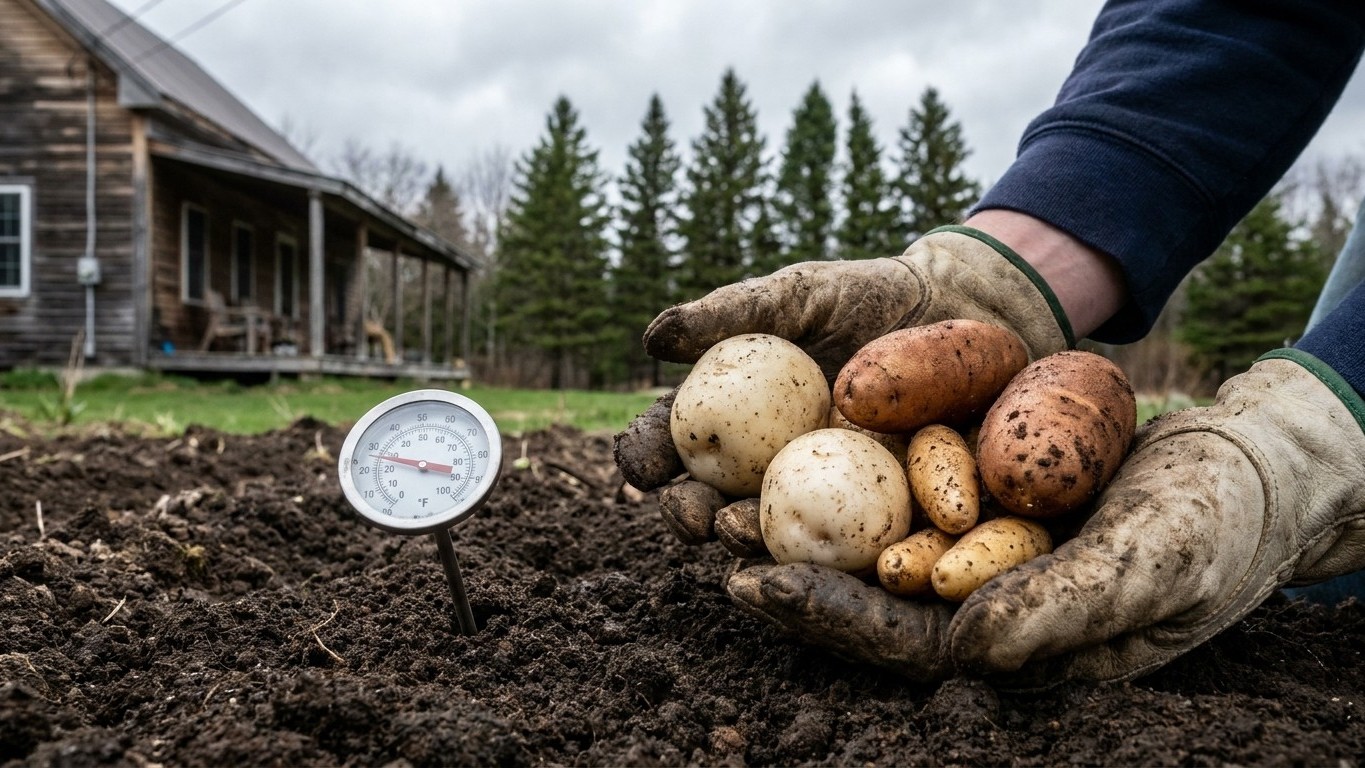
Potatoes aren’t planted on a fixed calendar date. They’re planted when soil temperature hits 50 F, and that moment typically arrives 14 to 21 days before the local last frost date, according to Utah State University Extension and the University of Maine Cooperative Extension’s Bulletin #2077. Seed potatoes and their sprouts can tolerate cooler soil and a light frost better than most garden vegetables, which is why the planting window opens well ahead of the frost-free date itself. In Portland, where the last spring frost runs April 22 to May 1 based on NOAA NCEI’s Climate Normals, that soil-temperature threshold is what actually triggers planting, not the frost date. A gardener working from a calendar alone, waiting for “frost danger to pass,” ends up planting later than necessary and shortens the growing window from the other end.
The heat ceiling: why late season struggles
The upper limit is less intuitive but just as firm: once soil temperature climbs above 90 F, tuber set and tuber fill are inhibited. This is the mechanism that decides the whole crop, and it’s the part gardeners tend not to guess correctly. Watering more doesn’t fix it. Shade cloth doesn’t reverse it once it’s happened. The tubers simply stop sizing while the soil stays that hot. What matters for choosing a variety is how many days a given location in Maine spends with soil above that 90 F line. Coastal Maine, moderated by ocean air, tends to see fewer of those days than inland valleys or southern interior Maine, where summer heat builds more persistently. Where the count of hot soil days is high, the answer isn’t to baby a long-season potato through summer. It’s to plant early, using the 50 F soil rule, and get an early or mid-season crop into the ground and out again before the heat ceiling becomes the limiting factor. A late-season class asks for a stretch of moderate heat that a hot inland spot in Maine may simply not offer most years.
| Location type | Last spring frost | Soil heat exposure | Season class that fits best |
|---|---|---|---|
| Coastal reference (Portland) | April 22 to May 1 (NOAA NCEI) | Fewer days above the 90 F soil ceiling | Early to mid-season reliably; late-season feasible in favorable years |
| Inland / northern Maine | Later than Portland (not published here) | More frequent high soil temperatures inland | Early season generally safer; dig before summer heat peaks |
How to do it
- Find your reference weather station and its published last spring frost date range, rather than relying on a memorized statewide date. Portland’s range, April 22 to May 1, only applies to that coastal reference point.
- Check actual soil temperature with a soil thermometer starting a few weeks before your expected last frost, watching for the point it holds at 50 F.
- Decide on a season class, early, mid-season, or late, based on how many high-heat soil days your specific location typically sees; more hot days pushes the decision toward early or mid-season.
- Buy certified seed potatoes for that season class rather than saving tubers from a previous harvest or a grocery store potato.
- Plant once soil hits 50 F, which lands 14 to 21 days before your local last frost date, not on the frost date itself.
- Track soil temperature through the growing season, especially heading into midsummer, so you know when the 90 F ceiling risk rises for your location.
- Dig early and mid-season potatoes before extended stretches of soil above 90 F set in, rather than leaving them in the ground to “finish.”
- Cure and store the harvest according to what the potato is meant for, whether that’s fresh baking and boiling use or longer storage.
What goes wrong
- Planting on the frost date instead of the soil temperature. Waiting for the calendar to clear the last frost date means missing the 14-to-21-day soil window that comes first. The remedy is a soil thermometer, checked directly in the planting bed, not an app or a printed date.
- Using saved or grocery-store potatoes as seed. Uncertified seed potatoes carry virus that can quietly reduce yield and vigor for the whole planting. The remedy is certified seed potatoes every season, sourced fresh rather than carried over.
- Choosing a late-season class in a hot inland spot. Where soil regularly climbs past 90 F, a late-season potato runs straight into the heat ceiling before it finishes filling tubers. The remedy is matching season class to local heat exposure, favoring early or mid-season where hot soil days are common.
- Applying Portland’s frost dates to a different part of Maine. The April 22 to May 1 window is specific to that coastal reference station and represents the mild end of the state. The remedy is checking data for the actual local reference station rather than borrowing one region’s numbers for another.
- Watering harder once soil gets too hot. Extra irrigation doesn’t reverse the tuber-set inhibition that starts above 90 F soil temperature. The remedy is timing the crop to avoid that heat window in the first place, not trying to out-water it once it arrives.
Common questions
Does the April 22 to May 1 frost date apply to all of Maine?
No. That range comes from NOAA NCEI’s 1991-2020 Climate Normals for the Portland reference station, and it represents the mildest end of Maine’s frost timing. Inland and northern parts of the state see later last-frost dates and earlier first-fall-frost dates, though this page doesn’t have published figures for those specific locations.
Can I rely on the days-to-maturity number printed on a seed catalog to plan my Maine planting?
Neither the University of Maine Cooperative Extension nor Utah State University Extension publishes a days-to-maturity figure for potato varieties, so treating a catalog number as a firm planning tool isn’t something these sources support. Working from the published season class, early, mid-season, or late, alongside your local frost dates and soil temperature is the approach both extensions back.
What does “certified seed potato” actually mean, and does it matter that much?
Certified seed potatoes are grown and inspected under programs designed to keep virus levels low, unlike potatoes saved from a home harvest or bought at a grocery store, which can carry virus without obvious symptoms. Since virus in seed potatoes quietly reduces vigor and yield, starting with certified seed each season is one of the simplest changes with an outsized effect.
If soil gets too hot in midsummer, does extra watering protect the tubers?
No. Once soil temperature climbs above 90 F, tuber set and fill are inhibited regardless of soil moisture, according to Utah State University Extension. The fix is timing, planting early enough by the 50 F soil rule and choosing a season class suited to how many hot soil days your location typically sees, rather than trying to compensate with irrigation once the heat arrives.