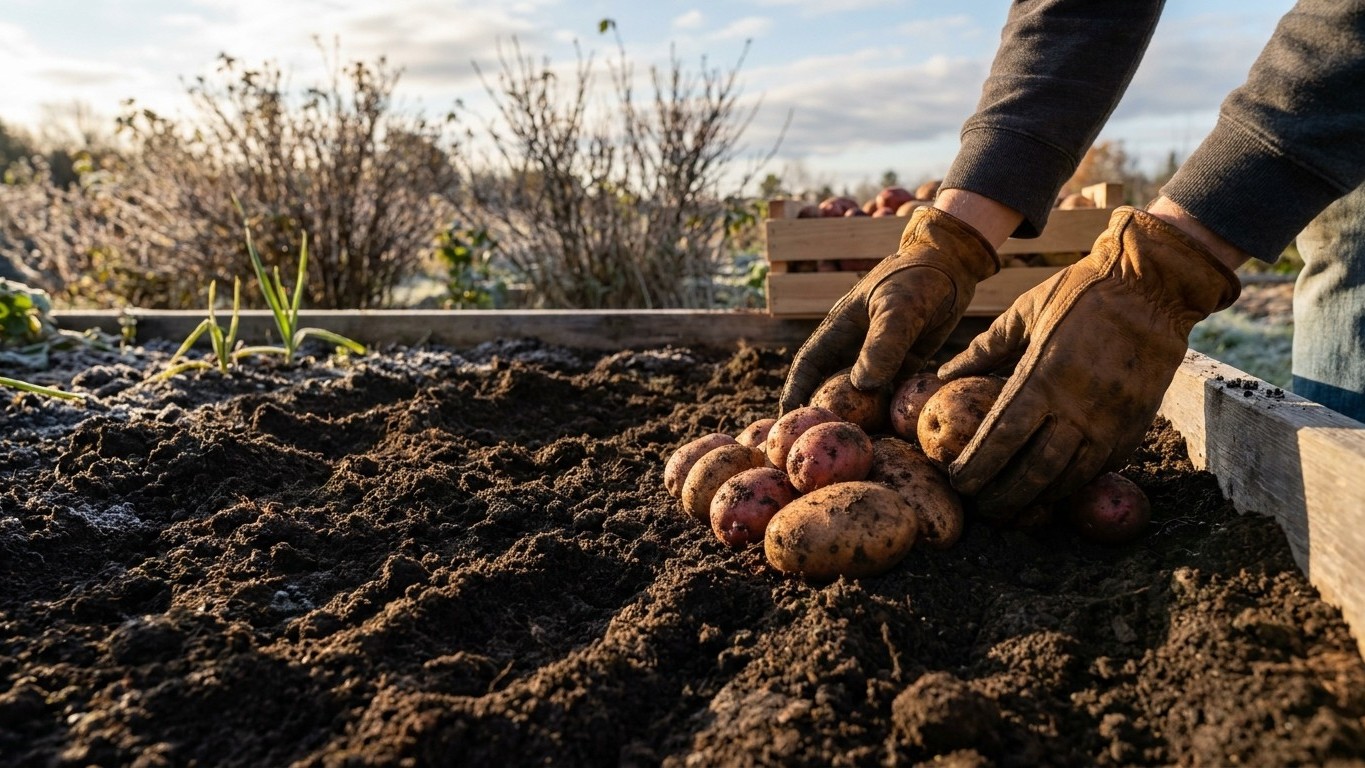

Maine’s short growing season, not its summer heat, is what shapes a potato harvest here. Portland averages just 3.8 days a year at 90°F or hotter, so tuber set almost never stalls from heat. The real constraint is a late, variable spring: the last frost falls between April 22 and May 1 near the coast, later inland. Plant by soil temperature, not the calendar, and match your variety’s season class to your county’s frost window.
The short answer

Two numbers decide how a potato season plays out in Maine, and neither of them is what most gardeners assume. The first is heat load: Portland’s reference station averages only 3.8 days a year reaching 90°F or higher, according to NOAA NCEI Climate Normals covering 1991-2020. That’s a fraction of what growers in the Southeast or Southwest deal with, and it means the season almost never runs hot enough to shut a potato crop down from heat alone. The second number is frost timing: the last spring freeze at that same coastal reference point lands somewhere between April 22 and May 1, based on NOAA NCEI’s 32°F freeze probability data. Inland and northern Maine push that window substantially later, sometimes by several weeks.
Put those two facts together and the picture is clear. Maine gardeners aren’t fighting summer heat, they’re racing a compressed spring-to-fall window bookended by frost on both ends. Utah State University Extension identifies the mechanism that matters most for potatoes everywhere: once soil temperature climbs above 90°F, tuber set and fill are inhibited, and no amount of watering reverses that. In a state where soil rarely if ever reaches that ceiling, the crop’s success depends almost entirely on knowing When to Plant Potatoes in Maine and choosing Potato Varieties That Suit Maine whose season class fits the number of frost-free weeks available, not on managing heat stress in July and August, and it carries through to Harvesting and Storing Potatoes in Maine once that compressed window closes.
Why the frost date matters more than the thermometer
A gardener in Georgia or Texas has to plan around dodging a 90°F soil ceiling. A gardener in Maine has to plan around a frost window that can shift by two to three weeks depending on elevation and distance from the coast. That changes the whole strategy: instead of racing to dig before summer heat arrives, Maine growers are racing to get seed potatoes into the ground early enough that the plant has time to bulk up tubers before fall frost ends the season. Season class becomes the tool for managing that timeline, not heat management.
| Season class | What it’s typically used for | Relevance in Maine |
|---|---|---|
| Early | Boiling, salads | Best fit for shorter inland or northern windows |
| Mid-season | Boiling, general use | Reliable choice along the milder coast |
| Late | Baking, storage | Needs the fullest possible frost-free stretch |
When to plant here
Seed potatoes go into the ground based on soil temperature, not a date circled on a calendar. Both Utah State University Extension and University of Maine Cooperative Extension point to the same threshold: soil at 50°F, which typically arrives 14 to 21 days before the last spring frost date. Here’s how to work that backward for your own location.
- Start with your last spring frost date. Near coastal Portland, that’s April 22 to May 1, per NOAA NCEI. Inland and northern counties run later.
- Subtract 14 to 21 days from that date. If your last frost falls around May 1, soil is likely to hit 50°F somewhere between April 10 and April 17.
- Confirm with an actual soil thermometer rather than guessing from air temperature alone. Soil warms slower than air, especially in clay-heavy ground or shaded plots.
- Once soil reads 50°F consistently for several days, seed potatoes can go in even though a light frost risk may still exist above ground; the seed piece itself is planted deep enough to be buffered from a mild freeze.
- Adjust the whole window later if you garden at higher elevation or well north of the coastal reference station, since those areas warm more slowly in spring.
This arithmetic is the same everywhere, only the frost date changes. A gardener in northern Maine simply plugs in a later last-frost date and shifts the entire planting window accordingly. There’s no fixed calendar date that works statewide, which is exactly why extension services publish the soil-temperature rule instead of a single planting day.
What the heat does to the crop
The mechanism here is simple and it applies everywhere potatoes are grown, not just in hot states. Once soil temperature climbs above 90°F, tuber set and fill are inhibited, according to Utah State University Extension. The plant may keep growing foliage, but the underground process that actually builds harvestable potatoes slows or stops. Watering more doesn’t fix it, because the problem isn’t drought stress, it’s the soil temperature itself interfering with the plant’s tuber-forming physiology.
In Maine, this ceiling is rarely tested. With an average of only 3.8 days a year reaching 90°F at the reference station, soil temperatures climbing high enough to stall tuber development are uncommon, especially since soil lags behind air temperature and rarely tracks an occasional hot afternoon all the way up to that threshold. That means Maine gardeners generally get to run a full-season crop, planted early per the soil-temperature rule and left in the ground through summer, rather than needing to treat potatoes as a spring-only crop dug out ahead of a hot stretch.
That’s a meaningfully different situation from a hot-summer state, where the smart move is often to plant as early as frost allows and dig before the soil ever approaches 90°F, accepting a shorter harvest window in exchange for avoiding the heat ceiling entirely. Maine’s climate removes that pressure. The trade-off is that the frost window on both ends is tighter, so the planting-date arithmetic above matters more here than heat management does.
What goes wrong here
- Planting uncertified seed potatoes. Grocery-store or leftover potatoes often carry viruses that certified seed is specifically inspected to avoid. A virus-infected seed piece can look fine and still produce a weak, low-yielding plant. Buying certified seed potatoes from a reputable supplier is the single easiest way to avoid this.
- Planting into cold, wet soil before it reaches 50°F. Seed pieces sitting in cold, saturated ground are prone to rot before they ever sprout. Waiting for the soil-temperature threshold, even if it means planting a bit later than a neighbor, protects the seed investment.
- Skipping hilling. Tubers that develop too close to the surface get exposed to sunlight and turn green, which means they’ve developed solanine and should not be eaten. Hilling soil up around the base of the plants as they grow keeps developing tubers covered and prevents this.
- Digging too early. Pulling potatoes before the plant has finished bulking tubers means smaller yields and thinner skins that don’t store well. Since Maine’s climate generally supports a full-season crop without a heat-driven reason to rush the harvest, there’s little upside to digging ahead of schedule here.
Checking this against your own county
A statewide frost window is a starting point, not an instruction for a specific garden. Elevation changes things fast: a plot a few hundred feet higher than the coastal reference station can run a week or more behind it in spring. The gap between southern Maine and the state’s northern counties is even larger, often stretching the last-frost date well past the coastal range of April 22 to May 1. Local microclimates, tree cover, and whether a garden sits in a low frost pocket all shift the timing further.
The most reliable way to pin down actual conditions for a specific address is to check with University of Maine Cooperative Extension, which tracks local frost data and planting guidance county by county. That resource, not a statewide average, should be the final word on when soil is likely to hit 50°F in a particular garden.
Common questions
Does summer heat ever stop potatoes from sizing up in Maine?
Rarely. With an average of only 3.8 days a year at 90°F or above at the Portland reference station, soil temperatures seldom climb high enough to hit the threshold Utah State University Extension identifies as the point where tuber set and fill are inhibited. Most Maine gardens run a full-season crop without hitting that ceiling.
How do I know when my soil has actually reached 50°F?
Use a soil thermometer inserted a few inches into the planting bed, checked over several consecutive days rather than relying on a single warm afternoon. Air temperature alone isn’t a reliable stand-in, since soil warms more slowly, particularly in shaded or clay-heavy ground.
Should I choose an early, mid-season, or late variety?
That depends on how long your frost-free window runs. Shorter windows, common inland or in northern counties, favor early-season varieties. Along the milder coast, mid-season and late varieties have more room to finish. Neither Utah State University Extension nor University of Maine Cooperative Extension publishes a days-to-maturity figure, so season class, not a specific day count, is the guide to use.
Is certified seed really necessary, or can I plant a store-bought potato?
Certified seed matters because uncertified seed potatoes commonly carry viruses that reduce vigor and yield without always showing obvious symptoms. Starting with certified seed removes that risk before the season even begins.