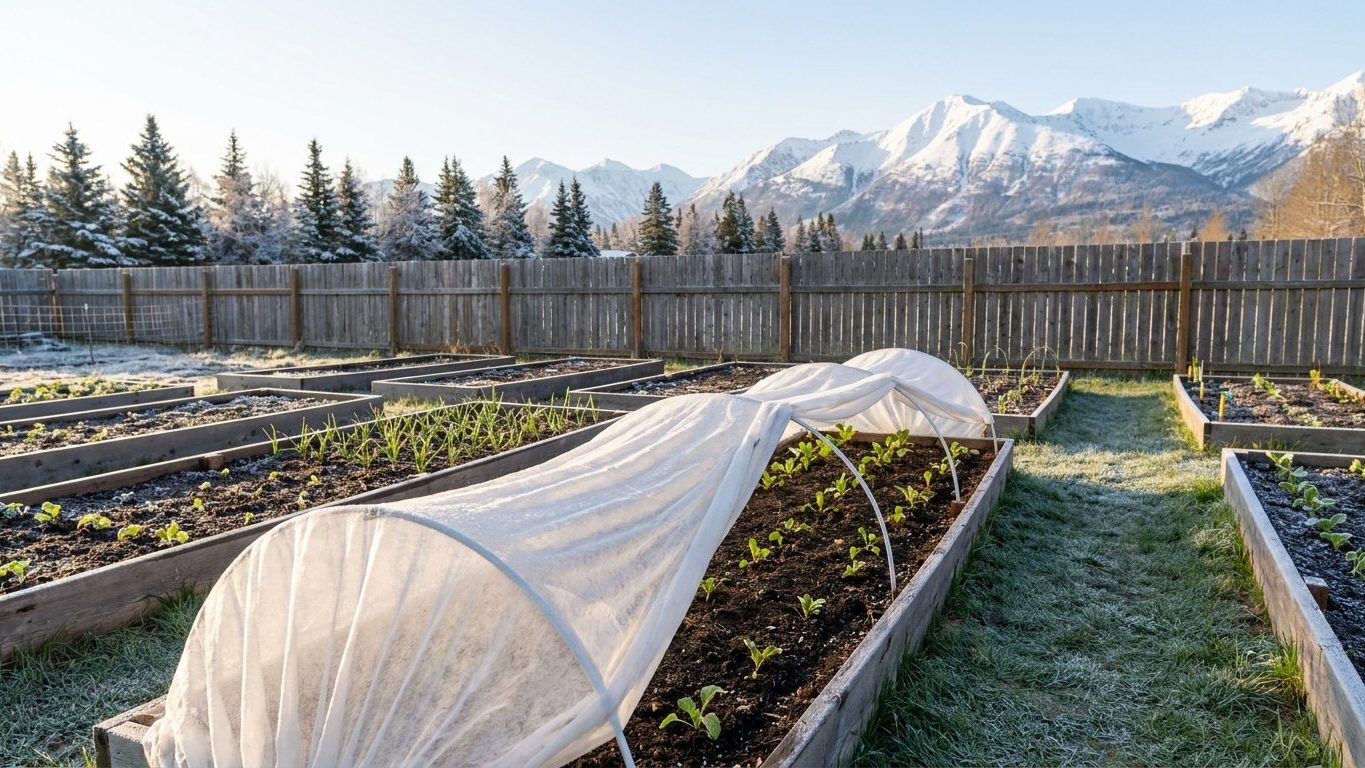

Cover tender plants any night the forecast calls for a freeze, which means 32°F or lower. In coastal Portland, the odds of that freeze stay meaningful from April 22 to May 1 in spring and begin again between October 9 and October 21 in fall. Inland and northern Maine run later in spring and earlier in fall, so the covering season there is longer at both ends.
The short answer for Maine
Those Portland dates are a probability, not a deadline. They come from NOAA’s 1991-2020 Climate Normals and mark the stretch in which the chance of a 32°F freeze falls in a band between 30 and 70 percent (NOAA NCEI data for the Portland station). Inside that stretch, a freeze is neither unlikely nor certain, and that is exactly why a cover is cheap insurance. Before April 22, a freeze is more likely than not. After the spring window, it becomes less likely but never impossible.
The mechanism behind a frost cover is simple. Soil stores heat during the day and gives it back at night, and fabric or plastic traps part of that heat near the plants. The cover buys a few degrees, enough to carry tender leaves through a night that dips to freezing, but not enough to carry them through a hard freeze.
Spring: late April through the first week of May, and beyond
Anything planted out before the window closes needs a cover on hand. Watch the forecast, and cover at dusk on any night predicted near 32°F. Clear, calm nights are the dangerous ones, because leaf surfaces can run colder than the thermometer reading. Take covers off the next morning once the air warms, so plants don’t overheat and so pollinators can reach flowers.
Fall: from the second week of October
The fall window works the same way in reverse. A first light freeze often arrives, then several mild weeks follow. Covering tender crops through that first cold snap can extend harvests by weeks. The table below sorts plants by how much cold they tolerate and when a cover earns its keep.
| Crop group | Examples | When to cover |
|---|---|---|
| Tender | Tomatoes, peppers, basil, cucumbers, squash, beans | Any forecast near 32°F, spring and fall |
| Half-hardy | Lettuce, chard, beets, potatoes (foliage) | Hard freezes, or a freeze after new growth has emerged |
| Hardy | Kale, spinach, carrots, leeks, peas | Deep cold, wind, or to keep growth going into late fall |
What will not work here
Planting tomatoes in early April under plastic fails. Even if a cover holds the air above freezing, it does little for cold soil, and roots sitting in cold ground stall and turn purple. Since the spring freeze window in Portland runs to about May 1 at its mild end, a cover can nudge planting a couple of weeks earlier but cannot turn April into June.
The season is also too short for slow warm-season crops, even with help. Between the end of the spring window and the start of the fall one, coastal Portland has roughly five to six months, and inland gardens have less. Long-maturing melons, sweet potatoes, and late peppers that need every warm day are gambles on that clock. A cover adds a couple of weeks at each end, and that is only useful when the variety already fits the season.
Winter is where expectations most often outrun the climate. The mean daily minimum in the coldest month is 15.6°F at the Portland station, and that is the mild end of the state. At those temperatures a low tunnel with no heat does not keep tender plants alive. It keeps hardy crops such as kale, spinach, and carrots from being killed outright. Growth largely stops anyway. At 43.65 degrees north (Portland’s latitude), daylight in midwinter is too short to push much leaf growth, whatever the cover. Plan on storing a winter crop, not growing it.
Several other things go wrong in practice:
- Plastic left sealed on a sunny spring day can cook seedlings within an hour or two.
- Wet snow collapses hoops that are spaced too widely or built from flimsy material.
- Coastal wind lifts lightweight fabric unless the edges are buried or weighted down.
- Covers left on for days in damp weather invite slugs and fungal disease.
What holds up depends on the structure, and the comparison is covered in Which Season Extenders Work in Maine. The rule that never changes is that a cover is a few degrees of insurance. It is not a way to turn the calendar.
What changes across Maine
Maine is not one garden. The USDA Plant Hardiness Zone Map (2023 edition, built on 1991-2020 normals) places the state in zones 3b through 6a. That is a spread of several zones, and the zone number is based on a single variable, the average annual extreme minimum temperature. So there is no single answer for the whole state. The Portland dates above describe the coastal edge, and most of the state differs from them.
Moving inland or north, shift both ends of the calendar. Spring freeze risk lasts later, and fall freeze risk arrives earlier. A gardener in the northern part of the state should assume the covering season starts and ends noticeably outside the Portland window, and should lean toward hardier crops and shorter-season varieties. Portland sits at 43.65 degrees north. The northern tip of the state is several degrees farther north, where days shorten faster in fall and growth under cover slows sooner.
Altitude and terrain matter almost as much as latitude. Cold air is heavy and drains downhill on still nights, so a low spot at the bottom of a slope or in a hollow can frost while a bed higher up stays clear. Hilltops get wind and exposure, while valley bottoms get frost pockets. Near the coast, the ocean moderates temperatures, and a few miles inland that buffer disappears.
To find your own zone, use the USDA Plant Hardiness Zone Map and look up your ZIP code rather than guessing from a neighbor’s garden. The overall approach to stretching the season is laid out in Extending the Growing Season in Maine.
Where to check this for your own county
The state’s land-grant extension service is the right next stop. University of Maine Cooperative Extension runs county offices and publishes gardening resources written for Maine conditions. Two things to look for there:
- The local planting calendar, which gives frost dates and sowing windows for your part of the state, not an average across all of it.
- The varieties trialled in your county, meaning cultivars actually grown and evaluated under local weather, which beat anything chosen from a seed catalog description.
A county recommendation beats a state one. A state-level guide has to average over coastal towns, river valleys, farmland, and mountain areas, and that average fits none of them exactly. Treat the Portland window here as a starting reference and an outer frame, then let the county calendar refine it. The extension office can also tell you about local conditions, such as late frosts in a particular valley or the pests that arrive in a damp spring.
If you have a specific problem, such as a tunnel that keeps collapsing or seedlings that rot under fabric, extension staff and Master Gardener volunteers answer questions about exactly that. A short call or email usually gets a more useful answer than a general web search.
Checking this against your own garden
Your own observations outrank every date on the calendar. Three signs, all free, tell you more about your garden than a regional average does.
Soil warmth by feel. Push your hand into the bed to the depth of a seed or transplant root ball. If it feels distinctly cold and makes your fingers ache after a minute, the soil is not ready for warm-season crops, whatever the date says. A bed that warms earlier than a neighbor’s, such as one against a south-facing wall or on a slope, is telling you its microclimate runs warmer. A bed that stays cold long after others have warmed sits in a cooler pocket and needs a later start.
The first true leaves. Seedlings first show seed leaves, and the first true leaves follow. Note how many days that takes after sowing, and how it compares from one bed to another. Fast, sturdy growth means the bed is warm enough. Slow, pale, or stalled seedlings mean the soil or air is still too cold, and a cover or a delay is the better call.
The first flush of male flowers. Squash, cucumbers, and melons produce male flowers before female ones. When the first males open, you can see how far the season has actually come in your garden. If they arrive late, there is less time left for fruit to ripen before the fall window opens, which argues for earlier varieties next year and for covers in October.
Keep a few dated notes each year: when the soil felt warm, when the first true leaves appeared, when the first male flowers opened, and the dates of your last spring and first fall freezes. After two or three seasons, those notes will serve you better than any published window.
Common questions
Should I cover plants when the forecast is 34°F?
For tender crops, yes, especially on a clear, calm night. Leaf surfaces can lose heat to the open sky and end up colder than the air temperature, so frost can form on foliage even when the thermometer reads a few degrees above freezing. Hardy crops such as kale and spinach usually do not need it.
Do the Portland frost dates apply across Maine?
No. April 22 to May 1 in spring and October 9 to October 21 in fall describe coastal Portland, the mild end of the state. Inland and northern gardens have later spring freezes and earlier fall ones, so those windows start later and end sooner.
Can I leave a cover on all the time?
Fabric row cover can stay on for days in cool weather, but plastic cannot. Vent plastic on sunny days, and remove covers from crops that need pollination once flowers open. Check under covers for slugs and mold during damp weeks.
Will a cover keep a winter garden growing?
Not in Maine. Even at the Portland station, the mean daily minimum in the coldest month is 15.6°F, and winter daylight is short. A cover helps hardy crops survive, but it does not make them grow. For growth in cold months, plan on heated space or on storing the fall harvest.