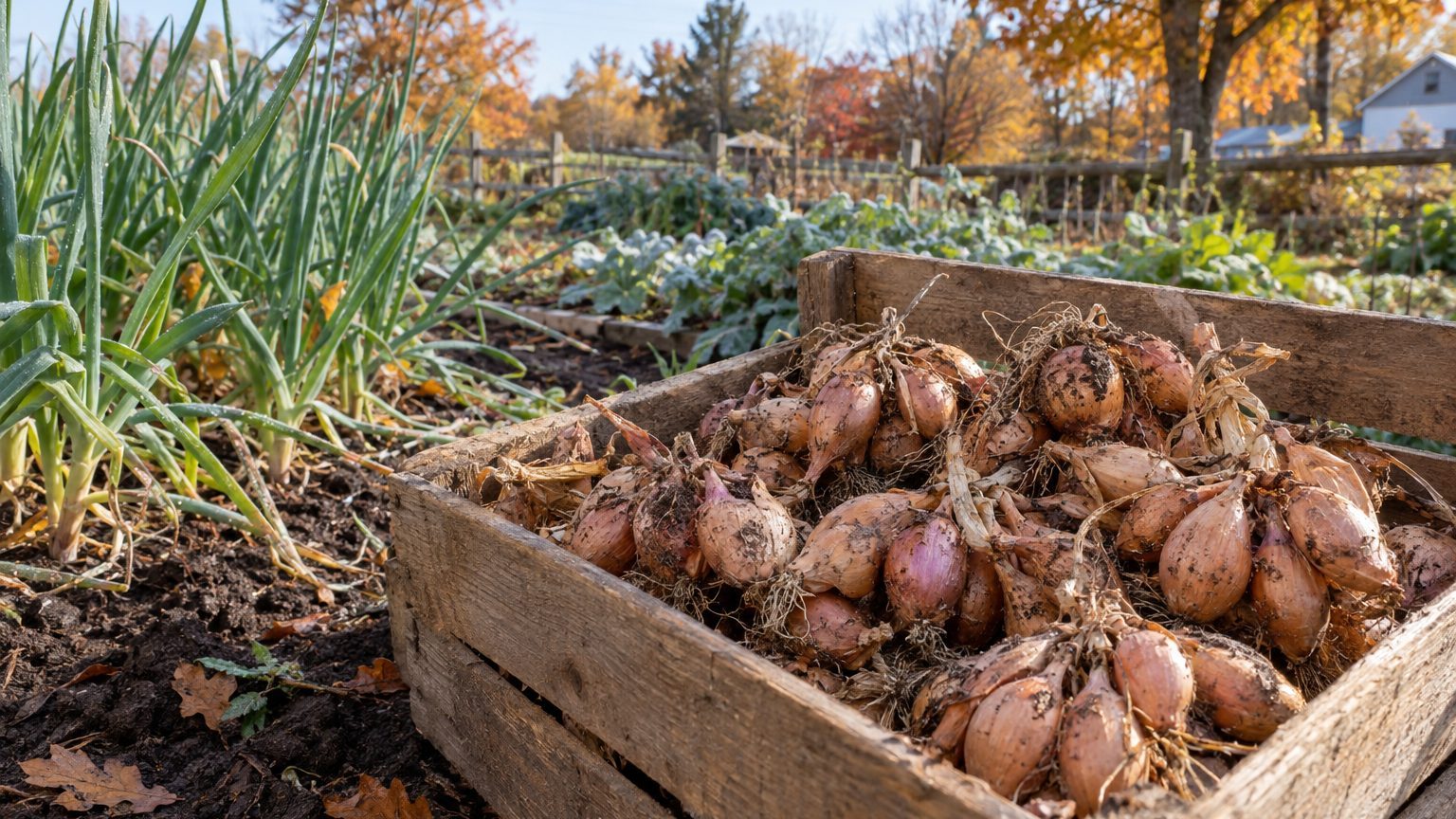

For most Maine gardens, the best shallots are the multiplying kind grown from bulbs, planted in fall or very early spring, not the seed-grown types that need a long, warm run. The season is short and the winters are hard, so the winner is whichever type finishes before the weather turns and shrugs off the cold in between. This page has no Maine variety-trial data, so it sorts by type rather than by name.
The short answer for Maine
Choose multiplier shallots, the ones that grow from a single bulb into a cluster, and plant them as bulbs. Treat seed-grown shallots as the second choice, reserved for gardeners willing to start them indoors early and accept some risk. That is the decision for Maine as a whole. It comes from two numbers: how much season there is, and how cold the winter gets.
Start with the season. At Portland, the reference station, NOAA’s 1991-2020 Climate Normals put the last spring frost at April 22 to May 1 and the first fall frost at October 9 to October 21. Those are not promises of a date. Each range is the 30 to 70 percent band of 32°F freeze probabilities, meaning the stretch of days when the odds of a freeze are neither remote nor near-certain. Before the early end of the spring range, a freeze is still more likely than not. After the late end, it has become unlikely. Shallots tolerate light frost far better than tomatoes do, so the dates matter more for when the soil is workable than for when the plants are at risk.
Then the winter. The mean daily minimum of Maine’s coldest month at Portland is 15.6°F. That is the figure that decides whether a fall-planted bulb lives through winter, and it is a coastal number. A bulb that sits under mulch at that temperature is in a very different position from one that sits bare through a thaw-and-freeze cycle.
| Type | How it is planted | Fit for Maine |
|---|---|---|
| Multiplier shallots from bulbs, fall-planted | Late fall, mulched | Best bet. Roots set before freeze-up and growth starts as soon as the soil thaws. |
| Multiplier shallots from bulbs, spring-planted | As soon as the soil can be worked | Reliable, and the sensible choice when fall planting was missed. |
| Seed-grown shallots | Started indoors, transplanted | Workable with early starts, but tighter on time and more effort. |
Our Growing Shallots in Maine page covers the full growing routine, and When to Plant Shallots in Maine turns these frost ranges into planting windows. Here the question is narrower: which type earns a spot in the bed.
What will not work here
Slow shallots fail first. A type that needs a long, warm stretch to bulk up has only the gap between the last spring frost and the first fall frost to do it, and in Maine that gap shrinks fast once you leave the coast. Portland is the mild end of the state. Inland and northern Maine run substantially later in spring and earlier in fall, so a variety that squeaks through on the coast can run out of days a short drive away.
Seed sown directly into the garden is the clearest example. Shallots from seed start tiny, and sowing outdoors in May, after the soil finally warms, leaves them little time to size up before autumn. Gardeners who try it often end up with small bulbs. Starting seed indoors recovers part of that lost time, but it is extra work compared with simply tucking bulbs into the ground, and the bulbs have a head start in any case.
Planting fall bulbs at the wrong moment also fails, in two opposite ways. Plant too early and the bulbs send up top growth that a Maine winter, with its 15.6°F average coldest-month minimum on the coast and far worse inland, can burn back. Plant too late and the roots never anchor before the ground freezes, so freeze-thaw cycles can push the bulbs toward the surface. Neither problem shows up in a mild winter, which makes both easy to underestimate.
Fall planting without mulch is the next mistake. A bare bed in Maine takes the full swing of cold snaps and thaws. A layer of straw or leaves over the planted bed keeps the soil temperature steadier, and it is cheap insurance in a state where winter is the longest season.
Finally, copying Portland dates across the whole state will fail more often than any variety choice. The frost dates on this page describe one coastal station. A gardener in the northern part of the state who plants on the Portland schedule will be working frozen ground in April and may lose a fall planting to an early freeze. The shallot type is only half of the decision. The date has to belong to the right place.
One more failure is quieter. Buying “shallots” without knowing the type, such as grocery-store bulbs of unknown origin, gives you no idea how they will handle Maine’s length of season. Plant stock sold for planting, from suppliers who describe the type, and you at least know whether you are growing a multiplier or a seed-grown line.
What changes across Maine
Maine is not one garden. The USDA Plant Hardiness Zone Map (2023 edition, built on 1991-2020 data) puts the state in zones 3b to 6a. That is a wide spread, and it means there is no single answer for the whole state. The zone system rests on one variable only, the average annual extreme minimum temperature, so it tells you about winter survival and says nothing about how long the growing season runs or how warm summer gets.
For shallots, that spread has practical consequences. Toward the warmer end, along the coast, fall planting with a modest mulch is a comfortable plan, and spring planting can start early. Toward the colder end, in the north and at higher elevations, the same bulbs need heavier mulch, and the planting dates slide: spring planting later, because the soil thaws later, and fall planting earlier, because the ground freezes sooner. A northern gardener should also lean harder toward the fastest-maturing multipliers and away from seed-grown shallots, where the short season leaves no room for error.
Elevation matters even within one zone. Cold air drains downhill and collects in low spots, so a hollow can frost when a slope a few feet higher does not. The zone map cannot see that, and neither can a state page.
I will not tell you which zone you are in. Look up your own location on the USDA Plant Hardiness Zone Map, which lets you search by ZIP code, and read the result as a starting point for winter survival, not as a planting schedule. Pair it with the frost dates for your nearest station, keeping in mind that the dates here are from Portland and sit at the mild end.
Where to check this for your own county
The best next stop is University of Maine Cooperative Extension, the state’s land-grant extension service. It is the source for advice tied to local conditions, and it has staff who work with gardeners county by county.
Look for two things there. The first is a local planting calendar, ideally one written for your county or region, with dates for fall and spring planting of alliums. The second is a record of which varieties have been trialled nearby. A variety that performed well in a trial plot in your part of Maine is better evidence than any general type recommendation, including the one on this page. If the extension has no shallot-specific trial, ask about garlic and onion results, since the timing and hardiness pressures are similar even if the crop differs.
Be clear about what this page is. It is the state-level view, built from one coastal reference station and a statewide hardiness range. A county recommendation beats it, because a county recommendation reflects the soil, the elevation and the frost pattern where you actually garden. When the two disagree, go with the county.
This page also does not have a Maine extension calendar for shallots in hand, and it says so instead of borrowing one from another state. A calendar built for another state’s frost dates or winter minimums would give you the wrong answer. If you cannot find a Maine calendar, ask the extension’s gardening help line or a local master gardener what they recommend for your town.
Checking this against your own garden
Your own observations outrank every date on this page. Three are worth watching, and none needs equipment.
Soil warmth, by feel. In spring, push a bare hand into the bed a few inches down. If the soil still feels cold and clings in a wet clump, planting can wait a week. If it crumbles and no longer numbs your fingers, shallots can go in. Done in the same spot each year, this tells you how quickly your site warms compared with a neighbor’s, which is your microclimate speaking.
First true leaves. If you start seed-grown shallots indoors, watch when the first true leaves appear after the thin seedling blades. How long that takes under your window or lights tells you whether your indoor start is on pace for transplanting, and it gives you a personal timetable that no state calendar can supply.
Your first frost, and your last. Note the date of the first frost that blackens tender plants in fall and the last one in spring, and compare them with the Portland ranges. If your frosts arrive earlier or linger later, as they often do inland, shift your planting dates to match. Frost that appears in your low corner but spares the slope tells you where to put the bed.
After a season or two of these notes, you will have a local calendar more reliable than any statewide one.
Common questions
Should I plant shallots in fall or spring in Maine?
Fall planting of bulbs, with mulch, is a strong choice because roots establish before winter and growth starts early. Spring planting works too, as soon as the soil can be worked. Your county’s frost pattern should set the exact timing.
Can I grow shallots from seed in Maine?
Yes, but it is the riskier route. The season leaves little margin, so seed needs an early indoor start, and the bulbs tend to be smaller than those from planted bulbs.
Will shallots survive a Maine winter?
Mulched, fall-planted bulbs generally do. Portland’s coldest-month mean daily minimum is 15.6°F, and much of the state is colder, with hardiness zones running from 3b to 6a. Heavier mulch matters more the farther north or higher you garden.
Which named variety is best for Maine?
This page does not have Maine variety-trial data, so it will not name one. Ask University of Maine Cooperative Extension what has been trialled in your county, and buy multiplier bulbs sold specifically for planting.