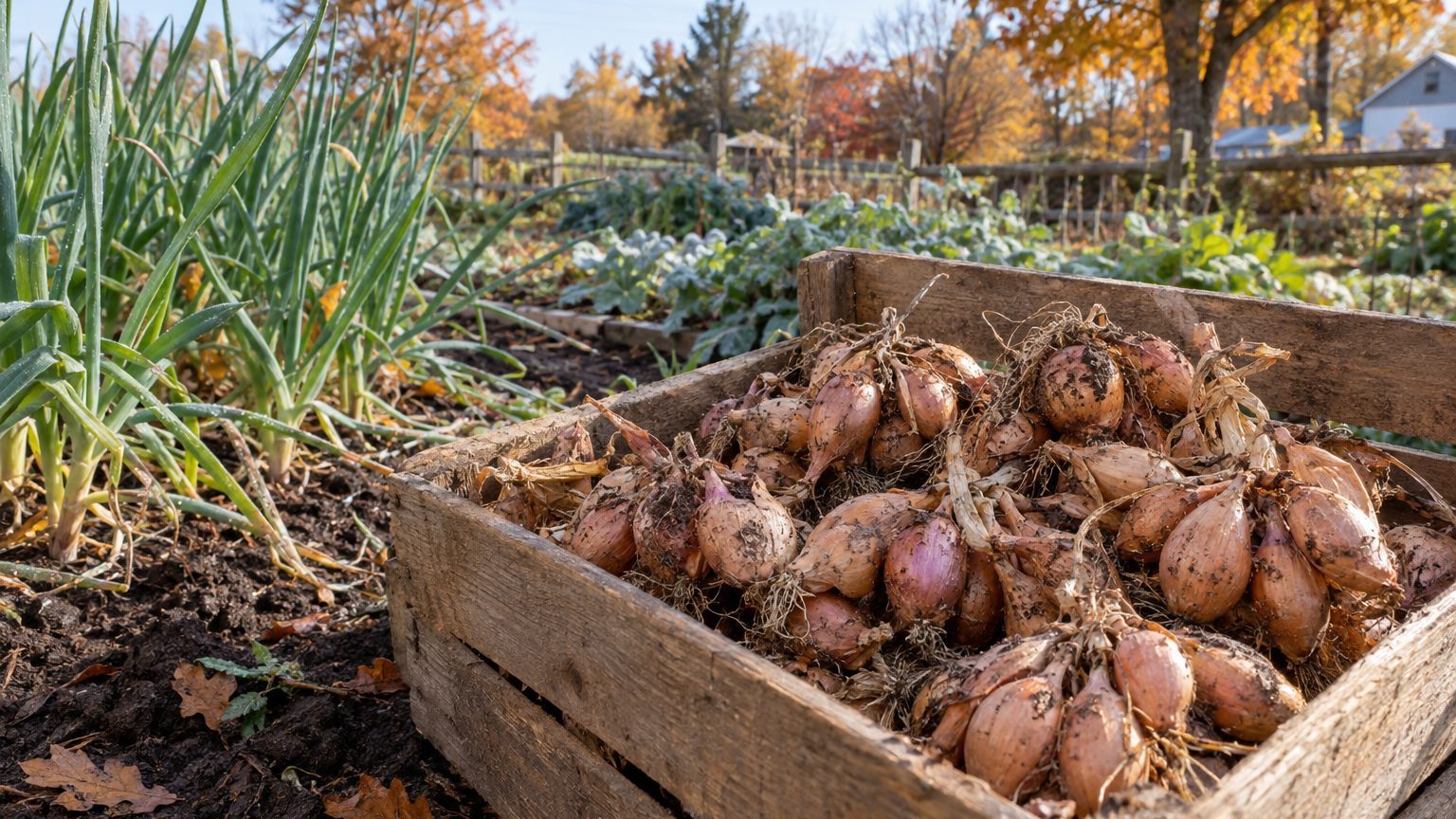

For most Minnesota gardens, the best shallots are multiplying types grown from bulbs. Plant them in fall under mulch, or in spring as soon as the soil can be worked. Seed-grown shallots can succeed, but only with an early indoor start. This page has no county trial data, so it ranks types rather than named cultivars, and the season numbers below explain why.
The short answer for Minnesota
Pick bulb-grown multiplying shallots first, and plant them early. Treat seed-grown shallots as a second choice that needs seedlings started indoors well ahead of the last freeze.
The Twin Cities dates behind the answer
The reference numbers come from NOAA’s 1991-2020 Climate Normals for the Twin Cities. The last spring frost falls between April 17 and April 30. The first fall frost falls between October 11 and October 23. These dates are a probability of a 32°F freeze, not a guarantee. Within each window, the chance of a freeze runs between 30 and 70 percent. A freeze on May 5 is unusual but not impossible, and one on October 5 is rarer still but happens.
Counting from the later spring date to the earlier fall date gives about 164 days. Counting from the earlier spring date to the later fall date gives about 189. That is the span a Twin Cities gardener has, and it’s the mild end of the state. A shallot started from a bulb skips the slow seedling stage, so it uses that span far better than one started from seed. Alliums also shrug off light freezes while young, which means you don’t need to wait for the spring window to close before planting.
Choosing by type
| Type | How it’s started | Fit for Minnesota | Main catch |
|---|---|---|---|
| Multiplying shallots, spring-planted | Bulbs, as soon as soil is workable | Best all-round choice, especially in the north | Planting late shortens the growing time |
| Multiplying shallots, fall-planted | Bulbs, mulched before the ground freezes | Good in the milder south with heavy mulch | Winter cold and freeze-thaw heaving |
| Seed-grown shallots, started indoors | Seed, transplanted in spring | Workable if started early | Needs indoor space and early timing |
| Seed-grown shallots, direct-sown | Seed in the garden | Poor fit | Too slow for the season |
For timing details, see When to Plant Shallots in Minnesota. For the full growing picture, Growing Shallots in Minnesota covers the rest.
What will not work here
Direct-sown seed shallots lose the most ground. They have to sprout, grow thin seedlings, and then bulb up, all inside a window of roughly 164 to 189 days between freezes in the south. In the north, where the season runs two to three weeks tighter at both ends, the slowest types may never finish bulbing before fall.
Waiting for the last frost
Some gardeners hold off planting until the last frost has passed. In Minnesota that wait costs weeks. The Twin Cities window runs to April 30, and further north it runs later. Shallot bulbs set into workable soil can sit through a cold snap. Planting in mid-May because the calendar felt safe leaves the crop with less time and hotter weather during the bulbing stage.
Fall planting without protection
The coldest month at the Minneapolis reference station has a mean daily minimum of 8.8°F. That is an average, so individual nights run colder. A shallot bulb set into bare soil in fall can be pushed out of the ground by repeated freezing and thawing, or can die in a snow-poor winter. Fall planting works when bulbs are set deep enough to root before the ground freezes and then covered with a thick layer of mulch. Planting too close to the first fall frost, which arrives October 11 to October 23 in the Twin Cities and earlier up north, leaves too little time for roots to form.
Advice written for warmer states
Much of the shallot guidance online assumes mild winters and long falls, where fall planting is the default and the main risk is summer heat. Minnesota has the opposite problem, with a short season and a hard winter. Following a southern calendar here puts bulbs in the ground at the wrong time and expects a crop on a clock Minnesota does not run. A fix for each problem exists, but only if you start with local dates.
What changes across Minnesota
Minnesota does not have a single hardiness zone. The USDA Plant Hardiness Zone Map (2023, built on 1991-2020 normals) places the state between zone 3a and zone 5a. That is a wide spread for one state, and it means no single recommendation fits everyone.
The zone is built on one variable, the average annual extreme minimum temperature. It tells you how cold the worst nights get. It does not tell you how long the season is, when the last freeze arrives, or how wet the spring runs. Two gardens in the same zone can have different frost dates, and a garden on a south-facing slope can behave like one a zone warmer than its neighbor in a low spot where cold air settles.
The Twin Cities are the mild south of the state. Northern Minnesota runs two to three weeks tighter at both ends of the season, meaning spring comes later and fall frost arrives earlier. A reader in the north should shift everything accordingly: plant in spring rather than fall, favor bulb-grown multipliers over seed-grown types, and treat any fall planting as a gamble that needs deep mulch. A reader in the southern counties has more room to try fall planting, and more room to start seed-grown shallots indoors.
Which zone applies to your garden is something to check on the USDA Plant Hardiness Zone Map itself rather than guess from this page. Enter your ZIP code there, then compare the result with the Twin Cities dates above and adjust. Snow cover also matters. A reliable blanket of snow insulates bulbs, so a snowy northern garden can overwinter plants that a windswept, bare one cannot.
Where to check this for your own county
The best next stop is University of Minnesota Extension, the state’s land-grant extension service. Its staff and Master Gardeners work with county-level conditions that a state page can’t capture.
Look for two things. The first is a local planting calendar for onions and their relatives, built for your part of the state rather than the Twin Cities. The second is any list of varieties trialled in your county or a neighboring one, since trial results show which shallots actually finished bulbing and stored well in local conditions. Ask whether fall planting is recommended where you live, and what mulch depth they suggest.
Be aware that a county recommendation beats a state one. This page is the state one. It rests on Twin Cities climate normals, a single reference point, and it covers a state that spans three hardiness zones. It does not have a county planting calendar or county variety trials, and it can’t tell you which named cultivar did best on your soil. If Extension staff or a nearby trial garden give you a different date or a different variety, go with theirs.
Then write down what you plant and when. A simple log of planting dates, first shoots, and harvest dates will tell you more about your garden than any regional table.
Checking this against your own garden
Your own observations outrank every date on this page. Three are worth watching, and none needs equipment.
- Soil warmth by feel. In early spring, push a hand into the bed. If the soil crumbles instead of clumping and doesn’t feel cold and heavy, it’s workable. A bed that reaches that point days before a neighbor’s is warmer, better drained, or better sheltered, and can be planted earlier.
- First green shoots. Note the day the first green tips show above the soil on fall-planted or early spring bulbs. A late emergence suggests a cold pocket or heavy soil, and next year you may want to plant even earlier or choose a different spot.
- First true leaves on seedlings. For seed-grown shallots, watch when true leaves appear after the thin grassy first blades. Slow development points to a cool or dim start indoors, which means starting seeds earlier next year.
After a season or two of notes, your garden’s pattern becomes clearer than any state average. A bed that always runs ten days ahead is a different place from one that never quite warms up, even in the same yard.
Common questions
Can I grow shallots from seed in Minnesota?
Yes, but start them indoors early and transplant in spring. Direct-sown seed is a poor fit, especially in the north, where the season is two to three weeks tighter at both ends than in the Twin Cities.
Is fall or spring planting better?
Spring is the safer choice statewide, and it’s the better one in the north. Fall planting can work in the milder south if bulbs root before the ground freezes and are covered with mulch. The coldest-month mean daily minimum at the Minneapolis station is 8.8°F, so protection matters.
Is there one best shallot variety for Minnesota?
This page does not have county trial data, so it can’t name one. The decision it can support is by type: bulb-grown multipliers first, seed-grown types only with an early indoor start. For named varieties, check what University of Minnesota Extension lists for your county.
Do the frost dates mean I can’t plant before them?
No. The April 17 to April 30 window is the range where a 32°F freeze has a 30 to 70 percent chance in the 1991-2020 Twin Cities normals. Shallot bulbs tolerate light freezes, so planting once the soil is workable is reasonable, even inside that window.