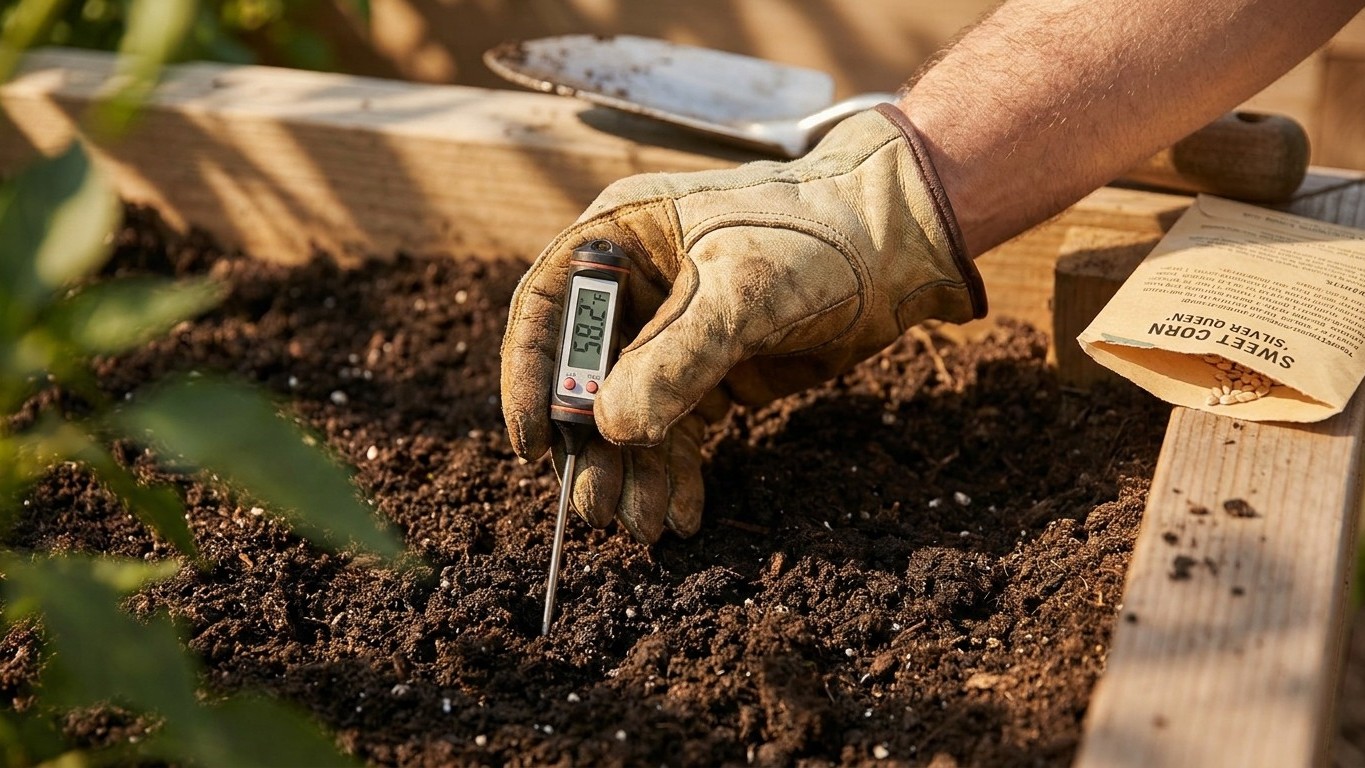

Sweet corn in Maine goes into the ground once the soil itself is warm, not once frost risk has passed. That means waiting past the last spring frost window of April 22 to May 1, and choosing a variety whose 60 to 90 day maturity clock can still finish before the first fall frost, which arrives between October 9 and October 21 depending on where you garden.
The short answer
Here’s the part gardeners miss: the soil doesn’t warm on the same schedule as the air. Maine’s last spring frost falls between April 22 and May 1, but sweet corn seed needs soil holding steady above 60°F to germinate well, and that threshold typically isn’t reached until well after that frost date has passed. Planting into cold, wet soil right after the frost risk clears is one of the most common ways sweet corn stalls in this state. The 60°F mark, not the frost date, is the real starting gun.
Once soil temperature clears that bar, the question becomes whether a 60 to 90 day maturity window still fits before the first fall frost. The table below uses the published frost-date ranges to show how much that window shifts across the state.
| Region | Last spring frost | First fall frost | Frost-free span |
|---|---|---|---|
| Coastal (mild end, e.g. Portland area) | April 22 | October 21 | ~182 days |
| Inland / Northern Maine | May 1 | October 9 | ~161 days |
Those frost-free spans look generous next to a 60 to 90 day sweet corn clock, but remember that the clock doesn’t start at the last frost, it starts once soil is reliably above 60°F, which trims real usable days from both ends of that span. Along the coast, where the frost-free window runs closer to 182 days, there’s comfortable room for the full range of maturities. Inland and in northern Maine, where the frost-free window shrinks toward 161 days and the soil takes longer to warm in spring, the effective planting-to-harvest window is noticeably tighter. That gap is exactly why the same seed packet can behave differently depending on which part of the state it’s planted in.
The practical takeaway: treat the last frost date as the earliest possible marker, not the planting date itself. Wait for the soil, not just the calendar, and lean toward the shorter end of the maturity range if you garden away from the coast.
Does a late variety fit here?
Maine’s climate doesn’t just set a planting date, it also caps how ambitious a maturity length you can reasonably plant. Maine averages only 3.8 days a year reaching 90°F, which matters because longer-season sweet corn relies on accumulated summer heat to finish on schedule. Fewer hot days means slower accumulation, and a variety rated for the long end of the range needs every one of those warm days to work in its favor.
A 60-day variety
A shorter maturity length is the forgiving option in this state. Once soil has warmed and seed goes in, 60 days later lands the harvest in mid to late summer, well ahead of even the earliest fall frost date of October 9. That leaves a comfortable buffer everywhere in Maine, coastal or inland, and it tolerates a slightly delayed planting if a cold, wet spring pushes the soil-warming date back. This is the maturity length least likely to run into trouble here.
A 90-day variety
The long end of the range is a different story. If soil doesn’t hold steady at 60°F until deeper into late spring, especially inland or in northern Maine, a 90-day variety planted at that point is racing the calendar. Add in the modest heat load, just 3.8 days above 90°F in an average year, and that variety may not accumulate enough warm days to finish before the first fall frost arrives, particularly in the October 9 end of the range rather than the October 21 end. Along the immediate coast, where frost holds off longest and soil warms earliest, a 90-day variety can work if it goes in promptly. Inland and northern Maine is a harder sell, and this is the maturity length that plainly does not fit reliably across most of the state.
What goes wrong here
- Soil sown too cold. Seed goes into the ground right after the last frost date instead of waiting for soil to hold above 60°F, and germination is patchy or seed simply rots in cool, damp ground. The remedy is patience: check soil temperature directly rather than counting days since frost, and delay planting until it holds steady, especially inland where warming lags.
- A variety too late for the season. A 90-day type gets planted as if it had the same margin as a 60-day type, and it runs out of season before the first fall frost, particularly away from the coast. The remedy is matching maturity length to region: shorter varieties inland and north, longer ones reserved for the mildest coastal gardens planted promptly once soil is warm.
- Sweetness lost to a neighbor, not the climate. This one has nothing to do with frost dates or soil temperature. Standard (su), sugary-enhanced (se), and supersweet (sh2) types cross-pollinate if they tassel at the same time nearby, and the result is starchy, disappointing ears even when everything else about the planting went right. The fix is timing, not distance: stagger plantings or choose varieties whose tasseling windows don’t overlap, and keep in mind sweet corn should be grown in blocks of three or more rows rather than single rows, which helps pollination happen within the block instead of drifting in from elsewhere.
Common questions
Can I plant sweet corn right after the last frost date in Maine?
Not reliably. The last frost date only marks when freezing air temperatures become unlikely; soil takes longer to warm and needs to hold above 60°F before sweet corn seed germinates well. Planting on the frost date alone risks cold, slow-starting seed.
Does the planting window differ between coastal and inland Maine?
Yes. Coastal areas near the mild end of the state see an earlier last frost (around April 22) and a later first fall frost (around October 21), giving a longer frost-free span. Inland and northern Maine run later in spring and earlier in fall, compressing the usable window on both ends.
How do I know if my sweet corn is actually ripe?
Look for all three signs together: dry, brown silks; husks that are still moist and green; and milky juice from a punctured kernel. Any one sign alone isn’t a reliable indicator, but all three together are.
Why did my sweet corn turn out starchy instead of sweet?
This is almost always a pollination issue, not a growing-season issue. If a standard, sugary-enhanced, or supersweet type tasseled at the same time as a different type nearby, cross-pollination can dull the sweetness of the harvest. Staggering planting times so tasseling windows don’t overlap is the fix.