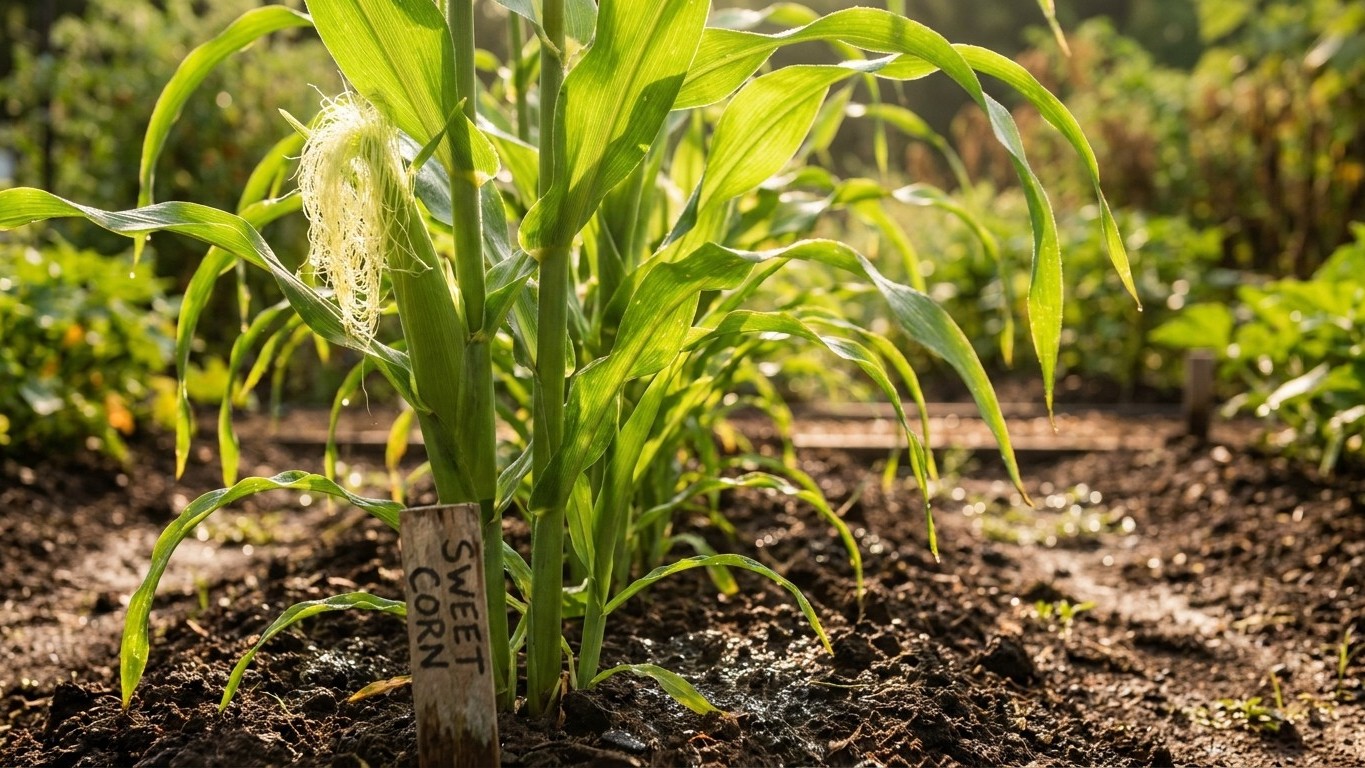

Yes, sweet corn can ripen in Maine, but only if the variety fits the real window between the day the soil warms enough to sprout and the first fall frost. Coastal Maine has room for both 60-day and many 90-day types. Inland and northern gardens have a tighter margin, and a variety on the long end of that range can run out of season before it fills out.
The short answer
The date most gardeners circle on the calendar, the last spring frost, is not the date that matters for sweet corn. What matters is when the soil itself reaches 60 F, and that day comes well after the last frost has passed. Around Portland, on Maine’s milder coastal edge, the last spring frost falls somewhere between April 22 and May 1, according to NOAA NCEI’s 1991-2020 Climate Normals. Air can be frost-free for weeks while the ground underneath stays too cold for a kernel to sprout. Sweet corn seed sown into cold, wet soil doesn’t slowly get going. It rots, or it sits and rots later once soil pathogens catch up to it. So the planting date that counts is the day soil temperature clears that 60 F line, not the day the thermometer stops dropping to 32 F overnight.
On the other end of the season, the first fall frost at that same coastal reference point arrives between October 9 and October 21. That gives a working season, from soil-ready to frost-ended, that comfortably holds 60 to 90 days of growing time at the coast. Inland and northern Maine are a different story. Spring soil warms later there, and fall frost arrives earlier, so the same 60-to-90-day math gets squeezed from both ends. A gardener in Aroostook County or the western mountains isn’t working with the Portland numbers; the window is real, but it’s narrower, and it punishes a variety planted late or picked on a variety that needs the full 90 days.
Summer heat matters too, though less than most gardeners assume. The Portland reference station averages only 3.8 days a year reaching 90 F or hotter. That’s a mild, moderate heat load, not the kind of blast-furnace summer that pushes corn through its growth stages faster than the seed packet promises. Sweet corn in Maine grows at something close to its stated pace rather than racing ahead on extra heat units, which means the days-to-maturity number on the packet is a reasonably honest guide here, not an optimistic one. The upshot: the season is long enough for sweet corn almost everywhere in the state, but the margin for error, especially with a slow variety, shrinks fast the farther you get from the coast.
Does a late variety fit here?
A 60-day variety
A variety rated near 60 days from planting to harvest is the safer bet almost anywhere in Maine. Once soil clears 60 F, even a coastal gardener working with a first fall frost as early as October 9 has a wide cushion. Sixty days of growth followed by weeks of margin before frost means a poor spring (a cold, wet stretch that delays planting by a week or two) doesn’t sink the crop. Inland and northern growers benefit even more from this shorter clock, because their compressed window, later soil warm-up on one end and earlier fall frost on the other, is exactly the kind of squeeze a fast variety is built to survive. If there’s one type of sweet corn clock that fits every corner of this state without much worry, it’s the 60-day one.
A 90-day variety
A 90-day variety is a tighter fit, and in the coldest parts of the state it may not fit at all. Even using the mild coastal numbers, soil needs to reach 60 F, then 90 days need to pass, then harvest needs to happen before frost arrives as early as October 9. That leaves little slack if soil warm-up runs late, if a cool stretch slows early growth, or if the calendar happens to land on the early side of that October 9-to-21 frost range. Inland and northern gardens face the added squeeze of soil warming later in spring and frost arriving sooner in fall, both working against the long end of the season at once. A 90-day variety isn’t impossible on Maine’s mild coast in a favorable year, but it is not a dependable choice, and in the colder inland and northern parts of the state it plainly does not fit the window with any real margin. Gardeners who want a long-season type are better served choosing something closer to the middle of the 60-to-90-day range and treating the full 90 days as the outer edge of what this climate allows, not the safe target.
What goes wrong here
- Soil sown too cold. Planting by the last-frost date instead of the soil-temperature mark is the most common misstep in this climate. Seed sitting in soil below 60 F doesn’t germinate slowly, it typically fails outright, rotting before it sprouts. The fix is simple: check soil temperature directly, ideally with a soil thermometer a few inches down, and wait for 60 F rather than counting days since the last frost.
- A variety too late for the season. Choosing a 90-day type in an inland or northern garden, where soil warms late and frost arrives early, leaves the crop racing a clock it can’t win. The remedy is matching the variety to the location: shorter-day types inland and north, and treating a 90-day type as a coastal-only gamble even there.
- Flat, watery flavor with no climate cause at all. Sweet corn’s sugar content depends on genetics, and su, se, and sh2 types cross-pollinate if they tassel at the same time. The result is starchy, bland ears that have nothing to do with soil temperature or frost dates. The remedy is timing plantings so different sugar types don’t tassel together, and growing each type in its own block of three or more rows rather than a single thin row, so pollen from one type doesn’t drift into another’s silks.
Common questions
Does the last frost date tell me when to plant sweet corn in Maine?
No. The last frost date only tells you when the air stops freezing overnight. Sweet corn needs soil at or above 60 F, and that mark is reached well after the last frost passes.
Is a 90-day sweet corn variety a safe choice anywhere in Maine?
It’s workable on the mild coast in a favorable year, but it leaves little margin even there. Inland and northern Maine, with later soil warm-up and earlier fall frost, generally can’t support the full 90-day type with any real safety cushion.
Why did my sweet corn come out starchy instead of sweet?
The most likely cause is cross-pollination between different sugar types, su, se, or sh2, tasseling at the same time nearby. It isn’t a soil or frost problem. Stagger planting dates or separate blocks so the types don’t tassel together.
How many rows of sweet corn should I plant?
Plant in blocks of three or more rows rather than one or two long rows. That block shape helps pollen reach the silks reliably across the planting, which is separate from the timing issue that affects sweetness.