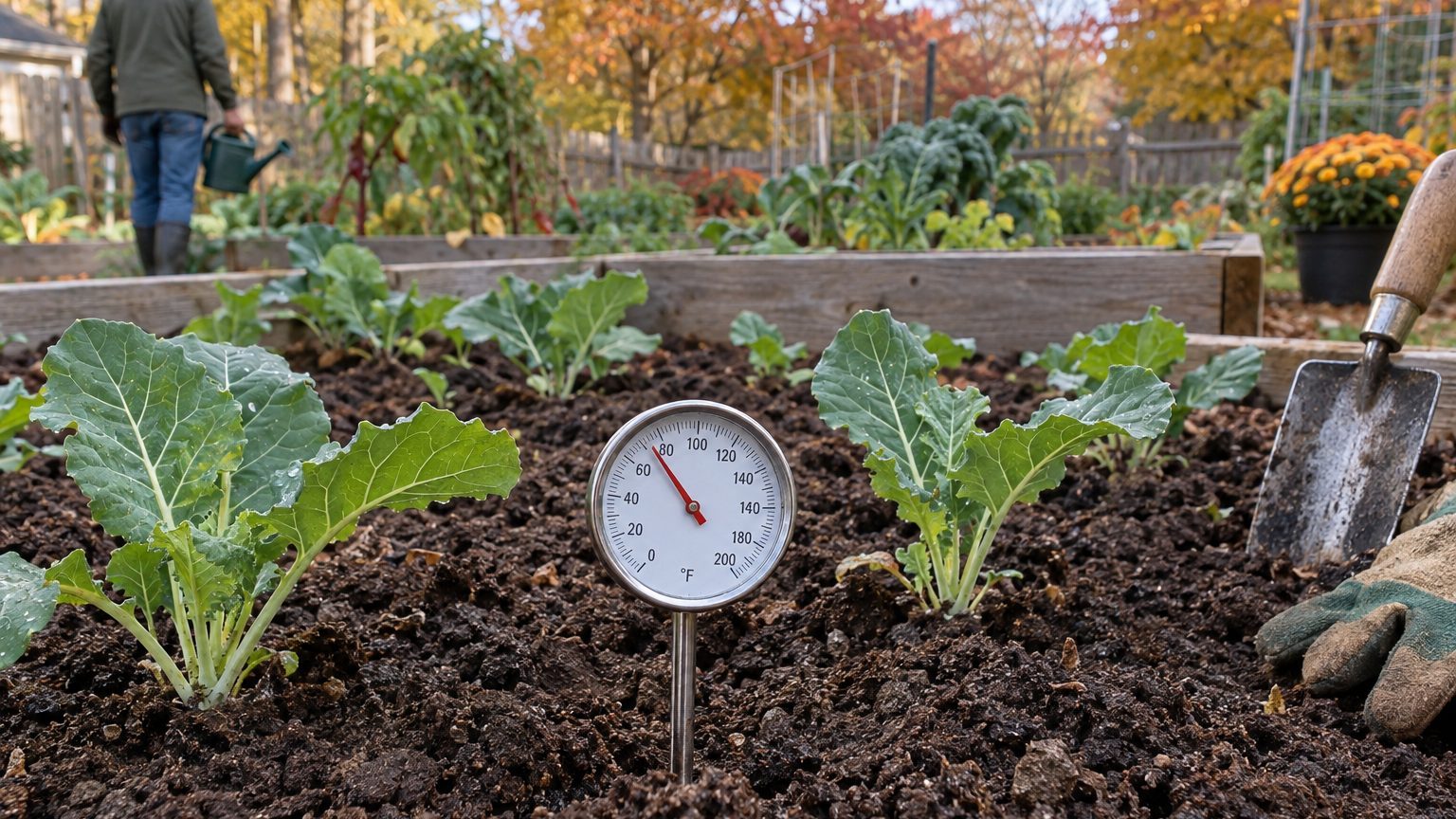

Collards do well in British Columbia, and on the mild south coast they can be picked from late fall through winter. Sowing time depends on soil warmth, which lags the last frost by a few weeks. The winter low shapes the whole bed. Where it stays near freezing, collards stand all winter. Where it drops hard, the crop ends in autumn.
When the soil is warm enough in British Columbia

At the Vancouver International Airport station, the mean last spring frost falls on March 18 (Environment and Climate Change Canada, Canadian Climate Normals 1981-2010). That is a midpoint. In one year out of two the last frost comes later, so treat March 18 as the middle of a window. The station sits on the south coast. Northern and upland districts run weeks behind it, and the normals end in 2010, so recent springs may not match them.
Frost is only the first gate. Once the risk of freezing nights passes, sun and warmer air still need weeks to lift the temperature of the ground. Collard seed sown into cold, saturated soil sits and rots, and transplants set into it stop growing. You want soil that has actually warmed. A handful should crumble instead of clumping, the bed should no longer feel chilly to a bare hand, and weeds should be germinating on their own. A soil thermometer pushed into the soil removes the guesswork.
Should you start collards from seed or transplants in spring?
Both work on the coast, and they follow different rules. Collards take a light frost in stride once hardened off, so transplants can go out around the frost date, a little before the soil is warm enough for direct seeding. Harden them for a week first, setting the trays outside by day and bringing them in at night.
Before planting, slide a few plants out of their cells and look at the roots. White, loose roots reaching the sides of the cell are what you want. A tight, circling mass should be teased apart by hand before the plant goes in, or it keeps circling in the bed. Brown, soft or sour-smelling roots mean the plant goes in the compost.
The types that start fastest in cool spring ground are not the same as those that hold in summer heat. Varieties trialled for your district are listed by the Government of British Columbia’s agriculture and seafood service, and that list is a better guide than any seed catalogue.
How long the season lasts here
The fall date is a midpoint too: in one year out of two the first frost comes earlier. That is a long window for a brassica, and it changes what you can do with it.
Can you sow collards twice in a season in British Columbia?
On the south coast, yes. The first sowing goes in once the soil is warm, and a second sowing in early to mid summer gives you plants that are still young and vigorous when fall arrives. Count backward from November 10 using the days-to-maturity on the seed packet, check whether the packet counts from sowing or from transplanting, and add a couple of weeks because growth slows as daylight shortens. The second planting is the one that carries the winter picking. A first planting alone tends to be bolting, tired or insect-chewed by then.
The long window also means transplanting is optional. You can direct-seed and skip the root check, or buy transplants to get a head start. The main guide, Growing Collards: One Planting, Months of Harvest, covers spacing sowings for a steady supply.
Move inland or north and the arithmetic changes. Upland and northern districts run weeks behind the coast in spring and begin freezing weeks earlier in fall. Their window is short enough that the first sowing may be the only one, and transplants start to pay for themselves. They give you weeks of growth indoors, so the root check at planting matters more. Gardeners facing a much harder season can compare notes in Growing Collards in Manitoba, where the plan starts from the freeze date.
Heat and water in British Columbia

On the south coast, summers are mild and dry, and winters are wet. That makes the cold season the one to plan around. The hot days that stress brassicas come mainly in the dry Interior valleys and in brief heat spells inland from the coast. Collards handle warmth better than most of their relatives, but in a heat spell the leaves toughen and the plants want steady moisture. A layer of mulch holds water at the root, and watering in dry stretches keeps growth even.
Where summers stay cool and damp, the trouble is different. Leaves dry slowly, mildew and leaf spots spread, slugs feed at night, and growth runs slow. Plant collards with enough space apart so air moves between them, water at the base in the morning, and remove yellowing lower leaves as they appear.
Do collards survive a British Columbia winter?
It depends on the coldest month. At Vancouver, the mean daily minimum in the coldest month is 0.8 °C (33.5 °F), just above freezing. Natural Resources Canada places the city in Canadian hardiness zone 9a. That is a separate system from the USDA’s, built on seven climate variables, and the two zones cannot be converted. Lows near freezing mean collards behave as a standing crop on the coast, picked leaf by leaf from November into March. Take the lower, older leaves and leave the growing tip so the plant keeps producing.
Colder districts get a different crop. Where winter lows fall well below freezing, collards are an autumn crop that ends at the first hard freeze, so the second sowing and a fall harvest are the whole plan. Gardeners in cold-winter states can see the same pattern in Growing Collards in New York.
Wet winters carry their own risk. Leaves sitting in cold, soggy conditions develop spots and slimy rot, so pick often and remove damaged foliage. Turnips and rutabagas are brassicas, and they share their diseases with cabbage, kale and mustard. A collard bed that follows turnips has not been rotated away from anything. Give collards at least a few years away from any plant in the cabbage family.
Which collards suit British Columbia
Choose by type first. In a short season, earlier-maturing types are the better bet, because a plant that reaches picking size before the freeze beats a bigger one that never gets there. This applies mainly to northern and upland gardens. On the coast, with a long window, maturity matters less than hardiness and disease tolerance.
Where summers run hot, favor types that hold their leaves without turning bitter or bolting quickly, and give them airflow and shade at the root. Mulch and a little afternoon shade from taller crops both help. Where fall and winter are wet and cool, as on the coast, disease resistance should be the first criterion, ahead of leaf size or flavor. Look for descriptions that mention tolerance to leaf spot and mildew, and plan for loose spacing.
For winter standing, pick types known to keep their quality through cold. Broad, smooth, blue-green leaves and looser, ruffled leaves behave differently in cold wet weather, and both can work. What matters is how a type holds up in your own district.
No variety is named here because a name picked from a catalogue says little about how a collard behaves in your district. British Columbia runs from the wet coast through the Fraser Valley and the dry Interior to the north. A type that thrives in one may sulk in another. The only recommendation that counts is one from local trials, and the Government of British Columbia’s agriculture and seafood service is the place to start. Regional seed suppliers and local garden clubs know what has worked in your valley, and they are worth asking before you buy.
Common questions
When should I plant collards in the Vancouver area?
Wait until the soil is warm, which comes after the mean last frost of March 18. That date is a midpoint, and half of years run later. Hardened-off transplants can go out around that time, and direct sowing follows once the soil has warmed. A second sowing in early to mid summer supplies the winter crop.
Can collards stay in the ground all winter in British Columbia?
On the south coast, usually yes. The mean daily minimum of the coldest month is 0.8 °C (33.5 °F), so plants keep growing slowly and can be picked leaf by leaf from November into March. In colder districts, a hard freeze ends the crop.
Can I follow turnips or rutabagas with collards?
Avoid it. Turnips and rutabagas are brassicas, and they share pests and diseases with cabbage, kale, mustard and collards. Rotate collards to a bed that has been free of the whole cabbage family for several years.
How do I check collard leaves before keeping them?
Look over every leaf and the stem base. Yellowing, slime, a soft patch, a weeping spot or mold on the crown means the leaf or plant should be discarded, even if the rest looks fine. Leaves that look sound can still carry rot from an unseen spot, so never trust appearance alone, and when in doubt throw it out.