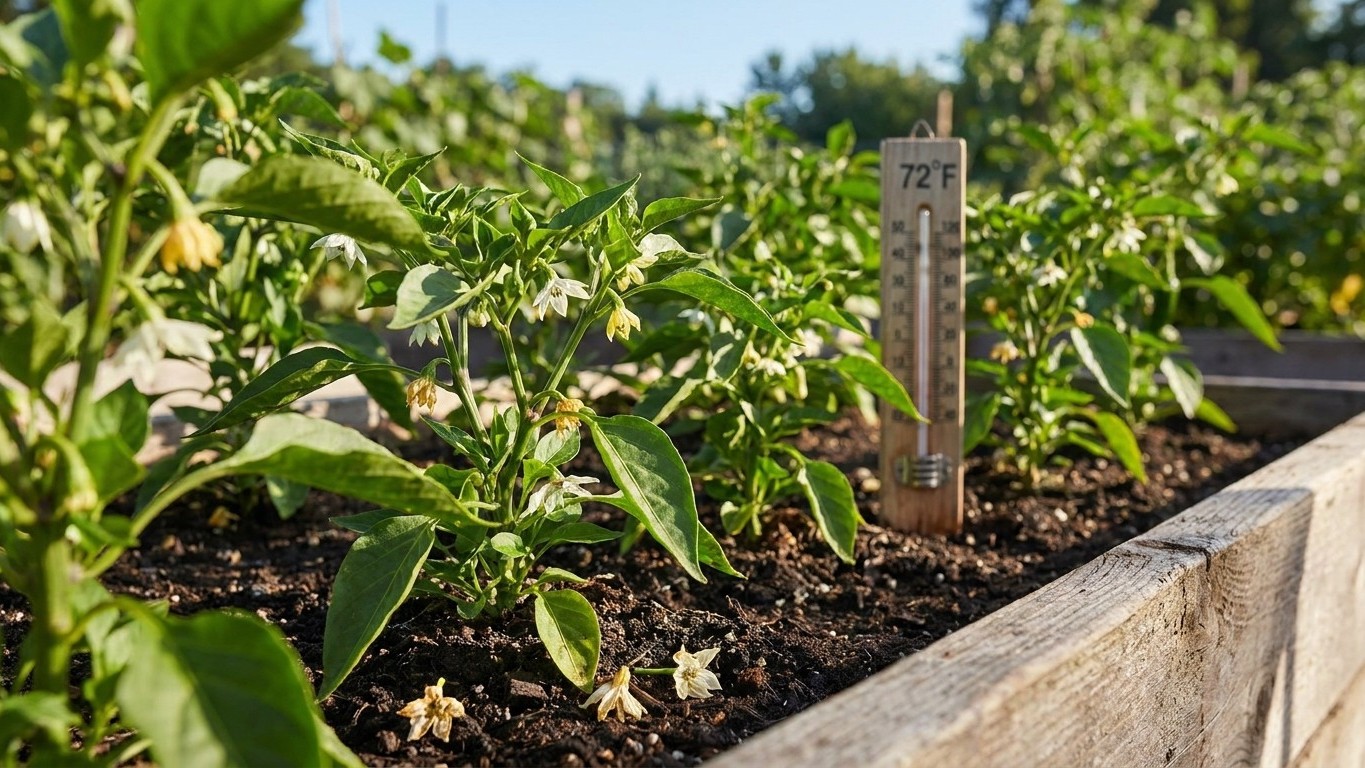

Start pepper seed indoors 8 to 10 weeks before you plan to set transplants outside. In Manitoba, that transplant window opens after the average last frost of May 23 and once soil has warmed to 60 F, so most gardeners around Winnipeg are sowing seed indoors somewhere between mid-March and early April, adjusting for how late the ground actually warms in a given spring.
The short answer
Winnipeg’s climate record shows an average of 0.0 days a year at or above 90 F, based on the 1981-2010 Canadian Climate Normals from Environment and Climate Change Canada. That number matters more than it looks like at first glance. Pepper fruit set collapses when daytime highs push past 90 F, because the plant aborts blossoms rather than spend energy on fruit it can’t support in the heat. A reading of zero means that failure mode almost never shows up here. Manitoba pepper growers are not fighting heat stress the way gardeners in Texas or Arizona are. That’s the good news, and it’s worth sitting with for a second before moving to the other half of the story.
The other end of the fruit-set equation is cold, not heat, and it’s the one that actually threatens a Manitoba pepper crop. Nights below 55 F cause the same kind of blossom failure as extreme heat does, just from the opposite direction: pollen turns sterile, flowers drop, and a plant that looked fine in the afternoon quietly resets to zero fruit overnight. This site does not carry a dataset of summer night-minimum temperatures for Manitoba, so no specific figure can be given here for how often that 55 F line gets crossed in July or August. That gap matters. A prairie growing season can deliver long, mild days and still tuck in a run of cool nights, especially early in the summer or during a stretch of clear, dry weather when heat radiates out fast after sunset. The only real fix is to watch your own thermometer through the season rather than assume the date on a calendar protects you.
Put those two facts together and the shape of the Manitoba pepper season becomes clear. Heat almost never wrecks a crop here. Cold, especially at night, is the threat that actually needs tracking, and it needs tracking locally, plant by plant, week by week, because no regional average can tell you what your particular yard does on a still, clear night in early July.
When to start seed here
The math behind a pepper start date isn’t complicated, but it does depend on a few local numbers you need to plug in yourself rather than borrow from a neighboring province or a seed packet printed for a different climate. Here’s how to work it out for your own address.
- Start with the average last frost. For the Winnipeg area, that date is May 23, drawn from the Winnipeg Richardson International Airport station in the 1981-2010 Canadian Climate Normals. Treat this as a midpoint, not a promise. It’s an average of thirty years of frost dates, which means in roughly half of those years, frost arrived later than May 23. Gardeners north of Winnipeg, or in low-lying and rural districts that sit colder than the airport site, should expect their own last frost to land later still.
- Add the soil-temperature test. Utah State University Extension is clear that peppers should go into the ground once soil has reached 60 F, and only after frost risk has passed, whichever of those two conditions is later. A calendar date can tell you frost is statistically unlikely; it can’t tell you whether the soil eight inches down has actually warmed up. A basic soil thermometer, pushed in a few inches at midday, settles the question in seconds and costs less than a six-pack of transplants.
- Count backward 8 to 10 weeks from that transplant date. If your working transplant target lands in the last week of May, 8 weeks back puts your indoor sowing date at the end of March, and 10 weeks back moves it to mid-March. If cool soil or a late frost pushes your real transplant date into early June, shift your sowing date the same number of weeks later.
- Re-run the count for your own county. Because the Winnipeg station is one point on a large map, any reader outside that immediate area should treat May 23 as a starting reference, not a fixed rule, and nudge the whole calculation later if local frost history or soil behavior runs colder.
The arithmetic is the same every year, only the inputs change. Watch your soil, watch your local frost pattern, and let those numbers, not the calendar page, set your sowing date.
What goes wrong here
Manitoba’s pepper problems tend to cluster around a short handful of predictable failures, most of them tied to the cold side of the ledger rather than the heat side.
- Blossom drop from a cool night. Because Manitoba almost never sees days above 90 F, the heat-driven version of blossom drop is rare here. The cold-driven version is the real risk: a night dipping under 55 F can cause flowers to fall without setting fruit, even mid-summer during a clear, calm stretch. The remedy is vigilance rather than a product: track nighttime lows through the season, and if a cool snap is forecast, consider a row cover or cloche over young plants to hold in a few extra degrees.
- Sunscald on exposed fruit. Prairie summers can deliver strong, direct sun even without extreme heat, and a pepper that loses its leaf cover, whether from wind damage, disease, or over-eager pruning, ends up with pale, papery patches on fruit facing the sun. Keeping the plant’s own foliage intact is the simplest defense; avoid stripping leaves for “better airflow” unless disease genuinely requires it.
- Blossom-end rot. This shows up as a sunken, leathery patch on the bottom of the fruit, and it traces back to inconsistent watering rather than a soil deficiency in most home gardens. Uneven moisture interrupts how the plant moves calcium into developing fruit. A steady watering schedule, paired with two to three inches of mulch to even out soil moisture between waterings, addresses the root cause far more reliably than adding calcium products to the soil.
Common questions
Do Manitoba pepper growers need to worry about heat stress?
Rarely. Winnipeg’s climate record shows an average of 0.0 days a year at or above 90 F, so the heat-driven form of blossom drop that plagues hotter states is not a meaningful risk in most Manitoba gardens.
What’s the single biggest threat to pepper fruit set in Manitoba?
Cool nights, not heat. Nights below 55 F can cause the same blossom failure as extreme heat does. This site doesn’t track summer night-minimum temperatures for Manitoba, so growers need to monitor their own thermometer through the season rather than rely on a regional average.
Is May 23 a safe date to count on for the last frost?
No. May 23 is the average last frost date for the Winnipeg Richardson International Airport station over 1981-2010. An average means frost arrives later than that date in roughly half of all years, so it should be treated as a planning midpoint, not a guarantee.
How do I know when to actually move transplants outside?
Wait until both conditions from Utah State University Extension are met: frost risk has passed and soil temperature has reached 60 F. Test soil directly with a thermometer rather than assuming a calendar date confirms it.