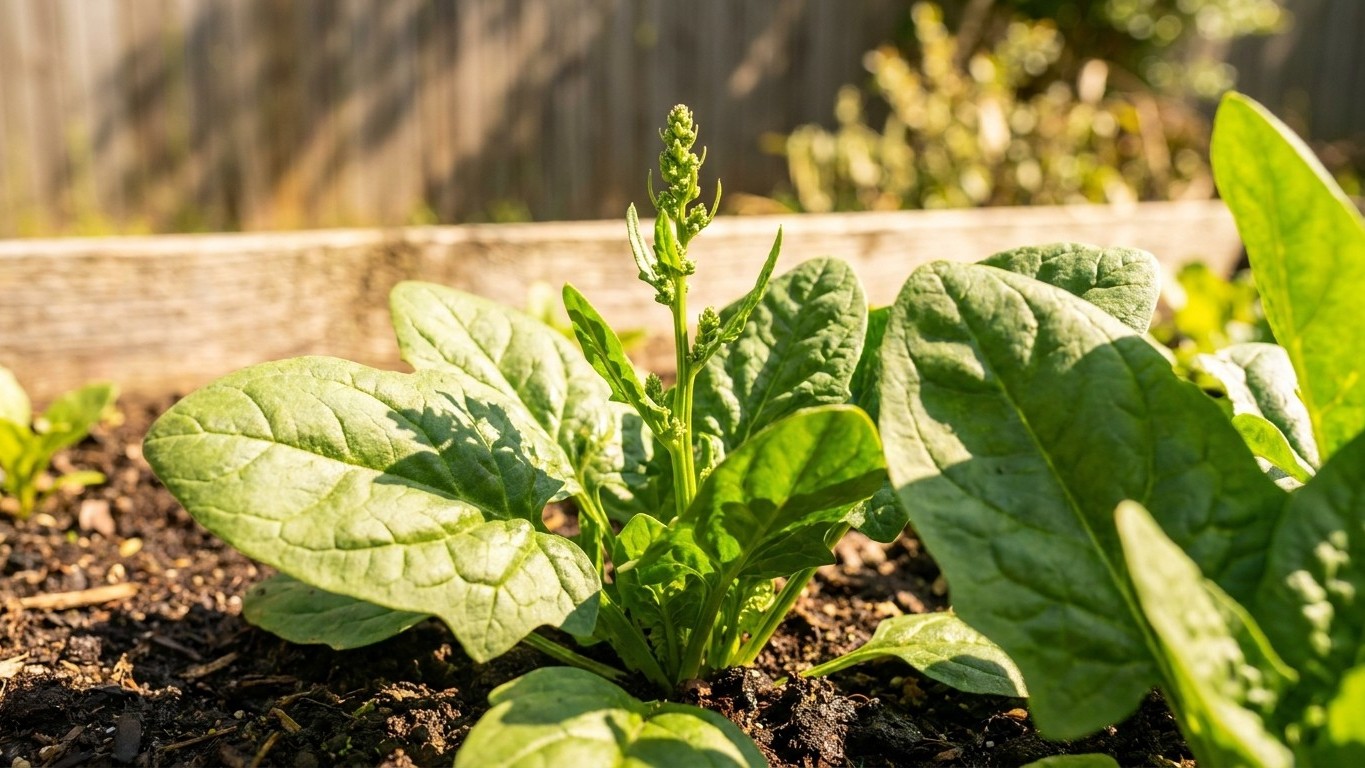

In Manitoba, spinach will bolt early because the growing season runs on long summer daylight rather than on heat. The province rarely gets hot enough to stress the crop on its own, so the calendar, not the thermometer, decides when spinach turns bitter and runs to seed. That single fact reshapes when you sow, both in spring and again in late summer for a fall crop.
The short answer
Winnipeg sits under 16 hours and 8 minutes of daylight on the longest day of the year. That’s an enormous amount of light, and for spinach, light duration alone is enough to switch the plant from making leaves to throwing up a flower stalk. Spinach bolts during long days and warm temperatures together, and it grows best where temperatures stay under 75 F. In Manitoba, the day-length trigger arrives whether or not the weather cooperates.
That’s the part gardeners moving from warmer states often get backward. A cooler summer doesn’t buy spinach extra weeks here. The plant doesn’t wait for heat to decide it’s time to flower. As days lengthen toward the June solstice, spinach reads that lengthening as a signal, and once the signal is strong enough, bolting starts even in mild weather. So the short answer is yes, spinach bolts early in Manitoba, and the reason is day length, not heat.
Heat isn’t really a factor here at all. The reference station for this region logs an average of 0.0 days a year reaching 90 F or higher. That’s about as close to zero heat load as a climate normal can show. So the 75 F growth ceiling for spinach is almost never breached by temperature alone in this province. What ends the spring crop is the calendar, specifically how fast the days are stretching toward that 16-hour-8-minute peak.
This distinction matters for how you plan the garden. If heat were the limiting factor, shade cloth or a north-facing bed might buy real time. Since day length is doing the work instead, those tricks help only at the margins. The plant is responding to something a shade cloth can dim slightly but never truly hide, the sun staying up for sixteen-plus hours. Manitoba gardeners are working against a light clock, and the clock runs the same whether the summer is cool or unusually mild.
None of this makes spinach a poor crop for the province. It just means the strategy has to shift toward timing rather than toward fighting the weather. Spring spinach is a race against lengthening days, and fall spinach is a race against cooling soil and an approaching frost. Both windows are real, and both are shorter than a gardener coming from a lower-latitude, shorter-daylight climate might expect.
How long the spring window really is
Working out the usable spring stretch means lining up three things: when it’s safe enough to sow, when the growth ceiling might come into play, and when lengthening days start pushing the plant toward bolting.
- Sowing date. Spinach seed goes in 2 to 3 weeks before the last frost. The average last spring frost at the Winnipeg Richardson International Airport station is May 23, so a 2-to-3-week head start lands sowing in the first half of May. That average is a midpoint, not a guarantee, meaning in one year out of two the real last frost falls later than May 23, so gardeners in colder pockets or in a late spring should watch the ground rather than the calendar alone.
- The heat ceiling, mostly theoretical here. Growth stops being good above 75 F, but with an average of 0.0 days a year reaching 90 F, Manitoba spring and early summer almost never push spinach past that ceiling through heat alone. This isn’t the bottleneck in this province, unlike in warmer regions of the same growing corridor.
- The real bottleneck: lengthening daylight. Once sown in early May, spinach has roughly six to seven weeks before the days grow long enough, on the way to the 16-hour-8-minute peak around the June solstice, to trigger bolting in most plantings. That puts the realistic harvest window from late May through mid-June for a spring-sown crop.
- Net usable spring window. Combining sowing timing with the bolting trigger leaves roughly five to six weeks of good spinach growth between an early-May sowing and the point where lengthening days start pulling the crop toward seed. Anyone hoping to stretch that further by waiting for cooler weather is fighting the wrong variable, since heat was never the constraint to begin with.
The autumn crop, and when the soil lets you sow
A second spinach crop, planted for fall harvest, runs into two separate obstacles rather than one. The first is invisible until you check a soil thermometer, and the second is the frost that eventually shuts the season down.
Soil too warm to germinate
Spinach seed germination drops noticeably once soil temperature climbs above 80 F. That threshold matters most in mid to late summer, when soil that has absorbed weeks of sun can sit well above air temperature even in a province where air rarely hits 90 F. A fall sowing has to wait until that soil warmth breaks, typically as days shorten and nights cool into August. Sowing into soil still holding summer heat is the most common reason a fall spinach planting germinates poorly or not at all, and it has nothing to do with frost.
The frost that ends the season
The average first fall frost at the same Winnipeg station falls on September 22. As with the spring figure, this is a mean date from the climate normals, not a firm boundary, so in one year out of two the first frost arrives later than that, and gardeners further north or in higher, colder pockets of the province should expect it earlier. The source for fall spinach timing doesn’t publish a fixed days-to-maturity number. Instead, the guidance is to sow 50 to 75 days before the date you want to harvest. Counting back from September 22 puts a fall sowing window somewhere between early July and the first days of August, depending on how close to that average frost date you’re comfortable harvesting.
Four named spinach varieties commonly discussed for garden use, Bloomsdale, Melody, Teton, and Olympia, don’t have published performance data tied to this figure, so no claims are made here about how any one of them handles Manitoba’s long days or its narrow fall window. What’s established is the window itself: sow after the soil has cooled below that 80 F germination threshold, and count backward 50 to 75 days from a harvest date you’re willing to risk against a first frost that, on average, lands September 22 but just as often lands later.
| Season | Limiting factor | Approximate sowing window |
|---|---|---|
| Spring | Lengthening daylight toward 16 h 08 | Early May |
| Fall | Warm soil, then first frost (avg. September 22) | Early July to early August |
Common questions
Can you slow spinach bolting once the days start getting long in Manitoba?
Not by much. Since the trigger is day length rather than heat, shade or extra water helps only around the edges. The plant is responding to how long the sun stays up, and that isn’t something a garden bed can fully block out.
Which spinach varieties do best in Manitoba?
Bloomsdale, Melody, Teton, and Olympia are commonly named spinach varieties, but no performance data tied to Manitoba’s day length or frost dates has been published for any of them here, so no variety can be recommended over another on that basis.
Is a fall spinach crop more reliable than a spring one in Manitoba?
Each has its own constraint. Spring spinach fights lengthening daylight pushing toward the June peak. Fall spinach fights warm soil that resists germination, followed by a first frost that, on average, arrives September 22 but lands later in about half of all years.
Does Manitoba’s cool summer help spinach avoid bolting?
No. With an average of 0.0 days a year reaching 90 F, heat was never going to be the problem in this province. Bolting is driven by day length climbing toward 16 hours and 8 minutes at the solstice, and that happens whether the summer is mild or unusually warm.