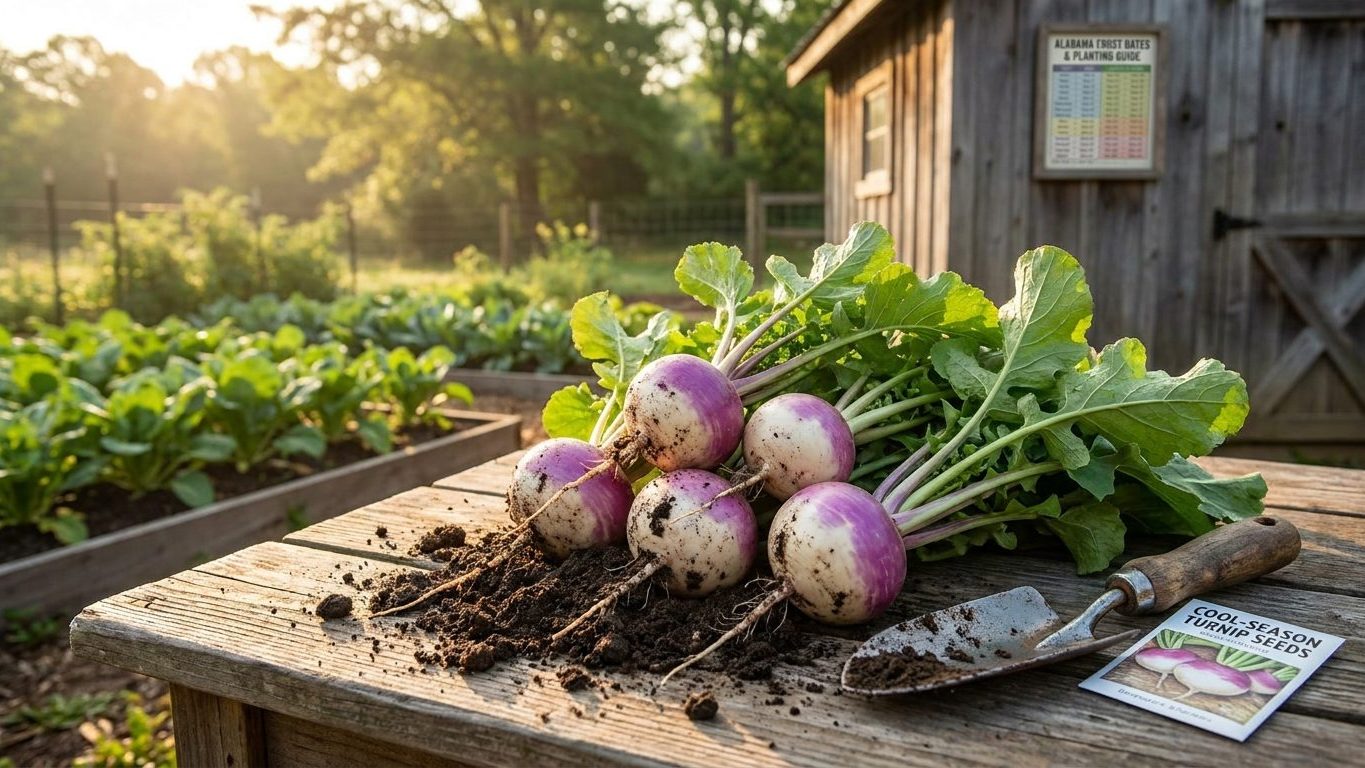

Sow turnip seed directly in the ground from late April through mid-June for a spring crop, and again in mid-to-late July for a fall crop timed to finish before the mean first frost on September 22. Everything else on this page explains why those windows are wider, and riskier, than they look.
The short answer for Manitoba
Turnips are a quick, cool-tolerant root crop, and Manitoba’s frost dates set the two sowing windows that matter. The mean last spring frost at Winnipeg Richardson International Airport falls on May 23, and the mean first fall frost falls on September 22, according to Environment and Climate Change Canada’s 1981-2010 climate normals. That gives a frost-free stretch of roughly 122 days between the two averages, which is enough for at least two turnip cycles if you time them right.
For a spring crop, turnip seedlings tolerate a light frost once they have true leaves, so gardeners commonly sow from the last week of April onward rather than waiting for May 23 itself. Sow between late April and mid-June for the spring crop, understanding that anything sown before the mean date is a calculated risk, not a guaranteed win. For a fall crop, count backward from September 22: most turnip varieties need roughly 40 to 60 days to reach usable size, which puts the safe sowing deadline somewhere between mid-July and the first days of August, depending on the variety’s stated maturity.
The word “mean” is the part readers skip past and shouldn’t. A mean frost date is not a safe date. It is the midpoint of a distribution built from thirty years of records, which means that in roughly half those years, frost arrived later than May 23 in spring, or earlier than September 22 in fall. Treat both dates as the center of a window that shifts a week or two in either direction depending on the year, not as a line you can plant right up against.
The other piece worth knowing before you touch a seed packet: this data comes from one weather station, at one airport, in one city. Manitoba is not a single climate, and a garden thirty miles north of Winnipeg, or one sitting in a low frost pocket, will see its own frost dates land earlier in fall and later in spring than what’s recorded here. Use the windows above as a starting point, then watch your own soil and your own sky, which the later sections of this page walk through in more detail.
What will not work here

Rutabaga, the turnip’s slower cousin, is the clearest casualty of Manitoba’s season length. A typical rutabaga needs 90 to 100 days to size up properly, which leaves almost no margin inside a 122-day average frost-free window once you account for germination time and the very real chance that fall frost arrives early. Sowing rutabaga any later than early June in most Manitoba gardens is asking it to finish in a window that, in a below-average year, may not exist at all. Turnips, with their much shorter 40-to-60-day cycle, have far more room to fail gracefully and still deliver a harvest.
Winter itself is the second trap, though it shows up in a different season than most gardeners expect. The mean daily minimum of Manitoba’s coldest month, drawn from the same Winnipeg reference station, sits at -21.4°C. That is not a record low. It’s the average low on an average night in January, which tells you plainly that the ground here freezes hard and stays frozen for months. Gardeners used to milder climates sometimes leave root vegetables in the ground under mulch to harvest through winter. That practice does not translate to a place where the mean nightly minimum sits over twenty degrees below freezing on the Celsius scale. Turnips left in unprotected Manitoba soil past the first hard freezes are not being stored. They’re being lost.
Water management is the third failure point, and it trips up gardeners who learned their habits somewhere wetter. Prairie summers bring stretches of dry heat, and turnip roots respond to inconsistent moisture by turning woody, pithy, or split at the shoulder. A watering routine built around once-a-week deep soaks, which works fine in a humid coastal garden, tends to leave Manitoba turnip beds swinging between parched and soaked, and the roots show it. Turnips want steady, shallow, frequent moisture through the growing period, not a single weekly deluge that dries out completely before the next one.
What changes across Manitoba
Winnipeg’s reference station places the capital in Canadian plant hardiness zone 3b, according to Natural Resources Canada’s Plant Hardiness Site using 1991-2020 normals. That number describes Winnipeg and the area immediately around it. It does not describe Manitoba as a whole, and treating it as if it does is the single most common mistake a gardener can make with this kind of data.
Manitoba stretches from the agricultural belt along the US border, through the Interlake region, up past The Pas toward Hudson Bay, and a province with that kind of north-south reach does not share one growing season. Communities well north of Winnipeg routinely sit in colder Canadian hardiness zones than 3b, with shorter frost-free periods and later springs, while some sheltered pockets closer to the border can run a touch milder. The Canadian zone system itself is built from seven separate climate variables, not the single minimum-temperature figure the US system uses, which is part of why one province can span a wide range of zones and why those zones don’t line up neatly on a map the way state-level lines sometimes suggest.
What that means practically: a reader gardening north of Winnipeg should expect to push both sowing windows described above later in spring and earlier in fall than what this page lays out, simply because frost lingers longer and returns sooner the further north and the higher in elevation a garden sits. Rather than guessing at how many weeks to shift, check the Canadian Plant Hardiness Site’s zone map for your own municipality before relying on Winnipeg’s numbers as a stand-in for your own backyard.
Where to check this for your own county
Manitoba Agriculture publishes provincial guidance for vegetable growers, and it’s the right next stop once this page has given you the general shape of the season. Visit gov.mb.ca/agriculture and look specifically for two things: any current seasonal planting calendar for vegetable crops, and any variety trial results published for root vegetables, since those trials tell you which turnip varieties have actually been grown and measured under Manitoba conditions rather than described in a seed catalog written for a different climate.
A municipal-level recommendation, where one exists, will always beat a provincial one. This page works from a single reference station at one airport, averaged across three decades. Your municipality’s soil, drainage, elevation, and microclimate are not in that dataset, and no provincial page can account for the difference between a garden on sandy loam near the Red River and one on heavier clay further from it. Provincial guidance is a starting frame, not a finished answer.
If your municipality or local extension office publishes its own frost dates or planting windows, use those over the numbers on this page without hesitation. Local data reflects local soil-warming patterns, local air drainage, and local microclimate effects that a single Winnipeg-based average simply cannot capture. Treat this page as the province-wide baseline it is, and treat anything more local as an upgrade, not a contradiction.
Some gardeners also time this by the Moon: when to plant turnips by the moon, as almanac tradition rather than fact.
Checking this against your own garden
Every date on this page is an average pulled from one weather station. Your own garden, watched carefully for a season or two, will always give you better information than any calendar can. Three signs are worth tracking, and none of them require anything more than your hands and your eyes.
Start with the soil itself. Turnip seed germinates poorly in cold, wet ground, and a soil that feels cold and heavy to the touch, rather than crumbling and warming under your fingers, is telling you the season hasn’t turned the corner yet regardless of what the calendar says. Wait for that crumbling, slightly warm feel before committing seed to the ground, especially in a spring that’s running behind average.
Next, watch germination speed. Turnip seed sown into properly warmed soil typically pushes up true leaves within about a week. If true leaves haven’t appeared within seven to ten days, the soil was likely still too cold when you sowed, and that’s a direct, personal reading of your own garden’s timing, more useful than any provincial average.
Finally, watch the root shoulders as the season progresses. Turnip roots push up and become visible at the soil surface as they size up, and that visible shoulder, alongside sturdy, deep-green foliage, tells you the plant is drawing steady moisture and growing on schedule. Pale, wilting leaves or roots that stall well below expected size are your garden’s way of flagging a watering or soil problem before it costs you the harvest.