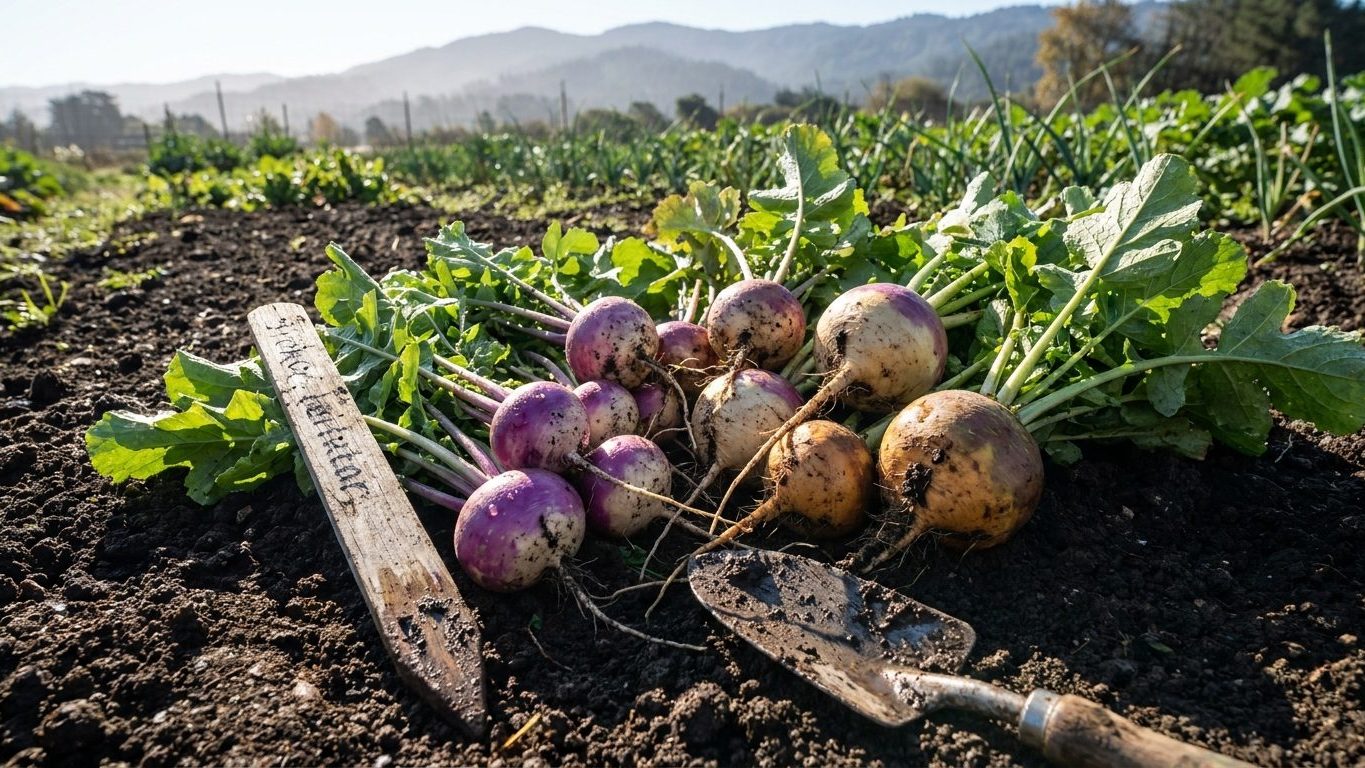

Manitoba gardeners get one real shot at Turnips and Rutabaga each year, and the calendar is unforgiving. The province’s frost-free stretch averages 122 days, tight for most rutabaga varieties and demanding even for slower turnips. Quick salad turnips and only the earliest rutabaga cultivars fit that math reliably. Everything else on the seed rack risks getting caught before it fills out.
The short answer for Manitoba
That 122-day figure comes from two mean dates recorded at Winnipeg: a last spring frost around May 23 and a first fall frost around September 22. Neither is a guarantee. Environment and Climate Change Canada calculates these as averages, which means in roughly half the years on record, spring frost arrived later than May 23, or fall frost showed up before September 22, or both. Treat the 122 days as a best-case window, not a promise, and build in a margin before committing to anything slow.
That margin is what separates the turnip varieties that work here from the ones that don’t. Salad-type turnips, the kind bred for eating small and raw, size up in around 35 to 40 days. Storage turnips run closer to 50 to 60 days but still leave room for a second sowing. Rutabaga is the outlier: most cultivars need 85 to 100 days of steady growth, which eats most of the available window in one shot.
| Root type | Typical days to maturity | Fits the Manitoba window? |
|---|---|---|
| Salad turnip (Hakurei, Tokyo type) | 35-40 days | Yes, room for two or three sowings |
| Storage turnip (Purple Top White Globe type) | 50-60 days | Yes, usually one main sowing plus a fall catch crop |
| Rutabaga (Laurentian, American Purple Top type) | 85-100 days | Only if sown right when frost risk clears, no delay |
The practical decision follows directly from that table. Grow salad and storage turnips as your dependable staple, sowing the first batch as early as the soil allows and following up through early summer. If you want rutabaga at all, sow it the week frost risk clears rather than waiting for warmer soil, because every week of delay in June comes straight out of the margin you’ll need in September.
What will not work here

Long-season rutabaga varieties bred for coastal or milder growing regions are the first thing to cross off the list. A cultivar that wants 100 to 110 days sounds fine against a 122-day mean window, until you remember that window shrinks in roughly half of all years. A late spring frost paired with an early fall one can trim the usable season down closer to 90 days, and a rutabaga still bulking up when that happens ends up small, woody, or simply lost to frost damage before harvest.
Late sowings of anything but the fastest turnips fail for the same reason. A 55-day storage turnip seeded in early August won’t reach maturity until close to September 20, right on top of the mean fall frost date, with no buffer if the season runs early. Past mid-July, salad turnips are really the only safe bet for a fresh sowing.
Manitoba summers also swing hot and dry through July, and that catches gardeners who water on a fixed weekly schedule rather than checking the soil. Turnips and Rutabaga both turn pithy, woody, or bitter when the soil dries out between waterings, and stressed roots are far more prone to cracking and forking. Consistent moisture matters more than any set interval, especially on the sandier soils found in parts of the Interlake and Parkland regions.
Crowded rows carry their own risk in low-lying or humid pockets of a garden, near a slough edge or a shaded corner that stays damp longer than the rest of the yard. Turnips and Rutabaga are both brassicas, and tight spacing there invites clubroot and other soil-borne disease. Give rows enough air movement rather than packing them in for volume.
Finally, don’t plan on leaving roots in the ground over winter for a spring dig. Manitoba’s coldest month averages a daily minimum of -21.4°C, cold enough to freeze unmulched root crops solid well before spring. Lift and store Turnips and Rutabaga before the ground locks up, not after.
What changes across Manitoba
The zone figure behind this page, Canadian hardiness zone 3b, applies to the Winnipeg area, the reference station used for the frost dates above. Manitoba is not one climate wearing a single number. The province stretches from farmland near the US border up to subarctic country along Hudson Bay, one of the longest north-south spans of any Canadian province, and conditions shift enormously across that distance.
Communities well north of Winnipeg run through a shorter, colder season than the numbers on this page describe, with both frost dates working against the gardener at once: spring frost lingering later, fall frost arriving sooner. Exact hardiness zone figures for those northern and remote communities aren’t part of this page’s dataset, and treating a northern garden as if it shared Winnipeg’s window would overestimate how much growing time is actually available.
Elevation plays a role even within southern Manitoba. Higher ground near the Pembina and Riding Mountain escarpments tends to hold cold air and frost longer into spring than the flat Red River Valley floor, sometimes by a couple of weeks. A garden sitting in a natural low spot, where cold air pools overnight, will see frost before a garden just a few hundred yards away on higher ground.
None of this can be settled from a provincial average. Check the official zone map at Natural Resources Canada’s Plant Hardiness site before treating any single date on this page as local truth, since the spread across Manitoba is wide enough that no single number covers it.
Where to check this for your own county
Manitoba organizes its local governments as municipalities rather than counties, but the principle is identical: whatever your rural municipality or region, a local recommendation will always beat a province-wide one, and this page is the province-wide one. It’s built to explain the mechanics behind Manitoba’s growing season, not to replace what’s published for your specific area.
Manitoba Agriculture is the right next stop. Once there, look specifically for two things: a vegetable production or planting guide with dates tied to your region rather than the Winnipeg station used here, and any variety trial results for turnips or rutabaga conducted in Manitoba conditions. Trial data matters more than a seed packet’s generic days-to-maturity number, because it reflects how a cultivar actually performed against Prairie weather rather than a controlled test plot elsewhere.
Search the site for your specific region, whether that’s the Red River Valley, the Interlake, the Parkland, or further north, since Manitoba Agriculture often breaks recommendations down by these zones rather than issuing one blanket calendar for the whole province. That regional layer is exactly the detail a provincial page like this one can’t provide.
If nothing region-specific turns up, a call to the local office or a Manitoba Agriculture extension specialist tends to get faster, more precise answers than searching alone, particularly for a crop like rutabaga where a week of timing can decide the whole harvest.
Checking this against your own garden
Every date and figure on this page comes from a single Winnipeg station, and your own garden will always have the final word over it. Three things are worth watching before trusting any calendar.
Start with the soil itself. Turnip and rutabaga seed will germinate in soil that still feels cool to the touch, but working ground before it’s ready compacts clay and undoes the benefit of an early start. If a handful smears rather than crumbles when squeezed, wait a few more days regardless of the calendar date.
Watch how fast true leaves follow the first cotyledons after sowing. If they’re slower to appear than expected for the variety, your microclimate is running cooler than the provincial average this page is built on, useful information for timing any later sowings the same season.
In fall, watch tender plants like beans or squash for the first blackened leaves, since that marks your garden’s actual first frost far than a station average ever can. Compare that date against September 22 over a season or two, and you’ll know whether your own patch of ground runs ahead of or behind the numbers this page uses.