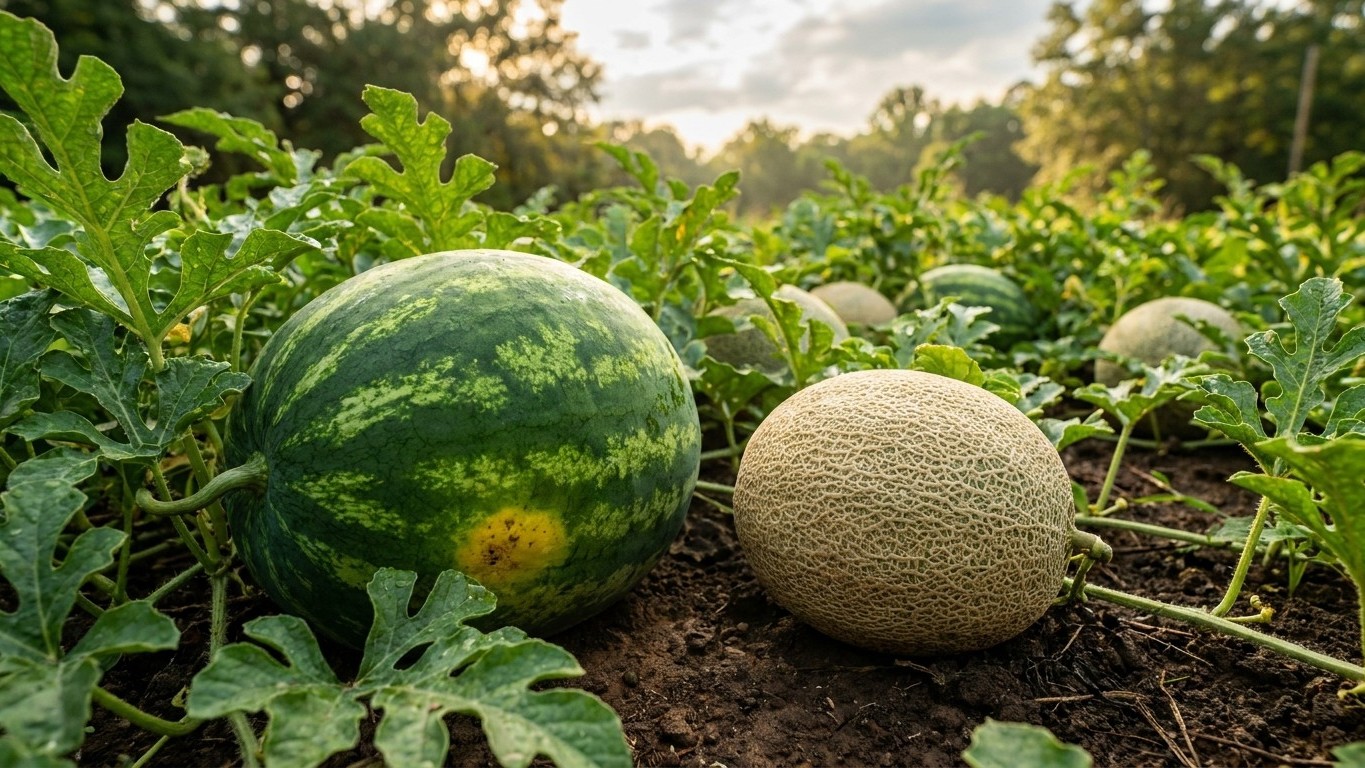

Maryland’s melon growers do best with short-to-mid-season cantaloupe and muskmelon varieties (75 to 85 days) and compact “icebox” watermelons rather than the giant, long-season types. The state’s frost window and humid summer rainfall favor varieties bred for disease resistance and faster maturity over the 100-day heirlooms that need a longer, drier stretch to finish properly.
The short answer for Maryland
Start with the frost dates, because they set the boundaries of everything else. The last spring frost across the reference area falls between April 3 and April 16, and the first fall frost arrives between October 26 and November 5. That gives a frost-free window of roughly six and a half months, generous by national standards but not limitless once you subtract the weeks melons need warm soil before transplant.
Inside that window, the heat load matters as much as the calendar. Baltimore’s reference station averages 24.6 days a year at or above 90F. That’s enough sustained heat to sweeten a cantaloupe properly, but it’s not the blast-furnace summer of the Deep South where 100-day watermelons ripen with room to spare. This is the number that should steer variety choice: pick melons whose seed packets list maturity in the 70 to 85 day range for cantaloupe and muskmelon, and 75 to 90 days for compact watermelon types, so the fruit has finished sizing and sugaring before the heat tapers off in September.
Rainfall backs up that same logic. Summer rain averages about 12.6 inches across June, July and August, split fairly evenly (June 3.98 inches, July 4.48, August 4.09). That’s a moist summer by melon standards, and melons are, at heart, a dry-climate crop pushed into a humid one. The varieties that handle Maryland best are the ones bred with resistance to powdery mildew and downy mildew, both of which thrive in exactly this kind of rainfall pattern. Look for cantaloupe and muskmelon cultivars marketed with mildew resistance codes on the seed packet, and favor watermelon varieties described as vigorous or disease-tolerant rather than heirloom types selected purely for flavor decades ago in drier growing regions.
Put plainly: this is cantaloupe and muskmelon country first, watermelon country second (with the smaller, faster varieties), and honeydew territory only for growers willing to manage humidity closely. The page below explains why the alternatives struggle.
What will not work here
Long-season, giant watermelon varieties are the clearest failure point. Varieties bred to run 95 to 100 days or more are built for regions with a longer stretch of dry heat than Maryland’s 24.6 average days above 90F can reliably deliver. Push transplant too early into cool soil and the plant stalls for two or three weeks before it even starts vining, eating into a season that was already tight. The math rarely works: a 100-day variety transplanted after the last frost risk has passed in mid-April still needs to finish by late July to have any buffer before disease pressure builds in the humid back half of summer.
Watering on a weekly schedule is the second common mistake, and it comes from a misreading of that summer rainfall figure. Twelve point six inches over three months sounds like plenty, but it arrives unevenly, often as a single thunderstorm that runs off a clay soil surface or drains straight through sand within a day. Neither pattern actually keeps melon roots consistently moist. Growers who water once a week regardless of what fell that week tend to either drown shallow-rooted transplants in a wet stretch or watch fruit crack and split when a dry spell (June, the driest of the three summer months at 3.98 inches, is the usual culprit) hits right as melons are sizing up.
Tight spacing is the third failure, and it’s a direct consequence of the humidity that comes with 12.6 inches of summer rain. Vines planted close together, or trellised with leaves overlapping, trap moisture around the foliage and create exactly the conditions powdery and downy mildew need to spread. Varieties without mildew resistance bred in, planted at the spacing recommended for a drier climate, tend to collapse mid-season just as fruit is filling out. It isn’t the variety alone that fails here. It’s the variety planted the way a drier-region garden would plant it.
What changes across Maryland
Maryland is not one growing climate, and the hardiness zone range on the USDA Plant Hardiness Zone Map (2023 edition, built from 1991-2020 winter extreme-minimum averages) makes that plain: the state spans zone 5b up through zone 8a. That’s a wide spread for a state this size, and it means there is no single planting date or variety list that applies everywhere.
A grower in the mountainous west, Garrett and Allegany counties, is working in the cooler end of that range. Spring frost risk lingers weeks later there than the April dates that describe the reference station, and fall frost arrives correspondingly sooner. That compresses the whole season, which argues for leaning toward the shortest-maturity cantaloupe and icebox watermelon varieties available, and treating anything above 85 days as a gamble.
A grower on the Eastern Shore sits at the milder end of the same range. Frost tends to arrive later in fall and let up earlier in spring than the reference dates, stretching the usable season and giving more room to experiment with a mid-season watermelon or a honeydew, provided the humidity management from the section above is still in place.
Everywhere in between, from the Piedmont through central Maryland, growers sit somewhere along that 5b to 8a gradient, and the practical move is to shift expectations toward the cooler or warmer end depending on elevation and distance from the Bay, rather than assume the statewide frost dates apply exactly. The USDA map itself is the tool for pinning that down at a specific address; this page can only describe the range, not tell an individual reader which zone their own yard falls in.
Where to check this for your own county
The University of Maryland Extension is the source that turns this statewide picture into something specific to one county. State-level figures like the ones on this page describe averages across a wide range of microclimates, and Extension’s county offices exist specifically to narrow that down.
Two things are worth looking for once there. First, the local planting calendar for vegetable crops, which will translate the statewide frost-date range into a working date for a specific county rather than the six-to-thirteen-day spread cited above. Second, any variety trial results or recommended cultivar lists published for melons and cucurbits in that region. Extension offices frequently run or track local trials, and a variety that has actually performed well in a nearby county’s soil and rainfall pattern is a stronger bet than any general recommendation, including the ones made here.
This page describes Maryland as a whole, built from statewide climate normals and a hardiness zone range that spans three full zones. That’s useful for framing the decision (short-season versus long-season, disease resistance versus flavor-first heirlooms), but it can’t replace a recommendation built from one county’s actual growing conditions. A county extension recommendation, grounded in local trial data and a narrower frost window, will always outrank a state-level average when the two disagree. That’s not a flaw in either source; it’s simply what each one is built to do.
Checking this against your own garden
Every date and average on this page describes a typical year at a reference station, not the particular patch of soil a reader is planting into. Three things a grower can check by hand and eye will settle the question faster than any calendar.
Soil warmth by feel is the first. Melon seed germinates poorly in cool soil, and a hand pushed a few inches into the bed on a sunny afternoon gives a rough but honest reading: soil that still feels cold to the touch in mid-April, even after the calendar’s last frost date has passed, is a sign that a particular yard runs cooler than the regional average, whether from shade, poor drainage, or simply sitting in a low spot where cold air pools overnight.
The first flush of male flowers is the second signal worth watching. Melons produce male blossoms well before the female flowers that actually set fruit, and an early, heavy flush of males on a vine that’s otherwise growing slowly often points to stress, usually cool nights or uneven watering, rather than a plant that’s simply ahead of schedule.
The first true leaves, the ones that appear after the initial seed leaves and actually look like a melon leaf, mark the point where a transplant has settled in and started real growth. A long delay between seed leaves and true leaves, longer than what a seed packet suggests, is often the clearest on-the-ground evidence that a given yard is running behind the statewide averages this page describes, and that variety choice or planting date should shift accordingly next season.