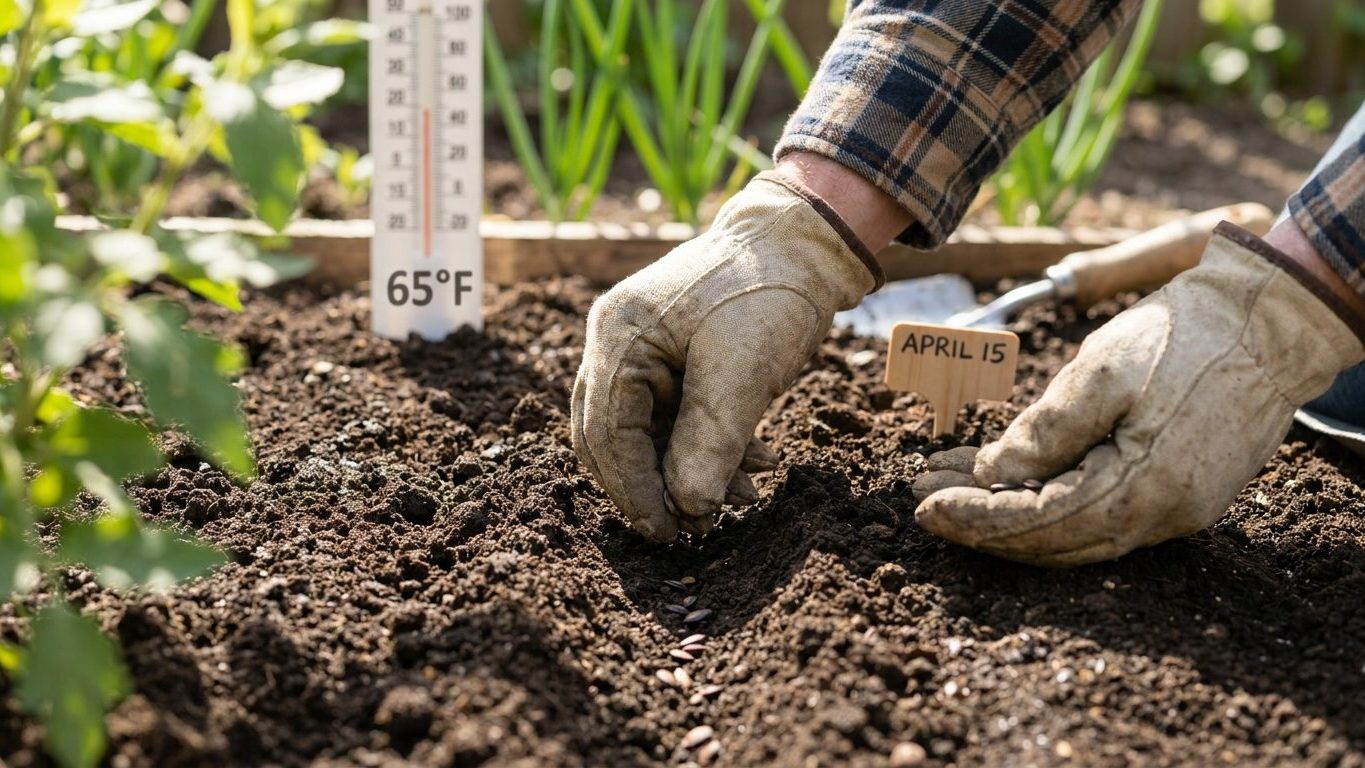

Melons need warm soil more than they need a calendar date, so the real window in Maryland runs from early May through early June for most of the state, once the last frost has passed and the soil has had time to catch up. That timing comes straight from the frost data below, not from a generic gardening rule of thumb.
The short answer for Maryland
Maryland’s last spring frost falls between April 3 and April 16, and the first fall frost arrives between October 26 and November 5, according to NOAA’s 1991-2020 Climate Normals for the reference station used in this data. Those two dates aren’t guarantees. They mark the 30-70% probability band for a 32°F freeze, meaning frost has roughly a coin-flip chance of showing up on either side of that window. That distinction matters for melons more than for almost any other crop in the garden, because melon seedlings die outright at temperatures that leafy greens shrug off.
The practical answer: don’t plant melons at the last-frost date itself. Wait two to three weeks past it, until soil temperatures sit reliably above 65-70°F at a few inches down. For most of Maryland, that pushes actual sowing or transplanting into the first half of May, sometimes later depending on the spring. Direct-seeding too close to that April 3-16 window risks cold, wet soil that rots seed before it ever germinates.
Counting backward from fall frost
The other end of the season matters too. With first fall frost landing October 26 to November 5, Maryland’s frost-free stretch runs somewhere between 193 and 216 days depending on where in that range a given year falls. Most melon varieties need 65 to 90 days from transplant to harvest, which leaves comfortable room even for a May planting. This is one place where Maryland’s season length works in a gardener’s favor: there’s rarely a race against the fall frost line the way there is in shorter-season states further north. The bigger risk here isn’t running out of season. It’s starting too early and losing the crop before it gets going.
So the short answer holds: target early May as a starting point, adjust later if a cold spring is dragging on, and trust soil temperature over the calendar square. The frost dates set the outer boundary. They don’t tell you the ideal day, and treating them as a green light the moment they pass is where a lot of melon patches go wrong.
What will not work here
Planting the moment the average last-frost date passes is the most common mistake, and it’s a mistake built directly into the probability math. An April 3-16 window means frost still has a real chance of showing up afterward in a given year. Melon seedlings have zero tolerance for that. A single light frost after transplant can wipe out a bed that took weeks to establish, and there’s no recovering a stand of ruined seedlings mid-May with enough season left to try again from seed.
Cool, wet soil is the second failure point, and it’s tied to the same early-planting instinct. Melon seed germinates poorly below roughly 65°F, and seed sitting in soil that hasn’t warmed up yet is prone to rotting before it sprouts. This isn’t a minor slowdown. It’s often a total loss that gets blamed on “bad seed” when the real cause was soil temperature.
Heat load and watering habits
Maryland averages 24.6 days a year at or above 90°F, based on Baltimore-area normals. That’s a real but moderate heat load, nowhere near what growers face in the Deep South, but enough to punish a once-a-week watering habit during a dry stretch. Melons under heat stress with inconsistent moisture tend to drop blossoms or produce fruit that splits after a sudden rain following a dry spell. Watering on a fixed weekly schedule, regardless of what the plants and soil are actually showing, is a setup for that kind of failure during any run of 90-degree days.
Rainfall timing compounds the problem. Summer rain averages about 12.6 inches across June, July and August, with June being the driest of the three at 3.98 inches. That’s not drought territory, but it’s uneven, often arriving as thunderstorms rather than steady soaks, which means a lot of that water runs off instead of soaking into the root zone. Combine that pattern with Maryland’s humidity and it’s easy to see why close plant spacing causes trouble here. Melon vines planted too tightly hold moisture on their leaves longer after rain or dew, and that’s exactly the condition powdery mildew and other fungal diseases need to take hold. Wider spacing and airflow aren’t optional extras in this climate. They’re what keeps a humid Maryland summer from turning into a disease problem by August.
What changes across Maryland
Maryland spans USDA Hardiness Zones 5b to 8a, based on the 2023 USDA Plant Hardiness Zone Map. That’s a wide spread for a state this size, and it means there is no single planting day that applies evenly from the mountains to the coast. The hardiness zone system is built on one measurement, the average annual extreme minimum temperature, so it’s a proxy for how harsh a location’s winters run, not a direct planting calendar. But it lines up with a real pattern gardeners feel every spring: the colder end of that zone range sits inland and at elevation, the milder end sits toward the water.
Western Maryland, including Garrett and Allegany counties, is mountainous terrain that runs weeks behind the rest of the state. A gardener there should expect the last frost to arrive later than the April 3-16 statewide window suggests, and should push melon planting correspondingly later, likely well into May or even early June depending on elevation. Treating the state’s frost-date range as if it applies uniformly to a mountain garden is a good way to lose a crop to a frost that was never really “late” for that particular spot.
The Eastern Shore runs the opposite direction. Milder winters and the moderating effect of the Chesapeake Bay tend to push both the last spring frost earlier and the first fall frost later than the statewide averages, which can open a slightly longer window and support earlier planting than a gardener further inland or upland would attempt. The takeaway isn’t a specific date for either region. It’s that “Maryland” as a planting zone doesn’t behave as one place, and a reader should treat the statewide frost window as a starting point to adjust from, not a fixed answer, once they know which end of the zone spread their own garden sits in.
Where to check this for your own county
The University of Maryland Extension, at extension.umd.edu, is the source built to answer what this statewide page can’t: what actually works in a specific county. State-level frost dates and hardiness zones are averages drawn from wide geographic bands. A county-level recommendation, built from local trial data and closer weather records, will always beat a statewide one for the simple reason that it’s measuring a smaller, more relevant patch of ground.
On the extension site, two things are worth looking for specifically. First, a local or regional planting calendar, if one is published for the reader’s part of the state, since it will reflect the frost timing and season length of that specific area rather than the statewide range covering both the mountains and the shore. Second, any variety trial results or recommendations tied to melons grown in Maryland conditions. Extension trials test how different varieties actually perform against the state’s real disease pressure, humidity and rainfall pattern, which is exactly the kind of local performance data a national seed catalog can’t provide.
This page has done what a statewide resource can reasonably do: lay out the frost dates, the heat and rainfall normals, and the zone spread that shape a Maryland melon planting decision. It hasn’t told a reader in Cumberland the same thing it would tell a reader in Salisbury, because that single answer doesn’t exist. The extension service is where that gap gets closed, county by county, with people who track the local numbers every season.
Checking this against your own garden
Every date in this article is a normal, an average built from thirty years of weather records. A reader’s own garden, this particular spring, on this particular patch of soil, will run its own schedule, and three simple checks tell that story better than any calendar box.
Soil warmth by feel comes first. Push a hand a few inches into the planting bed in the morning. If the soil feels cool and slightly damp rather than warmly dry, it likely hasn’t reached the range melon seed needs to germinate reliably, whatever the calendar says about the date. Waiting another week and rechecking costs nothing. Planting into cold soil risks the seed outright.
The first flush of male flowers is the second signal, and it shows up before any fruit does. Melon plants produce male blossoms first, often in noticeably higher numbers, before female flowers with the tiny swollen ovary behind the bloom appear. A strong early run of male flowers is a sign the plant has settled into its spot and is building toward fruit production, not a sign that pollination has begun yet.
The first true leaves matter too, distinct from the two rounded seed leaves (cotyledons) that emerge first. True leaves, the ones with the jagged, characteristic melon-leaf shape, signal the plant has moved past its most fragile seedling stage and started real growth. A slow or stalled emergence of true leaves after transplant, especially paired with cool, gray weather, is often the plant signaling that conditions haven’t quite caught up yet, regardless of what the statewide planting window suggests for that week.