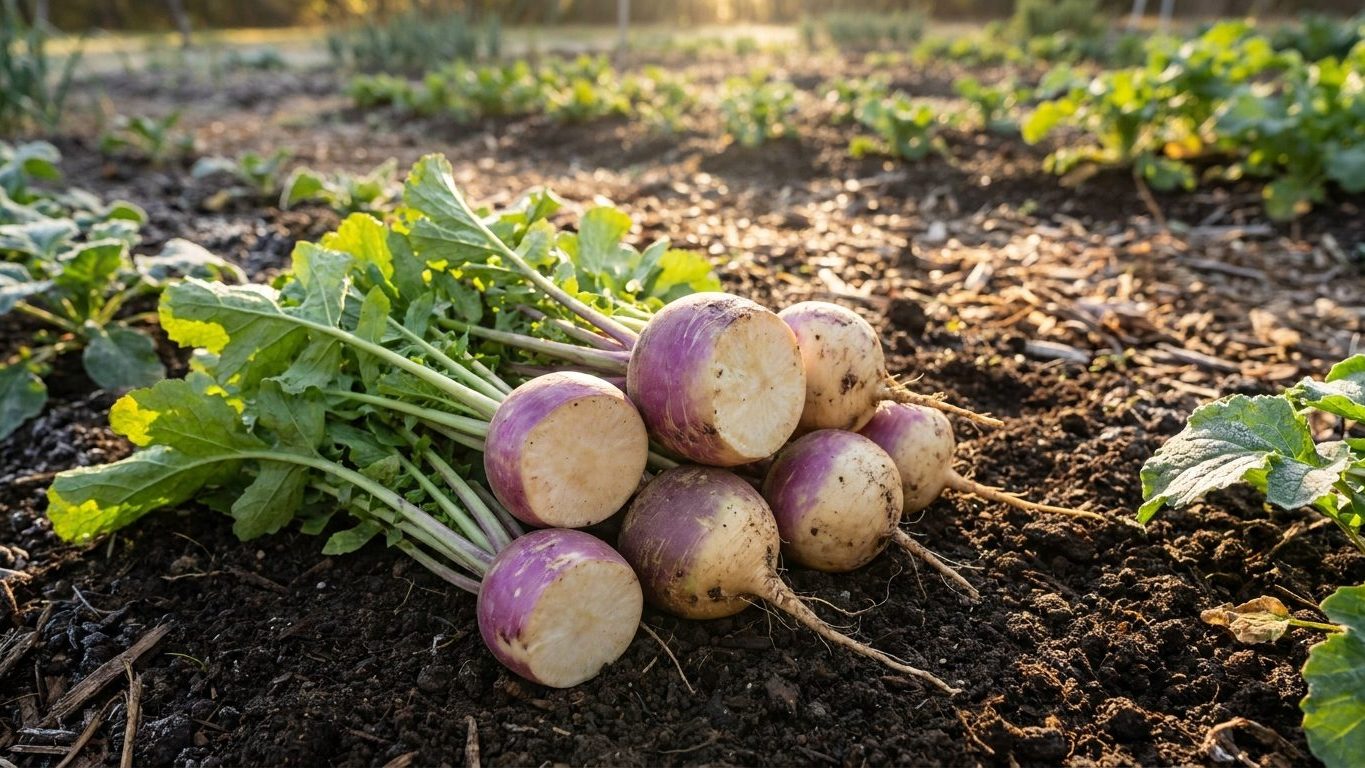

In Maryland, turnips and rutabaga are mostly fall crops, with a shorter spring window for turnips if you sow as soon as the ground can be worked. The frost calendar gives you a starting point, but the soil sets the real date. The state’s long, warm, humid summers decide the rest: when to sow, how much to water, and which types hold up.
When the soil is warm enough in Maryland
The last spring frost in Maryland falls between April 3 and April 16, according to the NOAA NCEI 1991-2020 Climate Normals (32 F freeze probabilities, 30-70% band; NOAA NCEI normals data). That is a probability, not a promise: some years a freeze arrives after the band, some years it never shows up. Western Maryland (Garrett and Allegany counties) is mountainous and runs weeks later, and the Eastern Shore runs milder, so adjust for where your garden sits.
A frost date measures the air. Turnips and rutabaga care about the soil, and soil lags behind the air by a good margin. A bed can be frost-free on paper and still be cold, soggy and slow to wake up. Seed sown into that bed sits and sulks, or rots. The soil warms after the frost risk ends, not with it.
So test the bed instead of trusting the calendar. A soil thermometer pushed a couple of inches down, read in the morning, tells you more than any chart. If you don’t own one, grab a handful of soil and squeeze it. If it forms a sodden ball that stays glued together, wait. If it crumbles when you poke it, the bed is workable. Clay-heavy soils in the Piedmont and sandy ground on the Eastern Shore will pass that test on different days, even within the same week.
Spring is the shorter opportunity. A spring turnip sown once the bed is workable has to finish before summer heat arrives, because heat pushes the plants to bolt and turns roots woody and sharp. Choose quick, small-rooted turnip types for this slot. Rutabaga is a different animal: it needs a longer stretch of cool weather to size up, which is why it belongs in the fall plan and not the spring one. The parent guide, Growing Turnips and Rutabaga: An Autumn Crop, Sweetened by Frost, covers why the whole family works this way.
A word on varieties. This page names none, because Maryland’s trial results are not in front of it and a made-up recommendation does more harm than silence. The University of Maryland Extension publishes what has actually been grown and tested in the state’s different regions, and that list is worth more than any generic seed-catalog pick.
One more thing before you sow. Turnip and rutabaga are brassicas. They share pests and diseases with cabbage, kale and mustard, so putting them into a bed where any of those grew last year rotates nothing. Count the whole cabbage family as one group when you plan the rotation, and follow the rotation page on this site for the spacing of years.
How long the season lasts here
The same NOAA normals give the other end of the calendar: the first fall frost arrives between October 26 and November 5. Put the two bands side by side and the window becomes visible.
| Marker | Date band (NOAA NCEI 1991-2020, 32 F, 30-70% band) |
|---|---|
| Last spring frost | April 3 to April 16 |
| First fall frost | October 26 to November 5 |
Count from the latest spring date (April 16) to the earliest fall date (October 26) and you get 193 days. Count from the earliest spring date (April 3) to the latest fall date (November 5) and you get 216 days. Call it a frost-free stretch of roughly 193 to 216 days, depending on how the dates pair up in a given year. Garrett and Allegany counties will not match those numbers, since their calendar shifts by weeks.
What does a window that size allow? Two sowings, comfortably. A spring planting can be pulled before summer’s worst, and a fall planting goes in late enough that the roots finish in cool weather, with the frost band still ahead. Gardeners in colder states often get one shot at the crop. In Maryland a missed spring sowing is an inconvenience, not a lost year, because the fall crop is the stronger one anyway. For spacing the sowings across weeks instead of dumping a whole packet in one afternoon, see the succession sowing guide on this site.
The length of the window also settles the transplanting question. Turnips and rutabaga build a taproot, and the root is the thing you are growing. Moving a seedling risks a kinked or forked root, and the loss of weeks of growth. In a short season you might be tempted to start indoors to buy time. With a window this long, direct sowing wins: the time you would save is not worth the root damage. If you do start flats, inspect each root when you tip the plant out, and discard any seedling with a bent or stunted taproot.
Frost dates also overstate how much growing time the crop actually uses. These are cool-weather plants, and a light frost does not end the harvest. A fall planting keeps sizing up after the first 32 F night, which is exactly what you want for flavor.
Heat and water in Maryland
This page does not carry a verified count of days above 90 F for Maryland, or a figure for summer rainfall, so it won’t quote either. What can be said without a number is that Maryland summers run warm and humid, and that is the reason turnips and rutabaga go in late for fall. Sown into midsummer heat, the plants bolt or turn woody, and the dry spells that hit between thunderstorms leave seedlings struggling. Look up local station data from your University of Maryland Extension office for your own county’s heat and rainfall before you commit to dates.
Water is the part you control. Roots that swing between dry and soaked tend to split, and uneven moisture also invites rot. Soaking the bed deeply once or twice a week and mulching the soil between rows holds the moisture steadier than a daily sprinkle. Humid air hangs foliar diseases over the bed, so thin the seedlings for airflow and water at the soil line in the morning, not on the leaves at dusk. Remember the family: these diseases are the same ones that attack cabbage, kale and mustard, which is why the rotation page matters as much as the watering schedule.
Now the cold facts, which govern the autumn crop more than any heat does. Baltimore’s coldest month has a mean daily minimum of 25.4 F (NOAA NCEI Climate Normals 1991-2020). That is the average overnight low, not the record low and not the monthly average. It sits about 6.6 degrees below freezing, a hard frost but not an arctic one. For a fall crop that is a favorable number: nights cold enough to push the roots to convert starch into sugar, without the ground locking up for months.
That suggests roots in the Baltimore area can often stay in the ground under a layer of straw or shredded leaves and be pulled as needed. In the mountains, where the USDA Plant Hardiness Zone Map 2023 puts parts of the state as low as zone 5b (the state range runs from 5b to 8a), plan to lift the roots before the ground freezes hard. A cold snap that dips well below that Baltimore average can freeze a shallow root solid.
Anything you lift for storage needs inspecting. Check each root, the crown especially. A soft patch, a weeping spot or a moldy crown ends the question: that root goes in the compost, not the cellar. A root that looks sound is not therefore safe, so keep the sound ones apart from each other and check them again. This page makes no promise about how long any root will keep.
Which turnips and rutabaga suit Maryland
Choose by type, and let Maryland’s own conditions do the ranking. Three things matter, in roughly this order for the state:
- Disease resistance first. Humid summers and a long damp stretch each fall make leaf diseases the main threat. Seed catalogs list resistance on the packet or in the description, and it counts for more here than size or color.
- Airflow and root-zone shade. Hot weather rewards types with upright, open foliage and roots that sit partly below the soil, and spacing wide enough that leaves dry quickly after rain.
- Earliness where the window is tight. The state’s window is long, so earliest types matter mostly for the spring sowing and for mountain gardens, where the calendar shifts by weeks.
Rutabaga takes a longer cool season than turnip, so it earns its bed space only if sown in time to size up before hard freeze. Turnips are the forgiving ones: they can fill gaps, go in as a fast fall crop, and give you both roots and greens.
What this page will not do is name a variety. Maryland ranges from the Eastern Shore’s flat, mild coast to mountain counties with a far shorter season, and a type that does well in one region can fail in another. The varieties trialled locally are the only recommendation that means anything, and this page does not have those trial results. Ask University of Maryland Extension, which tests and recommends for the state’s regions, and buy what it lists.
If you want to compare a different climate, the Growing Turnips and Rutabaga in Missouri and Growing Turnips and Rutabaga in Tennessee pages work through the same questions with their own frost dates and winters. Reading them side by side shows how much of the advice moves with the calendar.
Common questions
When should I plant turnips in Maryland?
Plant a spring crop once the soil is workable, which comes after the last spring frost band of April 3 to April 16. Plant the main crop in late summer, timed so the roots finish before the fall frost band of October 26 to November 5. Both bands are probabilities and shift by region.
Can I grow rutabaga in Maryland?
Yes, as a fall crop. It needs a longer cool season than turnip, so sow it in time for the roots to size up before the hard cold. Ask University of Maryland Extension which types have been trialled for your region.
Can turnips and rutabaga stay in the ground over winter?
Around Baltimore, where the coldest month has a mean daily minimum of 25.4 F, mulched roots can often stay in the ground. In the mountains, lift them before the ground freezes hard. Inspect anything you lift: a soft patch, a weeping spot or a moldy crown means discard it.
Can I plant turnips where cabbage grew last year?
No. Turnip and rutabaga are brassicas, sharing pests and diseases with cabbage, kale and mustard. Treat them as one rotation group and follow the rotation page on this site.