
Squash vine borer moths start flying in Maryland in late June, with peak activity running through mid-July. That’s the window when eggs get laid at the base of squash and pumpkin stems, and it’s also the only stretch when prevention actually works. Once larvae tunnel inside a stem, no spray fixes the damage. The plant either survives the injury or it doesn’t.
Maryland gardeners lose zucchini and yellow squash to this pest almost every season, often blaming the sudden wilt on drought or disease. It’s neither. A borer larva has usually been feeding inside the main stem for a week or two by the time the vine collapses, and by then the damage is done.
The weeks to watch

The insect overwinters as a mature larva or pupa inside a tough, silk-lined cocoon buried one to six inches deep in the soil, usually right where last year’s squash plants grew. As soil warms in spring, the pupa develops, and the adult moth emerges once conditions hit a fairly predictable threshold.
In central Maryland, that translates to first emergence around the third week of June most years, with the heaviest flight activity from late June through the third week of July. Coastal and Eastern Shore counties, where soil warms a bit earlier, sometimes see moths a week ahead of that. Western Maryland’s higher elevations can lag behind by a similar margin. Weather swings shift the calendar too: a warm spring pulls emergence forward, a cold, wet one pushes it back.
Most of the state gets one generation per year. But in warmer seasons, or in the southern and coastal counties, a partial second generation can show up in August, laying eggs on plants that escaped the first wave. That’s why a squash plant that looked perfectly healthy in July can still wilt and die in late August. Gardeners who assume the threat ends after the Fourth of July are often caught off guard by this second push.
Growing degree days matter more than the calendar
Because moth emergence tracks soil and air temperature rather than a fixed date, growing degree day (GDD) accumulation is a more reliable predictor than “check your calendar for late June.” Extension entomologists generally flag the start of significant squash vine borer flight around 900 to 1,000 accumulated GDDs (base 50°F) from January 1. In a typical Maryland season, that threshold lands right around the third week of June, which is why the calendar estimate and the GDD estimate usually agree. In an unusually warm or cool year, though, GDD tracking catches the shift weeks before a fixed date would.
How to tell it’s squash vine borer, not something else
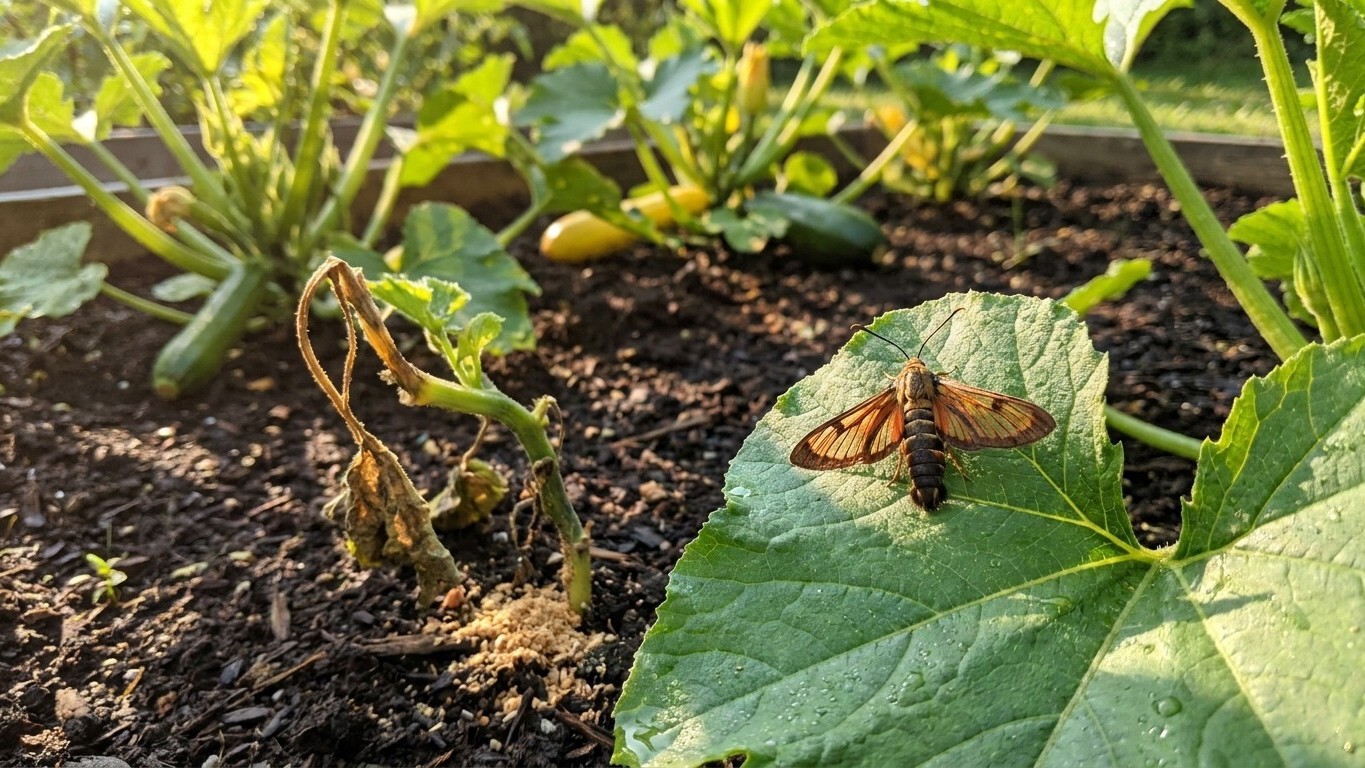
The adult is easy to misidentify because it doesn’t look like a typical moth. It flies during the day, has a wingspan close to an inch and a half, and sports an orange abdomen ringed with black dots, orange hind legs fringed with black hairs, and metallic greenish-black forewings. Gardeners often mistake it for a wasp on first glance. It’s most active in the morning and again in early evening, hovering around the base of squash plants to lay eggs.
The eggs themselves are small, flat, and brownish-red, usually laid singly at the base of stems or on leaf stalks near the soil line. They’re easy to miss unless you’re specifically checking the lower stem each week during flight season.
Once larvae hatch, the signs shift. Look for:
- Sudden wilting of one vine or the whole plant, even with adequate soil moisture
- A small entry hole near the base of the stem, often oozing a wet, sawdust-like frass
- A soft, hollowed-out feeling when you press the lower stem
- Larvae themselves: cream-white, wrinkled grubs up to an inch long, visible if you slit the stem open
Frass at the base of a squash stem is the single most reliable field sign. It looks like wet green-yellow sawdust and usually shows up before the plant visibly wilts, giving an attentive gardener a short head start.
What actually stops squash vine borer in Maryland gardens
Control has to be timed to the biology, not applied after wilting starts. Everything effective happens either before eggs are laid or in the narrow window right after larvae hatch but before they’ve tunneled deep into the stem.
Row covers, timed correctly
Floating row covers placed over young plants before moths emerge block egg-laying entirely. The catch is that squash flowers need pollinators, so covers have to come off once plants start blooming, right around the time moth flight peaks. Some growers hand-pollinate for a week or two, keeping covers on longer and removing them only in early morning to let bees in, then replacing them by midday. It’s extra labor, but it closes the gap that row covers otherwise leave open.
Stem protection at planting
Wrapping the lower four to six inches of stem in aluminum foil or a strip of nylon stocking creates a physical barrier moths can’t lay eggs through. Mounding soil an inch or two over the base of the stem accomplishes something similar and has the side benefit of encouraging secondary rooting, which helps a plant survive even if a borer does get in higher up the stem.
Insecticide timing, not insecticide choice
Sprays only work against eggs and newly hatched larvae sitting on the stem surface, before they bore inside. That means treatment has to be timed to adult flight, not to the appearance of wilted plants. Products containing spinosad or carbaryl, applied to the base of the stem weekly during peak flight (roughly late June through mid-July in most of Maryland), interrupt egg-laying and kill young larvae before entry. Once a larva is inside the stem, no surface application reaches it.
Bacillus thuringiensis (Bt) can also be injected directly into the stem with a syringe near the entry hole, a more surgical option for gardeners who catch an infestation early and want to save an individual plant rather than treat the whole row.
Surgical removal for plants already infested
If a stem is wilting and frass is visible, a vertical slit along the stem near the entry hole, made with a sharp knife, lets you dig out the larva by hand. After removal, mounding moist soil over the wound encourages the plant to root at that node and often allows it to recover, especially if the damage is caught within a few days of the first wilt symptoms. This works far better on vining winter squash and pumpkins, which root readily along the vine, than on bush-type zucchini and summer squash, which have a single main stem and less capacity to recover from surgery.
Resistant and less-preferred varieties
Not all squash species are equally attractive to egg-laying moths. Butternut squash (Cucurbita moschata) has a solid, less hollow stem and is consistently among the least preferred hosts, making it a reasonable substitute for gardeners who’ve lost zucchini or pumpkin crops repeatedly. Cucumbers and melons, both in different genera, are rarely bothered at all. Zucchini, yellow summer squash, and most pumpkins remain the highest-risk plantings.
Cultural practices that reduce next year’s population
Because larvae pupate in the soil right around the base of infested plants, tilling that area in fall or early spring exposes overwintering cocoons to freezing temperatures and predators, cutting survival significantly. Rotating squash plantings to a different part of the garden each year, even a modest 15 to 20 feet away, also reduces the odds that emerging moths find host plants immediately. Removing and destroying infested vines at the end of the season, rather than composting them, eliminates a source of next year’s population rather than just relocating it.
Timing a second planting to dodge peak flight
Because Maryland’s borer flight is concentrated in a known window, staggered planting is one of the more practical strategies for home gardens. A crop started indoors and transplanted in early May often reaches a sturdier, more established stage by the time moths are active in late June, giving it a better chance of tolerating minor stem damage. A second planting made in early July, timed to germinate and establish after peak flight has passed, frequently avoids the worst of the pressure altogether and can still produce a full harvest before frost, since squash matures quickly.
Gardeners in Maryland’s warmer coastal counties who see a partial second generation in August should treat that late planting with the same stem-base vigilance they applied in June, since a plant that dodged the first wave isn’t automatically safe from the second.
Related guides
- Squash vine borer in Delaware: When It Shows Up and What Stops It
- Squash vine borer in Pennsylvania: When It Shows Up and What Stops It
- Squash vine borer in Massachusetts: When It Shows Up and What Stops It
- Squash vine borer in Michigan: When It Shows Up and What Stops It
- Squash vine borer in Missouri: When It Shows Up and What Stops It
- Squash vine borer in South Dakota: When It Shows Up and What Stops It