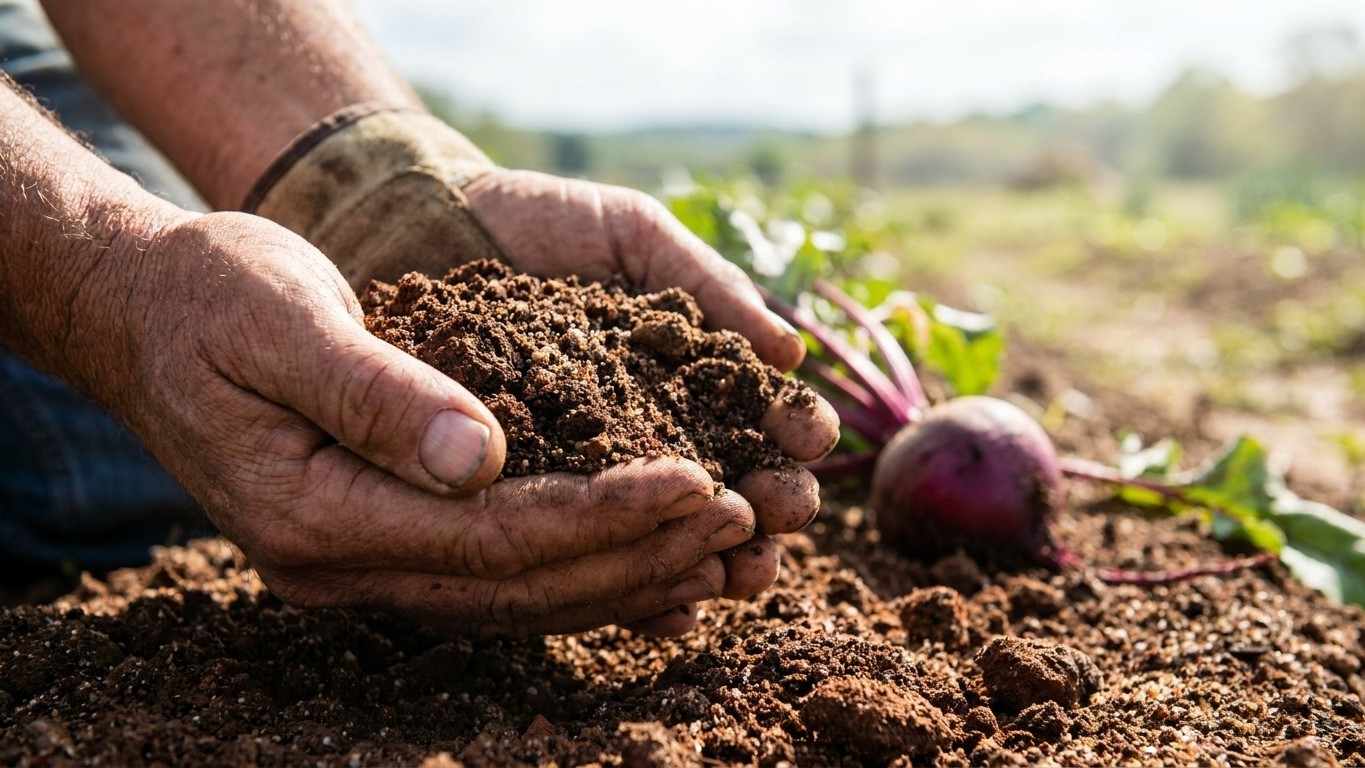

Plant a beet in Massachusetts and the root drops into ground that formed only a few thousand years ago under glacial till: acid, sandy, quick to drain, quick to dry out. That’s the state’s typical starting point, not a guarantee for any one yard. What actually decides whether the crop turns out sweet and round or split and woody is what happens in the six weeks after seeding, when frost timing, spring moisture, and early heat all land on a root that’s still deciding its shape.
The short answer
Massachusetts’ official state soil is the Paxton series, an Inceptisol, meaning it’s young and hasn’t built strong horizons the way older soils have. USDA data on the surface horizon of the series’ major components (265 components sampled) puts the texture at 61 percent sand, 7 percent clay, and 32 percent silt, with a surface pH around 5.5 and organic matter around 5.5 percent. The series is well drained, and Massachusetts law named it the state soil in 1990.
For a beet root, that texture is mostly good news. Sandy, well-drained ground lets a taproot push straight down without hitting a hardpan, so you’re less likely to see the forked or twisted roots that come from compacted clay. The tradeoff is that sandy soil sheds water fast. A root that depends on steady moisture in its first weeks will feel a dry stretch sooner in Paxton-type ground than it would in a heavier, clay-rich soil that holds water longer.
The pH sits on the acid side of neutral. That’s worth flagging on a soil test rather than assuming, because the 5.5 figure is a mapped average for the series as surveyed, not a measurement of any single worked garden bed.
What the heat side of the equation adds
The climate data used for this page (NOAA’s 1991-2020 normals for Logan Airport) doesn’t include a simple count of days per year above 90 F, so that figure isn’t published here. What matters more directly for beets, per Utah State University Extension, is that heat above 85 F combined with water stress is what turns a root woody. Sandy soil that dries fast raises the odds of hitting that combination during a hot stretch, which is a separate risk from the early bolting problem covered next.
None of this replaces a soil test. Massachusetts spans hundreds of mapped soil series, and river bottoms, hill country, and any lot a builder has graded or filled can look nothing like Paxton. Treat these numbers as what the region’s ground tends to do, not as a diagnosis of your own bed.
The six weeks that decide it here
Beets go into the ground as seed, not as transplants, and the standard timing is 2 to 3 weeks before the last spring frost. For Massachusetts, NOAA NCEI’s 1991-2020 climate normals put the last spring freeze (32 F) in the 30 to 70 percent probability band between April 1 and April 8, based on the Logan Airport station. That means the first six weeks of a beet’s life, sown on that schedule, usually falls somewhere across mid-March into May depending on exactly when a gardener seeds.
That window matters because it’s the same one Utah State University Extension flags as the make-or-break period for bolting: water stress during the first six weeks after seeding pushes beets toward premature flowering instead of root growth. Once a beet bolts, the energy goes into a flower stalk, and the root you were counting on stays small and tough.
Why the Logan number needs a local adjustment
Logan is a waterfront, urban station and the mildest spot in the state for frost timing. Inland suburbs and the Berkshires freeze later in spring and earlier in fall than that reading suggests, so a gardener working from the Logan-based date alone risks seeding too early for their actual local frost, or miscounting how long their six-week risk window really runs. The 2 to 3 week rule should be measured against a local frost date, not the coastal one, even though a single adjusted figure for inland Massachusetts isn’t published in the data behind this page.
Massachusetts spring in that stretch tends to swing rather than hold steady: thawing ground and rain one week, a dry, windy stretch the next as the topsoil warms. In sandy, well-drained ground like the Paxton series, that swing shows up fast at root level, because there’s little clay to buffer moisture between rains. That’s where the bolting risk concentrates here, in the early weeks right after seeding, before summer heat is even a factor.
What goes wrong here
- Bolting from an early dry spell. A week or two without rain during the first six weeks after seeding is enough to trigger premature flowering in beets, and sandy Paxton-type soil dries out faster than a clay-rich soil would. Check the top inch of soil weekly through that window and water before it fully dries, rather than waiting for visible wilting.
- Woody roots from a hot, dry stretch later on. This is a different failure from bolting. Once temperatures run above 85 F, any accompanying water stress toughens the root’s texture. Keep watering consistent through hot spells and consider mulch to slow moisture loss from sandy ground, since bare Paxton-type soil dries quickly under direct sun.
- Forked or hairy roots from over-amending or buried stones. Paxton soils can carry stony phases, and piling on fresh compost doesn’t fix that, it just adds another obstacle. Cap composted organic matter at 1 inch per 100 square feet, per Utah State University Extension guidance, and pick out stones when working the bed rather than tilling around them.
- Nutrient lockup from acidic ground. A surface pH near 5.5, on the acid side of neutral, can limit how well beets take up certain nutrients even when moisture and timing are right. A soil test, not an assumption based on the state soil figure, is the only way to know if lime is needed on your bed.
- Sowing on the coastal frost date instead of a local one. Using Logan’s April 1 to April 8 window as if it applied statewide can mean seeding too early inland, risking frost damage to seedlings, or misjudging how long the six-week risk period actually runs on a given property. Check a local frost record rather than the coastal figure before counting back 2 to 3 weeks.
Common questions
How long do beets take to mature from seed in Massachusetts soil?
Beets are direct-seeded, not transplanted, and Utah State University Extension’s guidance frames maturity as running from seeding, typically in the 60 to 80 day range depending on conditions through the season, not from any later transplant date.
Does the state soil tell me what’s in my own garden?
No. The Paxton series is the legally designated state soil and a useful reference point, sandy, acid, well drained, but Massachusetts contains hundreds of other mapped soil series. A river bottom, a hillside, or a lot that’s been graded or filled can differ completely. A soil test is the only way to know your own numbers.
When is it safest to sow beets outdoors?
The standard rule is 2 to 3 weeks before the last spring frost. NOAA’s 1991-2020 normals put that date, for the Logan Airport station, between April 1 and April 8 in the 30 to 70 percent probability band. Inland and higher-elevation areas of the state typically see frost linger later into spring than that coastal reading.
Can acidic, sandy soil be fixed for beets?
A soil test will show whether lime is needed to bring pH up from an acidic reading. On the organic matter side, Utah State University Extension recommends capping composted amendments at 1 inch per 100 square feet, since sandy soils like the Paxton series don’t need heavy amending to stay workable, they need moisture management more than bulk organic matter.