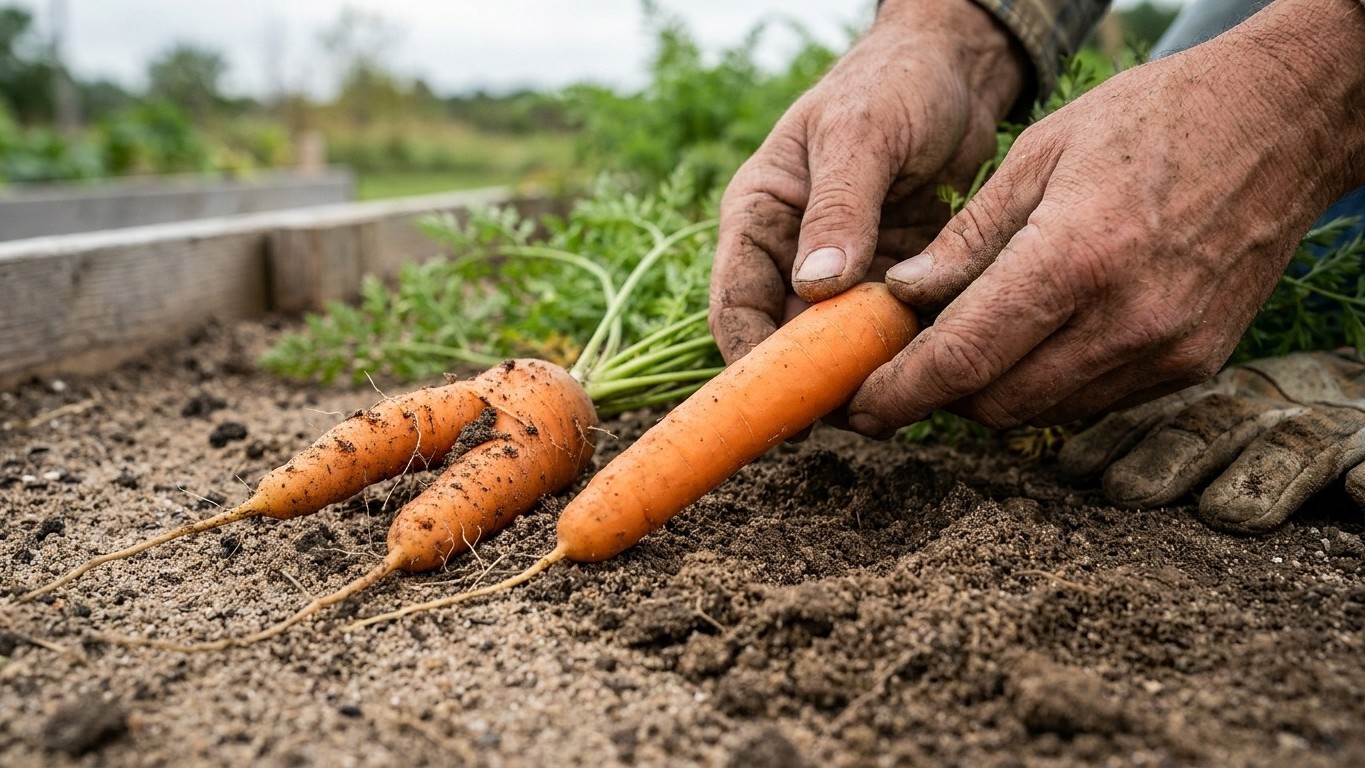

Michigan’s official state soil, the Kalkaska series, is sandy and acidic, exactly the kind of ground carrots like on paper but not necessarily the ground you’re standing on. The real answer depends on drainage, depth and how much clay sits under your particular bed, and that’s what settles whether your carrots grow straight or fork.
The short answer
Michigan’s designated state soil, named by state law and tracked under the USDA NRCS State Soils programme, is the Kalkaska series. It’s classified as a Spodosol, the kind of soil that forms under conifer forests through centuries of leaching. The surface horizon runs about 86 percent sand, 5 percent clay and 9 percent silt, with a surface pH around 4.7, which is strongly acid. Drainage is described as somewhat excessively drained, meaning water moves through fast rather than sitting. Organic matter at the surface averages around 75 percent, though that figure reflects a natural forest floor layer of needles and duff, not a worked garden bed with that much decomposed matter mixed in.
For a carrot, sandy and loose is close to ideal. Utah State University Extension is blunt about what carrots want: deep, sandy, well-drained soil rich in organic matter. Roots pushing down through fine, uncompacted sand meet almost no resistance, so they grow long and straight instead of splitting around a rock or twisting past a clay lens. Kalkaska soil, on paper, leans toward the friendly end of that spectrum. The acidity is a separate issue and would need lime worked in over time to bring it toward a range most vegetables tolerate better, but acidity alone doesn’t cause forking. Getting the timing right matters just as much as the soil itself, and that’s covered in When to Sow Carrots in Michigan.
Forking happens for a different reason. Utah State University Extension names it directly: heavy or rocky soil makes the root fork. If what you’re actually digging in is compacted clay, construction fill, or ground littered with stones, and not the sandy profile the state soil represents, you’re in forking territory regardless of what Michigan’s official soil looks like, and it’s worth checking Will Carrots Fork in Michigan Soil? for the specifics. The fix Utah State University Extension gives is straightforward: work in plenty of compost and double dig the bed, loosening and amending down farther than the carrot will ever need to reach. Where that’s impractical, because the clay runs deep or the yard has been graded and compacted by a previous owner, a raised bed filled with a sandy, compost-rich mix sidesteps the problem entirely.
None of this is a diagnosis of your yard. Michigan spans hundreds of mapped soil series, and the Kalkaska series describes forestland ground under state law, not the soil under your tomato stakes or your carrot rows. River bottoms run heavier and richer. Hill country varies by the slope. Any lot a builder has scraped, filled, or graded can bear no resemblance to what the county soil survey shows for that address. Treat the state soil as a starting point for what the region’s ground tends to do, sandy and quick-draining in a lot of places, and then check your own dirt before you decide anything.
The test that settles it in your own garden
A shovel tells you more in ten minutes than any statewide average ever will. Here’s how to read your own bed before you commit a seed packet to it.
- Dig a hole at least a foot deep where you plan to sow. Carrots need loose ground with no obstruction for most of that depth, so this is the first thing to check.
- Look at what the hole shows you. Note any change in color or texture as you go down, and note whether you hit rocks, a hardpan layer, or a dense clay band that resists the shovel.
- Pull out a handful of soil from the working depth and rub it between your fingers. Gritty and loose suggests sand. Sticky, smooth and moldable when wet suggests clay. Something in between, holding a shape loosely but crumbling with a poke, suggests loam.
- Fill the hole with water and watch it drain. Fast disappearance points toward excessively drained, sandy conditions like those the Kalkaska series represents. Standing water that lingers for hours points toward compacted or clay-heavy ground, the kind that forks a carrot root.
- Repeat the dig in two or three spots around the yard. Soil can change completely within twenty feet, especially on a lot that’s been partly filled or regraded, so one hole isn’t the whole story.
When to sow here
Carrots are sown directly into the ground. There’s no transplanting step to plan around, and the 70 to 100 days to harvest that most varieties need are counted from the day the seed goes into soil, not from any later date. Timing here comes down to three numbers working together.
- Start with the last spring frost. MSU Extension puts that date around April 30 in the Detroit area, with early to mid May typical across most of the Lower Peninsula. That date is your anchor point.
- Carrot seed needs soil at least 40 F to germinate at all, so before anything else, the ground has to have warmed past that floor. In much of the Lower Peninsula that happens close to the same window as the last frost, sometimes a little before.
- Sow 2 to 3 weeks before that last frost date. Working backward from an April 30 last-frost date puts sowing in mid to late April; working from an early to mid-May date pushes sowing into late April or the first half of May, depending on where in the state you’re gardening.
- Germination happens fastest and most reliably between 55 F and 65 F soil temperature. Sowing that early-spring window usually lands you close to that range as the soil finishes warming, rather than in the cold 40s where seed can sit for weeks doing nothing, or later in a hot spell where germination struggles for a different reason.
None of this arithmetic is exotic. It’s the same logic gardeners run every spring: find the frost date for your part of the state, count backward two to three weeks, and check that the soil itself, not just the calendar, has actually warmed to 40 F before the seed goes in.
What goes wrong here
- Forking in heavy ground. Clay pockets, construction fill or compacted subsoil block the taproot and split it around the obstruction. Utah State University Extension’s remedy is plenty of compost worked in along with double digging, loosening the bed well past the depth the root will reach, or switching to a raised bed filled with a sandy, well-drained mix.
- Poor germination in a hot spell. Carrot seed germinates best between 55 F and 65 F. A stretch of unseasonably warm days right after sowing, or sowing too late into a warming spring, can push soil temperature past that range and leave a thin, patchy stand. Sowing at the earlier end of the 2- to 3-week pre-frost window, once soil has cleared the 40 F minimum, gives the seed a better shot at hitting that cooler range.
- Splitting from uneven water. Roots that grow through a dry stretch and then get hit with heavy rain or a deep watering swell too fast and crack. Keeping moisture level with regular, consistent watering rather than letting the bed dry out and then soaking it heavily is the straightforward fix, and it matters most on sandy, fast-draining ground like the Kalkaska profile, where moisture disappears quickly between waterings.
Checking this against your own county
State-level soil data and a statewide frost window are a place to start, not a final answer for your address. Michigan State University Extension runs county-based outreach across the state, and its local offices can speak to conditions specific to your county rather than the state average. You can find your local office and its resources through MSU Extension’s outreach directory. A county-level soil test, along with a conversation with staff who know the local ground, will tell you far more than any statewide figure about whether your bed needs compost, a raised frame, or nothing at all beyond a rake and a seed packet.
Common questions
Does Michigan’s official state soil mean my backyard is sandy?
Not necessarily. The Kalkaska series is one soil series among hundreds mapped across Michigan, tied to forestland conditions under state law. Your own lot could be sandy, clay-heavy, or somewhere in between depending on your specific location and history of grading or filling.
Can I sow carrots in Michigan clay soil without a raised bed?
Yes, if you’re willing to double dig and work in plenty of compost, per Utah State University Extension’s guidance for heavy soil. A raised bed filled with a sandy, compost-rich mix is simply a faster route to the same loose, deep profile carrots need.
How early can I sow carrot seed in spring in Michigan?
Sow 2 to 3 weeks before your local last frost date, once soil has warmed to at least 40 F. That works out to mid to late April in the Detroit area, and roughly late April into the first half of May farther across the Lower Peninsula.
Why did my carrots come up patchy this year?
Carrot seed germinates best between 55 F and 65 F soil temperature. A hot spell right after sowing, or sowing too late once soil has already warmed past that range, is a common cause of thin, uneven stands.