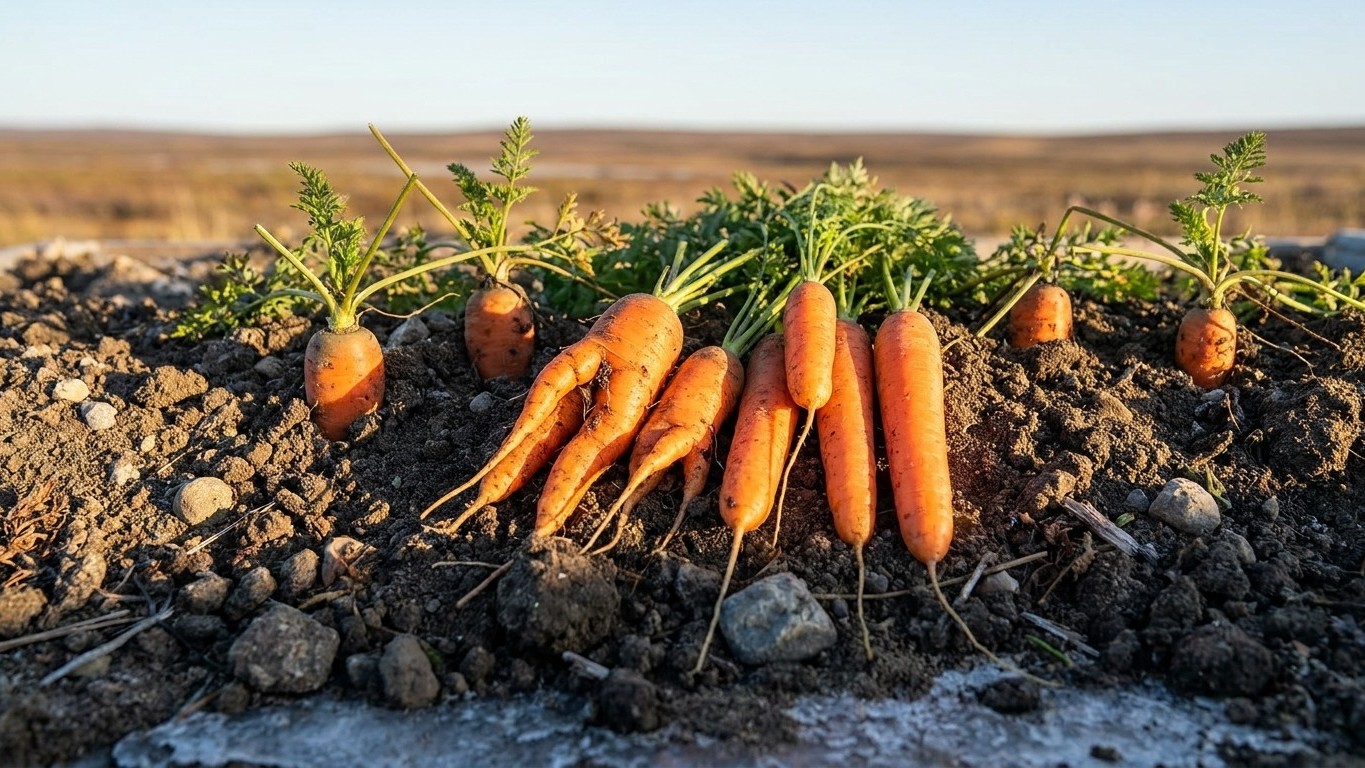

There’s no single, current answer to “what eats carrot in Massachusetts,” because no state agency keeps a static list of carrot pests, and pest pressure shifts by county and by year. What decides most of what a home gardener actually sees is simpler: the soil the root grew in, and the exact day count from seeding to harvest and storage. Those numbers are fixed. The insects are not.
Which pests attack carrot in Massachusetts
The sourced material behind this page does not include a Massachusetts-specific inventory of insects that feed on carrot roots or foliage. That is worth saying plainly rather than papering over: pest scouting reports change from one growing season to the next, they vary by county, and a fixed list published once would already be stale by the time a reader found it. Naming species here without that kind of current, local documentation would be a guess dressed up as a fact, and this page won’t do that.
What the record does support, solidly, is the ground those roots grow in and what that ground does on its own, no insect required. Massachusetts’ official state soil is the Paxton series, an Inceptisol, a young soil that hasn’t developed strong horizons yet. USDA’s Soil Survey Geographic Database gives representative surface values across 265 mapped components of that series: 61 percent sand, 7 percent clay, and 32 percent silt, a surface pH around 5.5, organic matter near 5.5 percent, and well-drained overall. That’s a sandy, mildly acidic, free-draining surface layer, not the tight, waterlogged clay that some gardeners assume “New England soil” means everywhere.
Carrots want exactly that kind of profile. Utah State University Extension’s guidance on carrot growing is direct: the crop needs deep, sandy, well-drained soil rich in organic matter, and heavy or rocky soil makes the root fork. That single fact does more diagnostic work than a pest list would. A gardener working ground that resembles the Paxton profile is starting from a texture the crop actually wants. A gardener working heavier, rockier, or compacted ground, which exists throughout the state despite what the official soil says about the region as a whole, is working against the plant before any insect shows up.
The Paxton series describes what the state’s ground tends to do at the surface as mapped. It is a starting point, not a diagnosis of any one backyard. River bottoms, hill soils, and any ground a builder has graded or filled will differ, sometimes completely, from those representative numbers. A home soil test, not the state soil profile, is what settles pH and texture for an actual garden bed. That test is also the fastest way to rule out soil as the cause of a bad-looking carrot before assuming something ate it.
When each one shows up, and what it does first
Because there’s no published, current pest calendar for this crop in Massachusetts, the timeline that can be stated with confidence is the crop’s own. Carrots are sown directly in place, never transplanted, so every day count on this page runs from the seeding date, not from any later date in the ground. Utah State University Extension counts the full growing period at roughly 70 to 100 days from seeding to a mature root, depending on the growing conditions and how long a gardener chooses to leave roots sizing up in the ground.
Clemson Cooperative Extension gives a narrower, harvest-focused window: carrots are ready to pull “about 65 to 75 days after planting.” The two figures aren’t contradictory, they’re measuring different things. One is the outer range for the crop to mature fully, the other is the practical point at which most home gardeners actually dig. Either way, nothing meaningful can be said about “what shows up first” on a fixed calendar month, because a carrot bed sown early against a late frost and one sown in warm soil weeks later hit the same growth stages on different actual dates.
That’s the practical lesson for anyone trying to catch feeding damage early: track it against your own seeding date, not the calendar on the wall. A root that looks fine at 40 days and shows a problem by 65 to 75 days has had roughly that many days for something, insect, soil, or moisture stress, to act on it. A forked or stunted root, specifically, is a symptom that develops from the earliest weeks of root growth even though it’s only visible at harvest, which is why blaming a late-season insect for early-season forking gets the timeline backwards.
Foliage-level problems, when they occur, tend to show earlier than root problems simply because leaves are visible above ground the whole season while the root is hidden until harvest. That’s a mechanical fact about where you’re looking, not a claim about which specific organism is responsible. Anyone seeing chewed or discolored foliage well before the 65-to-75-day harvest window has more useful evidence, an actual date and an actual symptom, to bring to a county extension office than a name pulled from a general list would ever provide.
Telling the damage apart from everything else
Most of what looks like insect damage on a home carrot bed isn’t. The two sourced facts on this page, soil texture and storage temperature, already explain two of the most common complaints without any insect involved at all.
| What you see | Likely cause | What separates it from feeding damage |
|---|---|---|
| Forked, split, or stubby root | Heavy, rocky, or compacted soil | Happens even with zero pests present; Utah State University Extension names heavy or rocky soil directly as the cause. A soil test and a raised bed or double-digging fix it, not a spray. |
| Soft, limp, or sprouting roots weeks after harvest | Storage above 33°F, or tops left on | Clemson Cooperative Extension notes 33°F storage with high humidity, and that bunched carrots with tops on last only 10 to 14 days versus months for trimmed roots, because the leaves keep pulling moisture from the root. No feeding marks means storage temperature, not an insect, is the cause. |
| Actual tunnels, holes, or missing tissue in the root or leaves | Feeding damage from an organism | This is the one category that genuinely needs identification, and that identification should come from a current county extension observation, not a guess from an article. |
The distinguishing habit worth building is simple: check the two things this page can source, soil texture and storage temperature, before assuming anything ate the carrot. A root with no chew marks, no tunnels, and no discoloration that simply came out crooked has a soil problem, not a pest problem. That single check eliminates a large share of what home gardeners report as “something’s eating my carrots” every season.
What actually works here, and what is a waste of time
On a texture-driven problem like forking, the fix is physical, not chemical. Utah State University Extension’s answer for heavy soil is plenty of compost and double digging, or building a raised bed filled with a lighter mix, so the root has a clear, loose path down instead of pushing around rock and clay. That work has to happen before seeding, since carrots are sown in place and can’t be moved once they’ve started forking.
On the storage side, the single highest-value habit is cutting the tops off before the roots go into cold storage, then holding them at 33°F with high humidity. Leaving the tops on for looks, or storing at a warmer, more convenient temperature like a garage shelf or a refrigerator crisper set higher than that, is what turns a root that should keep for months into one that softens or sprouts in under two weeks.
What’s a waste of time, based only on what’s sourced here: treating a forked or stubby root as a pest problem and reaching for a spray. No pesticide corrects soil texture, and applying one to roots that were always going to fork on heavy ground solves nothing while adding cost and risk. Equally wasteful is guessing at pest identity and timing a treatment against a symptom that a home soil test or a storage temperature check would have already explained. Where actual feeding damage is confirmed, the state’s Cooperative Extension office is the only source that knows what’s currently labeled for use in Massachusetts, and that answer changes over time in ways a general gardening article can’t track.
Where to check this for your own county
Massachusetts’ land-grant Cooperative Extension is based at the University of Massachusetts Amherst, operating through UMass Extension and its county-level offices and programs. That’s the correct first call for anything beyond what’s sourced on this page: current pest scouting reports, confirmation of an actual insect from a sample or photo, and whatever treatment options are currently labeled for use in the state, none of which this page can responsibly guess at.
What’s mapped at the state level, including the Paxton soil profile discussed above, describes a broad average across hundreds of components sampled statewide. It does not describe any one garden. Pest presence works the same way: a county with active reports of a given insect this season says nothing certain about the next town over, let alone a specific backyard bed. Treat any general list, including a hypothetical statewide one, as background, not a diagnosis.
The next useful step for a gardener looking at a damaged carrot bed is concrete: pull a root, note whether the damage is a fork (soil), a soft spot with no chew marks (storage or moisture), or an actual tunnel or bite mark (feeding), then bring that specific, dated observation to the county extension office rather than a species name guessed from a search engine. A home soil test, ordered through that same office, settles the pH and texture question for the actual bed, since the state figure of pH 5.5 and 61 percent sand describes the Paxton series as mapped, not necessarily the dirt under any one garden fence.
Common questions
Does Massachusetts publish a single official list of carrot pests?
Not one that this page’s sourced material includes. Pest pressure is monitored and reported on a rolling basis by county through Cooperative Extension programs, which is a better source than any fixed list because it reflects the current season.
Why did my carrots come out forked instead of straight?
Utah State University Extension attributes forking directly to heavy or rocky soil that blocks the root’s downward growth. The fix is compost and double digging, or a raised bed, not a pest treatment.
How long can I actually store carrots before they go bad?
Clemson Cooperative Extension puts trimmed roots at 33°F with high humidity for long-term storage, while bunched carrots with the tops still on last only about 10 to 14 days, because the leaves continue drawing moisture out of the root.
When should I count “days to harvest” from, seeding or transplanting?
Always from seeding. Carrots are sown directly in the garden and never transplanted, so the 70 to 100 day range from Utah State University Extension and the 65 to 75 day window from Clemson Cooperative Extension both start on the day seed went into the ground.