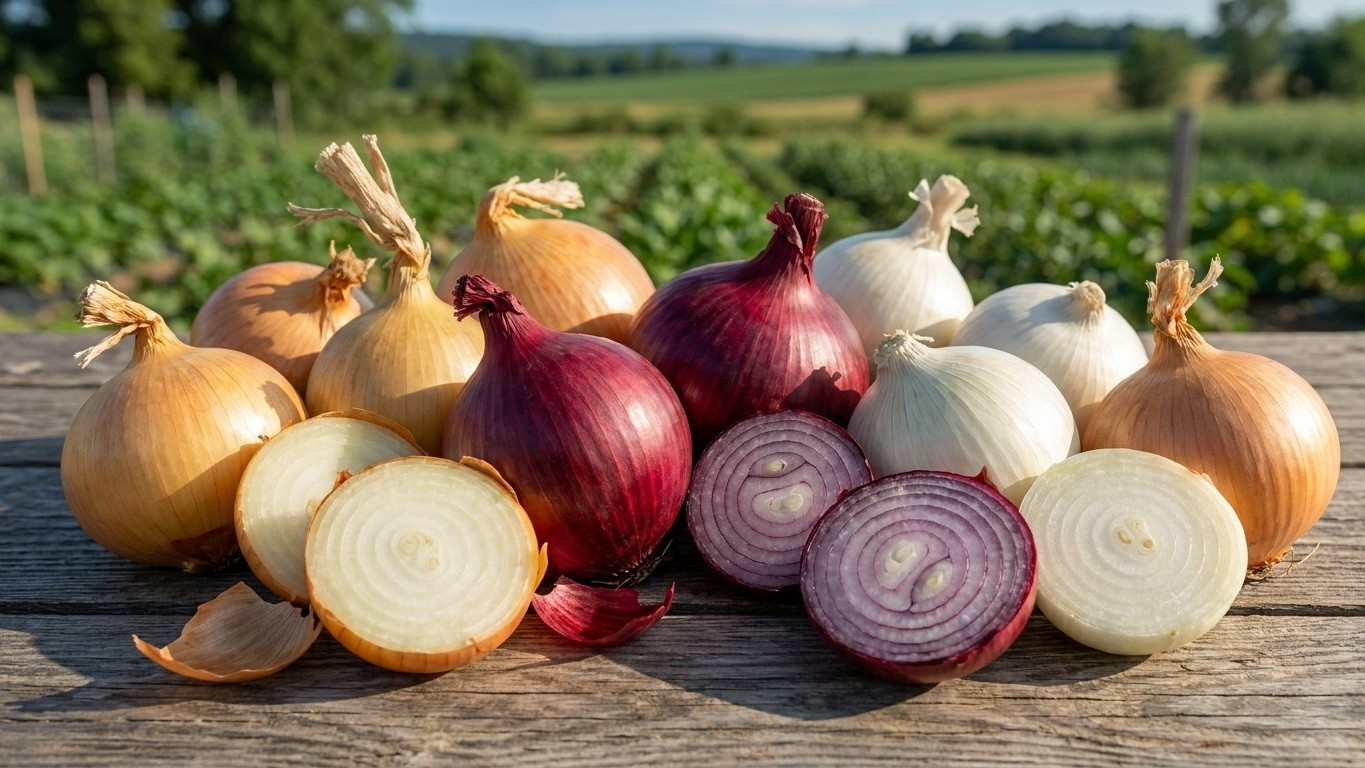

Ask what’s eating your onions in a Massachusetts garden, and the honest answer is: probably nothing that anyone tracks by name. UMass Extension documents ten pests active in this state’s landscapes and gardens, and not one of them is a dedicated onion feeder. That’s not a dodge, it’s the record. Onion trouble here usually traces back to soil, water, or weather rather than a chewing insect, and knowing why the documented list looks the way it does tells you what’s actually worth watching in your own rows.
Which pests attack onion in Massachusetts
UMass Extension documents ten species for this territory: Cabbage root maggot fly, Colorado potato beetle, European corn borer, Lily leaf beetle, Mexican bean beetle, Spotted lanternfly, Squash bug, Squash vine borer, Striped cucumber beetle, and Winter moth (Operophtera brumata). Run each one against onion and the list falls apart fast.
- Cabbage root maggot fly targets the base of cole crops, cabbage, broccoli, radish, not the bulb layers of an allium.
- Colorado potato beetle feeds almost exclusively on potato, eggplant, and other nightshade foliage.
- European corn borer tunnels corn stalks and pepper fruit, structures an onion doesn’t have.
- Lily leaf beetle is easy to confuse with an onion threat since both are bulbs, but it feeds on true lilies and fritillaria, a different plant family entirely.
- Mexican bean beetle stays on bean foliage and pods.
- Spotted lanternfly favors tree of heaven, grapevines, and hardwood bark, not low garden greens.
- Squash bug and squash vine borer both require cucurbit vines and hollow stems to feed and tunnel.
- Striped cucumber beetle is drawn to cucumber and squash seedlings specifically, often before onion is even up.
- Winter moth caterpillars defoliate deciduous trees and shrubs, maple, oak, apple, blueberry, an entirely different growth habit than a strap-leafed onion.
Zero of these ten target onion directly. That’s a genuinely useful finding for a gardener worried about a thin, papery leaf, because it means the usual suspects live somewhere else in the yard. It doesn’t mean onion is invincible, just that whatever shows damage on your bulbs isn’t on the state’s currently documented pest radar for this crop, which shifts the question toward disease, environment, and mechanical wear covered further down.
When each one shows up, and what it does first
Since none of the ten targets onion, the useful calendar here isn’t about onion pests, it’s about knowing what’s landing on the rest of the garden so you don’t mistake a neighbor’s problem for your own. Winter moth caterpillars are usually the earliest arrival, hatching as tree buds swell and chewing new leaves on maples, oaks, and fruit trees well before most vegetables are transplanted. Cabbage root maggot fly follows in cool, damp spring soil, hunting cole-crop transplants. Colorado potato beetle adults climb out of the ground once potato and eggplant foliage is established, and striped cucumber beetle often finds squash and cucumber seedlings within days of germination, sometimes the very week they emerge. Squash bug and squash vine borer arrive later, once vine crops start flowering. Mexican bean beetle shows up as bean pods begin to form, and European corn borer moths lay eggs on corn and pepper through midsummer. Spotted lanternfly builds gradually across the warm months, shifting toward tree of heaven and grapevines by late summer.
None of that rotation ever centers on the onion bed. What actually governs an onion’s season in Massachusetts is day length, not any insect’s life cycle. Bulbing starts once daylight stretches toward the long-day threshold, and at the reference latitude of 42.36 degrees north, the longest day of the year delivers 15 hours and 6 minutes of daylight. That’s the real trigger a gardener should track: the shift from leaf growth to bulb formation, which has nothing to do with any of the pests circulating through the rest of the yard.
Telling the damage apart from everything else
Because no documented species specifically feeds on onion here, damage that looks like a pest problem is more often something else. Sorting it out starts with what’s actually visible on the plant.
| Symptom | Likely cause | What tells it apart |
|---|---|---|
| Yellowing, dying leaf tips | Drought stress or a nitrogen shortage | Spread evenly across the row, no holes or ragged edges |
| Soft, water-soaked base of the neck | Fungal or bacterial rot | A strong odor at the neck, often after wet weather |
| Split or lopsided bulbs | Irregular watering during the bulbing weeks | Splits run along a clean line, not a torn edge |
| Bent or bruised leaves | Mechanical damage from wind, hail, or a hoe pass | Damage clusters near stakes, paths, or the last time you cultivated |
| Small chewed holes in the leaf | A wandering insect from a nearby crop | None of the ten species documented for this state normally feeds here, so the insect itself needs a look |
If chewing damage does turn up on onion foliage, the responsible move is to bag and photograph the damage before treating anything, then hand that to someone who can identify it rather than guessing from a symptom list. A leaf photo tells an extension agent far more than a description ever will.
What actually works here, and what is a waste of time
Since nothing on the documented list is built to eat onion, the smartest move is prevention aimed at the garden as a whole rather than the onion bed specifically. Keeping cull piles and rotting plant debris away from the vegetable garden reduces the decaying-matter draw that attracts root maggot flies broadly, even though their real target is the cabbage family growing nearby. A floating row cover set over transplants right after they go in the ground keeps wandering egg-laying insects off young seedlings of every kind, onion included, without costing anything beyond the fabric and a few stakes.
What wastes time is spraying an onion bed preemptively for Colorado potato beetle, squash vine borer, or lily leaf beetle. None of those insects recognize onion as a host plant, so treating for them there kills beneficial insects for no protective gain and does nothing for the potatoes or squash they’re actually after. The better rule is simple: no treatment until you can see actual feeding damage on the onion itself, and even then, confirm what’s causing it before reaching for anything. Crop rotation still helps generally, moving alliums away from where cole crops or cucurbits grew the year before keeps soil-borne pressure and disease spores lower across the whole plot, even without a documented onion-specific insect driving that decision.
Where to check this for your own county
State-level documentation only goes so far. A pest tracked across Massachusetts doesn’t behave the same way in a coastal garden as it does in the Berkshires, and a species absent from this list statewide could still show up locally in numbers worth reporting. UMass Extension keeps a network of county offices for exactly this reason, and each one fields questions specific to its own soil, microclimate, and pest pressure.
Because none of the ten documented species targets onion, anything chewing on your bulbs or leaves falls outside the current state record, which makes a direct report more useful than a guess from a photo online. The next step is contacting your county’s UMass Extension office or sending a sample through their diagnostic services, especially if the damage doesn’t match anything in the table above. What’s documented at the state level tells you what’s been tracked, not what’s necessarily crawling through your own onion rows this week.