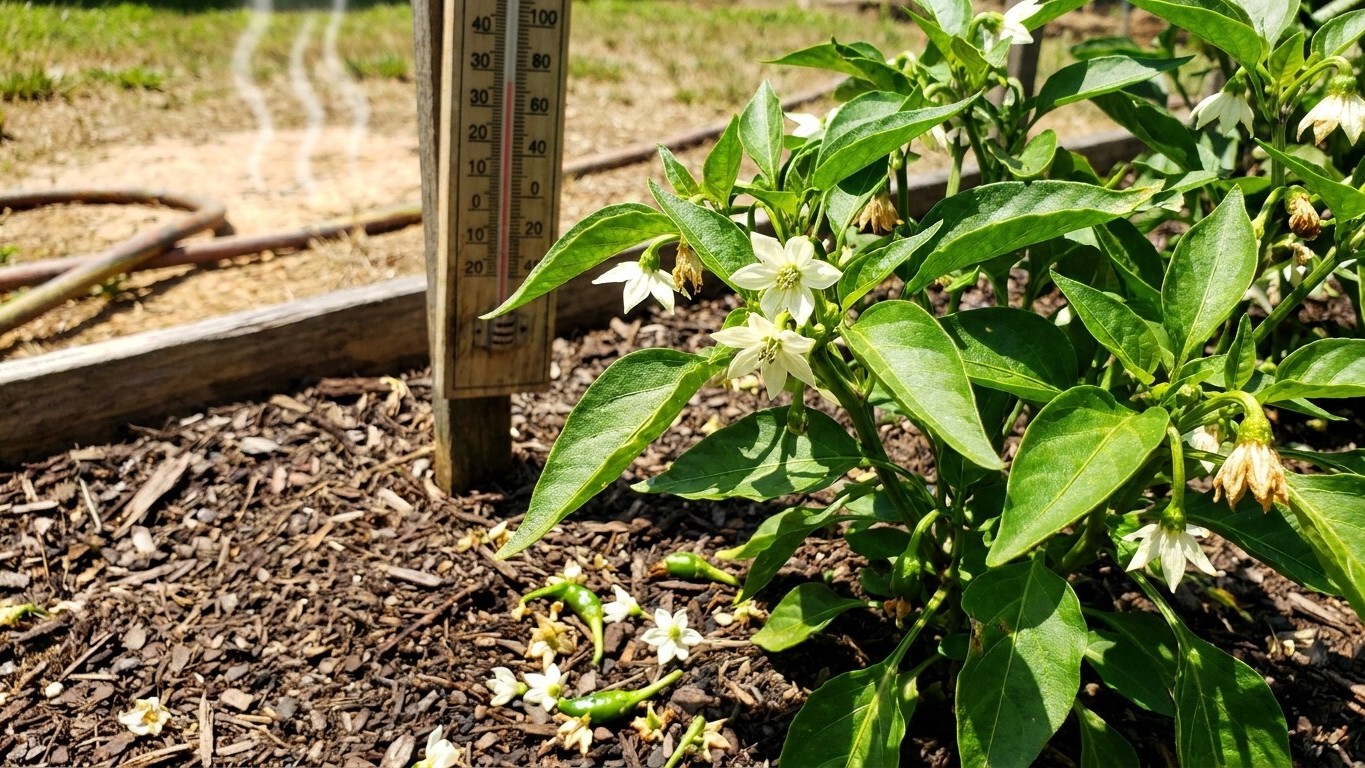

Massachusetts peppers stall for two separate reasons that often get blamed on one thing. Heat spikes above 90 F can knock blossoms off just as easily as a stray cool night can, and a short growing season leaves little room to recover from either. Get the timing and the temperature swings right, and the plant does the rest.
The short answer
Start with the number that matters most for summer heat load: the Boston reference station averages 10.2 days a year at or above 90 F, based on NOAA NCEI Climate Normals from 1991 to 2020. That’s not a huge tally compared to states farther south or west, but it doesn’t need to be. A pepper plant only needs one or two afternoons in that range, arriving right when flowers are open, to drop a good share of its blossoms before they ever set fruit. The plant isn’t dying. It’s simply protecting itself, shedding flowers rather than spending energy on fruit it may not be able to support in extreme heat.
That’s one end of the failure. The other end is just as real and, for a lot of Massachusetts gardens, more common. Peppers also Fail to Set Fruit when nights drop below 55 F, because the plant needs warm nights to keep its flowers viable and its pollen functional. Massachusetts summers can deliver plenty of nights in that cool range, especially away from the coast, in low-lying inland valleys, and up in the Berkshires where cold air pools after sunset.
This is where a gardener has to do some homework that no regional dataset can do for them. This site tracks days at or above 90 F because that figure is published and measured at fixed reference stations. Summer night minima aren’t part of that same public dataset, and they vary enormously across a state as topographically mixed as Massachusetts. A backyard in a river valley in Franklin County can run several degrees cooler at night than a yard twenty miles away on higher ground, and coastal Bristol County holds heat overnight in a way that inland Worcester County simply doesn’t.
The practical move is to watch your own thermometer through July and August rather than assume anything based on where you sit on a map. Latitude tells you almost nothing about a specific yard’s overnight low. Elevation, distance from water, and whether cold air can drain away from a planting bed matter far more. If your peppers are setting fruit poorly and daytime highs haven’t cracked 90, check your overnight lows before blaming anything else.
When to start seed here
Working backward from transplant day is the most reliable way to time pepper seed starting in Massachusetts, and the math is simple enough to redo for any county in the state.
- Find your last spring frost window. NOAA NCEI’s 1991-2020 climate normals put the 32 F freeze probability window at Logan Airport between April 1 and April 8. Logan sits on the waterfront in Boston, which makes it the mildest reporting station in the state, so treat that window as an early-side benchmark rather than a statewide rule. Inland suburbs, the Connecticut River Valley, and especially the Berkshires will see their last frost noticeably later in spring, sometimes by two to three weeks.
- Wait for the soil, not just the calendar. Peppers need soil that has warmed to 60 F before transplanting outdoors, according to Utah State University Extension. Air temperature can feel warm well before soil catches up, particularly in heavy clay or shaded beds, so a soil thermometer pushed a few inches down is worth more than a glance at the forecast.
- Set your transplant date after both conditions are met. For a Boston-area garden, that might mean mid-to-late April at the earliest once frost risk has passed and soil has caught up. For an inland or higher-elevation garden, this same logic can push transplanting into May.
- Count back 8 to 10 weeks for indoor seed starting. Utah State University Extension recommends starting pepper seed indoors 8 to 10 weeks before that outdoor transplant date. If your target transplant date lands in late April, that places seed starting in late February to early March. If your local frost and soil conditions push transplanting into mid-May, seed starting shifts to mid-to-late March instead.
- Redo the math with your own dates. Because frost timing and soil warm-up both shift depending on where you garden in Massachusetts, plug in your own last-frost estimate and your own soil check rather than borrowing someone else’s calendar. The arithmetic stays the same; only the dates change.
What goes wrong here
Even with good timing, Massachusetts’s particular mix of heat spikes, bright sun, and uneven watering causes a specific set of pepper failures season after season.
- Blossom drop from a hot spell. When daytime highs push into the 90s, even for a day or two, open flowers can abort rather than set fruit. Since the reference station averages 10.2 such days a year, this isn’t a rare event in a typical Massachusetts summer. There’s no fix for the heat itself, but light shade cloth over plants during a forecasted hot stretch, and keeping soil evenly moist so the plant isn’t also fighting drought stress, both reduce how many flowers are lost.
- Blossom drop from a cool night. The flip side happens when overnight temperatures fall below 55 F while flowers are open. Because this site doesn’t track summer night minima, the only reliable defense is watching your own outdoor thermometer through the growing season. If a stretch of unusually cool nights is forecast, row cover pulled over plants in the evening and removed the next morning can hold in a few extra degrees of warmth right at flower height.
- Sunscald on exposed fruit. Strong summer sun can scorch pepper fruit that isn’t shaded by enough foliage, leaving pale, sunken patches on the side facing the sun. This tends to show up on plants that have been over-pruned or that lost leaves to wind or pest damage. Leaving natural foliage in place, rather than trimming it back for airflow, is usually enough to prevent it.
- Blossom-end rot on developing fruit. Uneven watering, common during a stretch of hot days followed by heavy rain, interrupts calcium uptake and shows up as a dark, leathery patch on the fruit’s bottom end. Consistent watering on a schedule, rather than reacting to whatever the weather did that week, is the most direct remedy.
Common questions
Do all pepper varieties fail the same way in Massachusetts?
Utah State University Extension names several pepper varieties suited to home gardens but doesn’t publish heat tolerance ratings, days-to-maturity figures, or fruit size for any of them. Without that data, there’s no basis for saying one named variety handles Massachusetts heat or cool nights better than another. Choosing varieties based on general garden performance, and managing the heat and cold thresholds directly, is the more reliable approach.
How long after flowering should I expect fruit?
Fruit typically forms over a window of roughly 35 to 45 days after flowering, not from the seed-starting or transplant date. If flowering is delayed by a cool spring or interrupted by a hot spell, that 35-to-45-day clock resets each time flowers drop and new ones open, which is part of why a rough summer can push harvest well past what a gardener expected in spring.
Is Boston’s frost date reliable for the whole state?
No. The April 1 to April 8 window comes from Logan Airport, a waterfront station in Boston that runs milder than almost anywhere else in Massachusetts. Inland areas, higher elevations, and especially the Berkshires see their last spring frost later, sometimes by several weeks, so gardeners outside the immediate Boston area should treat that window as a starting reference rather than their actual local date.
Can I do anything about cool summer nights if I don’t know my exact low temperature?
Track it yourself with an outdoor min-max thermometer placed near your pepper bed rather than relying on a regional average or a nearby town’s forecast. Microclimate differences from low-lying cold pockets to elevated, more sheltered beds can shift nighttime lows by several degrees within the same neighborhood, and that’s the range that actually determines whether flowers hold or drop.