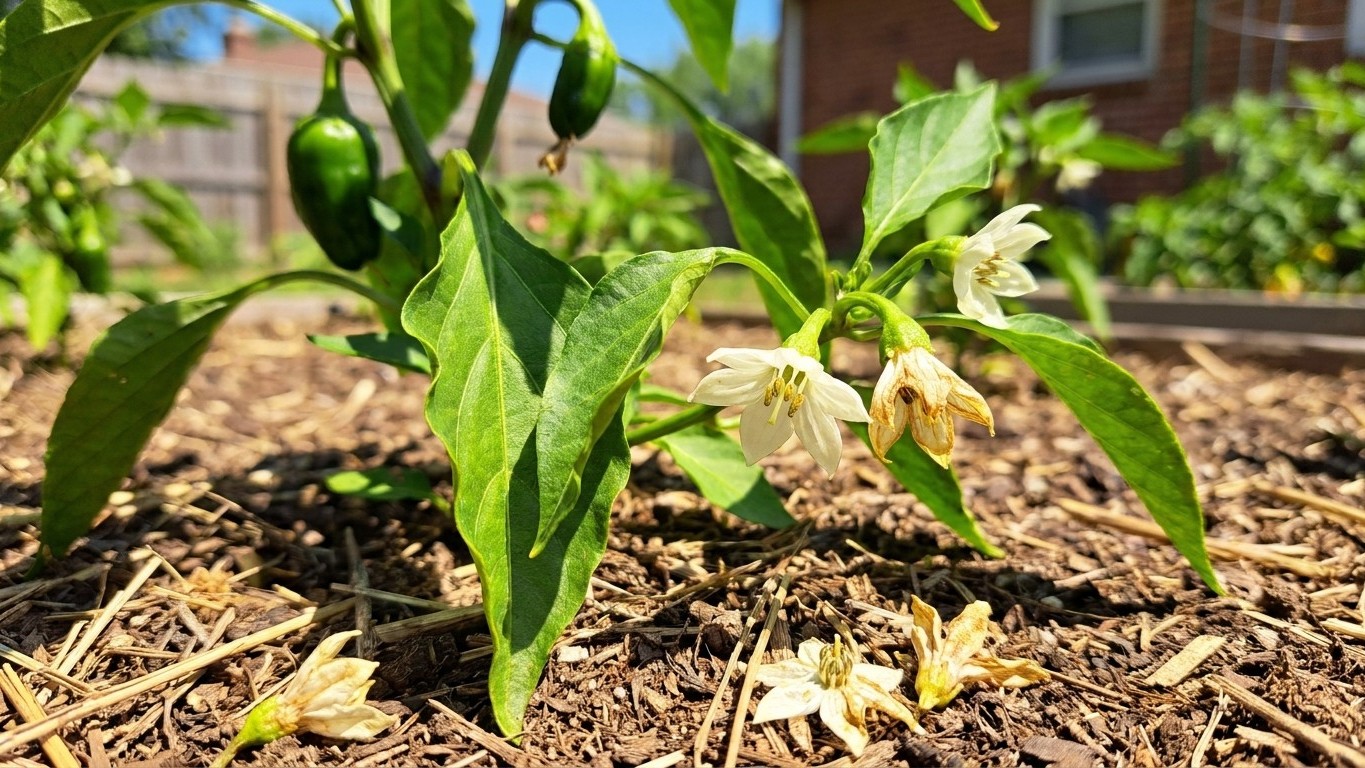

The facts documented for this page don’t include a species-by-species pest survey for Massachusetts pepper growers. What’s actually sourced and verified is climate physiology: pepper flowers abort when nights drop below 55°F or days climb past 90°F, and Boston’s reference station averages 10.2 days a year at or above that heat mark. A lot of what gardeners blame on insects here is really the thermostat.
Which pests attack pepper in Massachusetts
Here’s the honest answer before anything else: the sourced material behind this page does not carry a Massachusetts-specific pest census for pepper, the way it does for Utah’s fruit-set research or Clemson’s storage guidelines. No state or county pest survey is named in the facts this page draws from. That matters, because a lot of garden content invents a tidy list of bugs to sound thorough. This page won’t do that.
What the sourced material does document is the plant’s own breaking points, and those come from named, checkable sources. Utah State University Extension has published the physiology behind pepper fruit set: flowering fails when nights fall below 55°F and again when days rise above 90°F, with the fruiting window running 35 to 45 days after flowering, not from the sowing date. NOAA NCEI’s 1991-2020 Climate Normals, drawn from the Boston reference station, put the average at 10.2 days a year reaching 90°F or hotter. Clemson Cooperative Extension has separately documented harvest and storage windows for the crop generally.
None of those three sources names an insect. That’s the point worth sitting with. A grower who sees blossoms dropping off a pepper plant in a Massachusetts backyard is often watching temperature stress play out, not a hornworm or an aphid colony at work. Assigning a bug’s name to that symptom without a matching source is exactly the kind of guess this page is built to avoid.
If chewed leaves, holes in fruit, or visible insects show up in a garden, that’s a real observation worth acting on, just not one this page can name for you. The right move is a photo and a call to the local extension office, covered further down. Skipping that step and reaching for a spray based on a guessed species wastes a treatment window and sometimes damages a plant that was never under insect attack at all.
When each one shows up, and what it does first
Since no insect calendar is sourced here, the more useful clock to watch is the plant’s own stress calendar, and it runs on soil temperature and the frost window rather than the wall calendar. Transplants need 8 to 10 weeks indoors before they go in the ground, and they shouldn’t go in until soil reaches 60°F, after the last frost has passed. For the Boston reference station, that last spring frost falls between April 1 and April 8, though inland suburbs and the Berkshires run colder and later, sometimes by a couple of weeks.
The first thing most Massachusetts pepper growers notice isn’t a bug. It’s blossoms falling off a healthy-looking plant with no chewed leaves and no visible insect anywhere on it. That symptom lines up with nights below 55°F early in the season, and separately with days above 90°F once summer heat sets in. Those are two different failure points bookending the growing season, and a plant can hit either one without ever encountering a single pest.
Later in the season, once flowering has held and fruit begins to set, the 35 to 45 day countdown to harvest starts from the flower opening, not from transplant date and not from the first fruit you spot. A grower counting from the wrong starting point will expect harvest weeks before the crop is actually ready, and may misread slow sizing as insect or disease damage when it’s simply not time yet.
This page can’t tell a reader when a specific insect arrives in a given county, because that data isn’t part of the sourced facts. What can be said plainly: any damage that shows up as chewed foliage, holes in fruit skin, or visible insects on the plant is a different category of problem from blossom drop, and it deserves a different response, starting with identification rather than a calendar guess.
Telling the damage apart from everything else
Pepper plants get blamed for a lot they didn’t do. Sorting out what’s actually happening starts with matching the symptom to the thing that actually distinguishes it, not the thing that first comes to mind.
| Symptom | Likely cause | What distinguishes it |
|---|---|---|
| Blossoms drop, no chewing, no insects visible | Temperature stress at either extreme | Check recent nights (below 55°F) or recent days (above 90°F), not the plant |
| Fruit slow to size or soft after picking | Harvested too early, or stored wrong | Count days from transplant (70 to 85 typical); check storage temperature with a thermometer |
| Fruit pitted, soft, sunken after storage | Chilling injury from cold storage | A refrigerator running below 45°F is the usual culprit |
| Chewed leaves or holes in fruit skin | Insect feeding | Requires an actual ID; photograph it and contact extension rather than guessing |
| Wilting despite normal watering | Root or vascular issue, not drought | Check soil moisture directly before assuming water stress |
The fridge is too cold for peppers, and it’s the mistake nearly everyone makes. Clemson Cooperative Extension’s Home & Garden Information Center puts the correct storage range at 45 to 50°F with 80 to 90 percent relative humidity, holding for two to three weeks under those optimal conditions. A standard home refrigerator usually runs colder than that, and below roughly 45°F peppers develop pitting and softening from chilling injury, a texture problem that gets blamed on disease or rot when it’s really just the wrong drawer.
None of this replaces an actual look at the plant. When chewed leaves or visible insects are present, that’s the one category on this list that genuinely needs a person with local knowledge, not a table.
What actually works here, and what is a waste of time
On a growing season bounded by a firm frost date on one end and a heat count on the other, timing beats almost everything else a grower might try. Transplanting only after soil hits 60°F, and only after the local last frost has passed, is the single decision that prevents more losses than any treatment applied later. For the milder Boston area that window opens around April 1 to April 8; inland and hill-town gardens should expect it later and should watch their own conditions rather than borrowing the coastal date.
A physical barrier, like a floating row cover put in place at transplant, does two jobs at once on a short New England season: it buffers young plants against a cool night that dips below that 55°F fruit-set threshold, and it blocks early insect access before anyone even knows what’s out there. Timed right, that single step does more than most sprays applied after damage is already visible.
What wastes time: treating blossom drop with any product at all. If the cause is a cold night or a 90°F-plus stretch, no spray reverses it, because the flower has already failed to set for a physiological reason, not a feeding one. Equally wasteful is guessing at a pesticide based on a symptom alone. Massachusetts, like every state, restricts which products are legally usable on food crops, and that list is held by the extension service, not by general gardening advice. This page names no product and no active ingredient, on purpose.
Harvest timing matters as much as planting timing. Fruit generally reaches readiness 70 to 85 days after transplant, and pulling it too early or storing it too cold afterward undoes weeks of otherwise careful growing.
Where to check this for your own county
Everything documented here comes from statewide or national sources: NOAA NCEI’s Boston reference station for frost and heat data, and university extension research from Utah State and Clemson for the plant’s own biology. None of it is a substitute for a local check, and that’s the geste that actually matters next.
A pest present in one Massachusetts county isn’t necessarily present in another, and a coastal garden near Boston runs a noticeably different frost calendar than a garden in the Berkshires or a cooler inland valley. The state-level heat count, 10.2 days a year at 90°F or above, describes the Boston reference station specifically, not every yard in the Commonwealth. Treat it as a baseline for comparison, not a forecast for a specific garden.
UMass Extension and its county-level offices are the right next call for anything that looks like actual insect feeding, since identification requires eyes on the plant (or at minimum a clear photograph) rather than a description matched against a generic list. A county office can also confirm what’s legally labeled for use on peppers in Massachusetts, which changes over time and varies by product.
Before reaching for any treatment, take a photo of the damage, note when it appeared relative to the last frost or the most recent hot stretch, and bring both to the local extension office. That single step sorts climate stress from actual pest damage faster than any at-home guess.
Common questions
Does frost date matter more than the calendar month for planting peppers in Massachusetts?
Yes. The Boston reference station’s last spring frost falls between April 1 and April 8, but inland and higher-elevation areas run later. Planting by a fixed month rather than the actual frost date and soil temperature (60°F) is a common and avoidable mistake.
Can I tell if cold nights or heat caused my pepper’s blossom drop?
Not always without checking your own recent weather. Fruit set fails at both ends, below 55°F at night and above 90°F during the day. This page doesn’t carry summer night minimums for Massachusetts, so track your own local overnight lows rather than guessing from the season or the coldest month of the year.
Is it safe to store harvested peppers in the refrigerator?
Only if it holds 45 to 50°F, which most home refrigerators run colder than. Below about 45°F, peppers pit and soften from chilling injury. Two to three weeks is the maximum under optimal conditions, not a guarantee.
Who do I contact if I see actual insect damage on my pepper plants?
UMass Extension and your county extension office, with a photograph in hand. Species-level pest identification and current, legally labeled treatment options for Massachusetts aren’t part of the facts sourced for this page, and they change, so a local, current answer beats a general one.