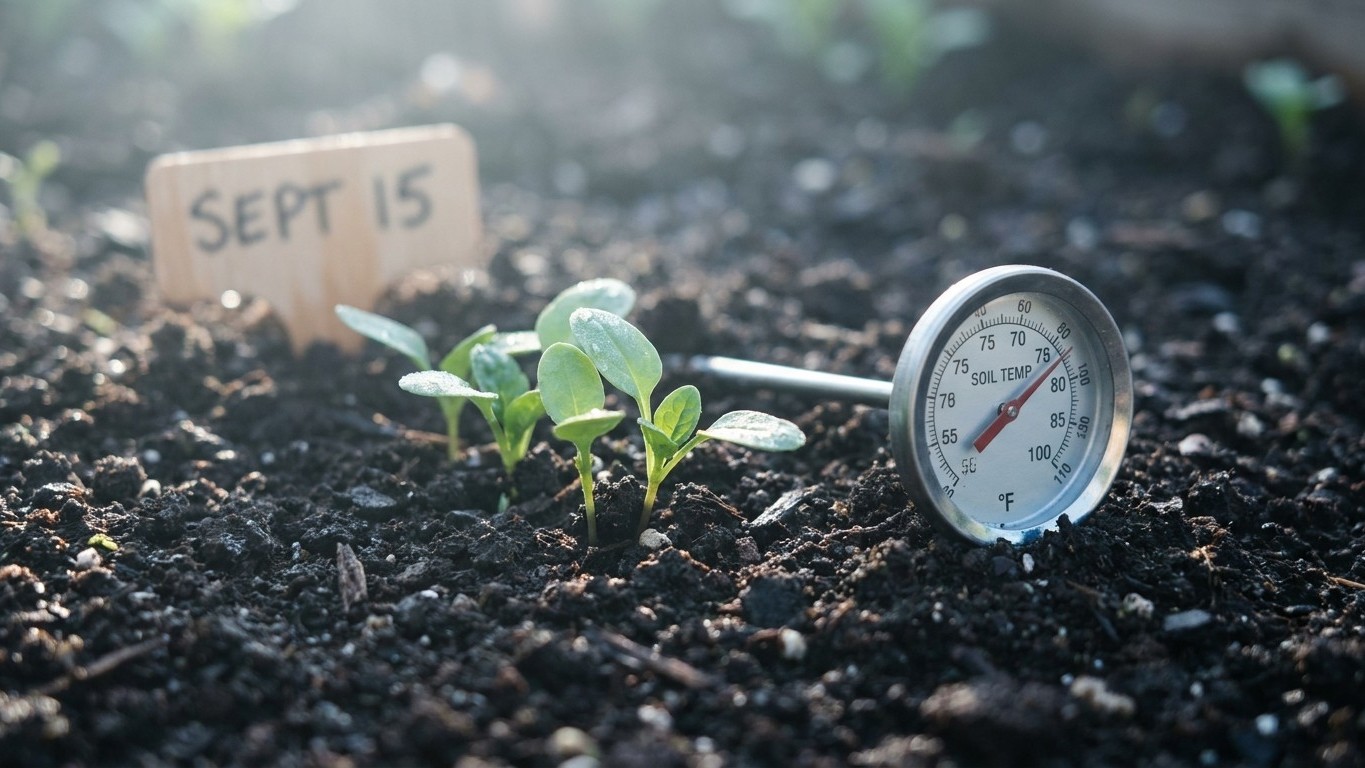

For most Massachusetts gardens, autumn spinach goes into the ground somewhere between mid-August and mid-September, counting back from a harvest you want to bring in before the first hard frost hits in November. That window shifts a bit depending on how fast the soil cools after summer’s peak heat and how close to Boston or how far inland your garden sits. Get the timing wrong in either direction and the crop struggles before it ever reaches your kitchen.
The short answer
At the summer solstice, the Boston area sees 15 hours and 6 minutes of daylight, among the longest stretches of any latitude commonly gardened in the continental United States. For spinach, that number works against the plant rather than for it. Long days, not warmth alone, push spinach toward flowering, so as the calendar climbs toward the solstice the plant edges closer to bolting no matter how mild or cool the weather happens to be that year. A cool June in Worcester County does nothing to slow that clock; day length keeps rising regardless of the thermometer.
That’s the first ceiling. The second is heat, and Massachusetts adds its own pressure there too. The reference station in Boston, per NOAA’s 1991-2020 climate normals, averages 10.2 days a year at 90F or hotter, and spinach’s own growth ceiling sits at 75F, a mark both air and soil regularly cross well before official heat-wave days show up. Once temperatures settle above that line, growth slows, leaves turn bitter, and the plant treats the heat as one more signal to bolt.
So which one actually limits spinach here, the days or the heat? Both, and they land at roughly the same moment. Day length climbs into bolting range through late spring right as air and soil temperatures also cross 75F for good. The two pressures overlap instead of waiting on each other, which is why Massachusetts gardeners get a spring spinach season that closes hard rather than fading slowly, and why the plant is a poor fit for the entire mid-summer stretch. Spring seedings that outrun the frost date and fall seedings sown too early both run into the same wall of long, hot days.
The practical consequence: spinach in Massachusetts is a two-season crop, spring and fall, with summer effectively off the table no matter how attentive the watering or how much shade cloth gets deployed. Anyone who has watched a spring sowing throw up a flower stalk in early June has already met this limit firsthand. The plant isn’t struggling with drought or nutrients at that point; it’s simply responding to day length exactly as it’s built to. Once you accept that neither shade nor extra water buys weeks in July, the only real strategy left is timing sowings to land in the two windows where day length and heat both stay low enough.
How long the spring window really is
Working out the real spring window means stacking two numbers on top of each other: the last frost date and the temperature ceiling that ends good growth.
- Start with the last frost. Around Boston, the last spring freeze falls between April 1 and April 8, based on NOAA’s 1991-2020 climate normals. That reference station sits on the waterfront, the mildest spot in the state, so inland suburbs and the Berkshires should expect frost lingering later into spring than that date suggests.
- Sow two to three weeks ahead of it. That puts seed in the ground somewhere in the second and third week of March for the milder parts of the state, a bit later for inland gardens still holding onto frozen or waterlogged soil.
- Track the 75F ceiling, not the calendar. Growth stays good only while temperatures stay under that mark. There’s no fixed date tied to it, but as day length climbs toward the June peak of 15 hours and 6 minutes, air and soil temperatures climb right alongside it, and the two pressures typically converge by late spring.
- Add it up. A mid-March sowing followed by roughly ten to twelve weeks of usable growth before quality drops is a reasonable expectation for most of the state, shorter in a hot spring, longer in a cool one, but never stretching deep into summer no matter what the weather does.
That’s a workably long spring run for a crop many gardeners assume only tolerates a few weeks of cool weather, but it closes fast once it starts closing. A sowing that goes in on schedule in March still bolts on roughly the same June calendar as one planted two weeks late; the plant is responding to day length, and lost time up front doesn’t buy a later exit, it just shortens the harvest at the front end.
The autumn crop, and when the soil lets you sow
Autumn spinach runs the calendar math in reverse: instead of counting forward from a frost date, the standard approach counts backward from harvest. Utah State University Extension gives a simple rule for fall crops like this one: sow 50 to 75 days before the date you want to bring the crop in. Massachusetts gardeners have to fit that window between two obstacles arriving from opposite directions, one from the tail end of summer heat and one from the calendar’s approaching cold.
The soil is still too warm to germinate
Spinach seed loses germination once soil temperature climbs above 80F, according to Utah State’s guidance, and Massachusetts summers keep soil there for weeks past the point most gardeners expect. With the Boston area averaging 10.2 days a year at 90F or hotter, the ground beneath a sunny bed holds heat well into late August even after air temperatures start easing. Sowing straight into that warm soil in July or early August usually means poor, patchy germination, not because the seed is bad but because the ground itself is working against it. The window doesn’t really open until soil temperatures drop back down as nights lengthen, typically putting the earliest sensible sowing somewhere in the second half of August.
The frost that ends the season
On the other side sits the first fall frost, arriving between November 3 and November 14 around Boston, again based on NOAA’s 1991-2020 normals from that waterfront station. Inland gardens and higher ground in the Berkshires should plan on frost showing up earlier than that. Aiming for a harvest in the first days of November and counting back the 50 to 75 days the source specifies lands the sowing date somewhere between mid-August and mid-September, which lines up neatly with the point where soil has finally cooled enough to germinate reliably. Push later than mid-September and the plant runs out of daylight and warmth before it fills out; push earlier than mid-August and the soil is still working against the seed. Common spinach varieties sold for this kind of sowing include Bloomsdale, Melody, Teton, and Olympia, though the source data behind this guidance doesn’t break out germination rates or days-to-maturity for any one of them individually, so the sowing window above applies across the board rather than favoring one name over another.
Common questions
Can I sow spinach in Massachusetts in July for a fall harvest?
Generally not with good results. Soil in most of the state is still above the 80F germination ceiling in July, and July sowings also sit under long days that push seedlings toward bolting before they’ve had a chance to size up.
Does a cooler summer in the Berkshires let me sow spinach later in spring?
Not by much. Bolting is triggered largely by day length, so a cool stretch of weather doesn’t hold the plant back the way it might for other crops. The Berkshires do frost later in spring and earlier in fall than the Boston reference station, which shifts the whole calendar slightly but doesn’t change the day-length mechanism itself.
Is fall spinach less likely to bolt than spring spinach?
Usually, yes, because days are shortening after the solstice instead of lengthening toward it. But late-August heat can still push an early fall sowing toward premature flowering if it goes in before the soil has cooled and while days are still fairly long, which is why the mid-August start is treated as an earliest, not an ideal.
What happens if I sow spinach after mid-September in Massachusetts?
The plant risks running out of the 50 to 75 day window before the first fall frost, which falls between November 3 and November 14 near Boston and earlier inland. Late sowings often end up small or immature by the time cold shuts growth down for the season.