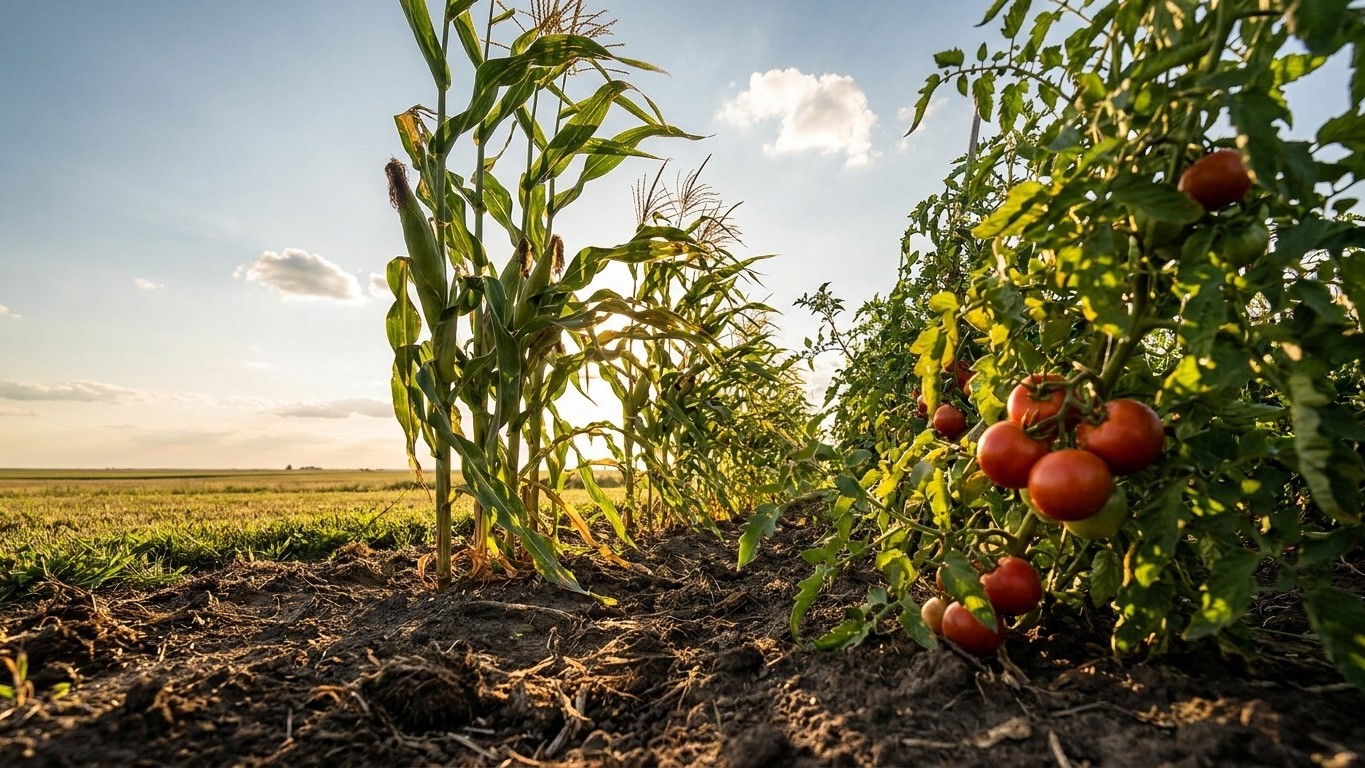

In Massachusetts, the calendar eats a corn crop more reliably than anything else. Soil has to warm to about 60 F before seed does well, and that happens well after the last frost. Then 60 to 90 days of growing must fit before autumn frost. On the coast they do, even for a late variety. Inland and in the Berkshires the margin thins.
The short answer
Soil reaches 60 F later than the last frost, and that gap is where most spring mistakes start. At Boston’s Logan station, NOAA NCEI Climate Normals put the last spring 32 F freeze between April 1 and April 8, using the 30 to 70 percent probability band. That date describes the air. Four inches down, soil warms slowly, so the day frost stops threatening and the day seed can germinate happily are separate events, often weeks apart. Treating them as one day is how a gardener ends up with a gap-toothed row of seedlings that never came up.
Utah State University Extension gives the working rule: sweet corn needs soil above 60 F and 60 to 90 days from planting. Clemson Cooperative Extension adds the measuring detail. Do not plant before the soil temperature at the 4-inch depth is at least 50 F, and wait to plant extra-sweet varieties until soil temperatures reach 65 F. So the floor for ordinary sweet corn is 50 F, the comfortable target is 60 F, and extra-sweet types want 65 F. The instruction here is a thermometer reading, not a calendar date. A surface reading runs warmer than the soil beneath it and would send you out too early.
Now the other end of the season. Logan’s first fall 32 F freeze falls between November 3 and November 14, again from NOAA NCEI. On paper that leaves a long frost-free stretch, and 60 to 90 days from planting fits inside it with room to spare, even if planting waits for warm soil.
One caution matters a great deal. Logan is a waterfront urban station and the mildest spot in the state. Inland suburbs and the Berkshires frost noticeably earlier in fall and later in spring, so both ends of the window pinch at once. Look up your own town’s dates before trusting the coastal cushion.
Heat is the smaller worry during the growing season. The Boston reference station averages 10.2 days a year reaching 90 F or more, a modest summer heat load for corn. Heat becomes a bigger problem after picking, which comes up in the questions at the end.
Two separate clocks run on this crop, and they answer different questions. The 60 to 90 days from planting tells you whether a variety fits the season. A second count, 17 to 24 days from silk emergence, tells you which week to pick. Keep them apart. For the full planting picture, see When to Sow Sweet Corn in Massachusetts, and for the broader guide, Growing Sweet Corn in Massachusetts.
Does a late variety fit here?
It depends on where in the state you garden, and on how long you wait for the soil. The test is simple: add the days to maturity to the day the soil reaches its threshold, and see whether the total lands before your first fall frost. The comparison below uses the two ends of the published range, 60 days and 90 days.
A 60-day variety
This one fits almost anywhere in Massachusetts. Even if the soil takes its time and you plant late, 60 days is a short run against a first frost that arrives, at the mildest station, in early to mid November. Inland and in the Berkshires, where fall frost comes sooner, the cushion shrinks but a 60-day type still has a comfortable margin. It also leaves room for a mistake: a replant after a cold snap rots the first sowing, or a few days lost to a wet spell.
The short-season type is also the sensible pick for anyone who wants a second planting. A later sowing has the same 60-day clock but starts further into summer, and it still finishes before frost in most of the state.
A 90-day one
On the coast, yes, it fits. Planting once soil sits at 60 F, or at 65 F for an extra-sweet type, and adding 90 days still leaves a gap before the November freeze at Logan. That gap is thinner than the 60-day gap, but it is real, and a mild coastal fall often stretches it further.
In the Berkshires, I would doubt it. Frost there comes noticeably earlier in fall and leaves later in spring, which means a later planting and an earlier deadline. But a 90-day type planted late in cold soil is the combination most likely to run out of season. If your local first-frost date is not comfortably past the 90-day mark, choose something shorter. The question of whether a given planting will actually finish is covered in Will Sweet Corn Ripen in Massachusetts?
What goes wrong here
Three failures account for most disappointing corn in this state. Two come from the climate, and the third has nothing to do with it.
- Seed sown into cold soil. Air that feels like spring is not soil that is ready. Check the temperature at the 4-inch depth, not at the surface. Ordinary sweet corn needs at least 50 F there, and Utah State’s target is above 60 F. Extra-sweet types (sh2) need 65 F, and a supersweet seed sown at 50 F tends to rot rather than germinate. That is why a gardener can succeed one year and fail the next after switching variety, even with the same bed and the same date. The remedy is a thermometer and patience, and sowing by the reading, not by the last frost date.
- A variety too late for the season. Inland, a 90-day type sown into slowly warming soil can run into the first fall frost before the ears fill. The remedy is to count forward from the day soil reaches its threshold, not from the day frost ends, and to pick a shorter-season variety when the total looks tight. The Berkshires and inland suburbs deserve the most caution, since the coastal frost dates quoted above do not apply to them.
- Sweetness lost to the neighbor’s pollen. This failure is unrelated to climate. Sweetness is lost if su, se and sh2 types tassel at the same time, and it is decided by what tassels nearby. The rule is about timing: do not let different types shed pollen together. Stagger plantings so the tassel stages do not overlap, and keep each type in its own planting. Plant in blocks of three or more rows, not in a single long line, so pollen lands where it should. That is a shape of garden, not a date.
Common questions
Is the last frost date the right day to plant sweet corn?
No. The last frost date describes air temperature, and the soil warms well after it. At Logan the last spring 32 F freeze falls between April 1 and April 8, and the soil at 4 inches has to climb to its own threshold after that: 50 F as a floor, 60 F as a target, and 65 F for extra-sweet types.
How far apart should different sweet corn types be planted?
What it does say is that sweetness is lost when su, se and sh2 types tassel at the same time. Build your plan around timing, staggering plantings so the types do not shed pollen together, and plant each in blocks of three or more rows.
How do I know an ear is ready to pick?
Look for three signs together: dry brown silks, husks that are still moist and green, and milky juice when you puncture a kernel. One sign alone can mislead. As a rough guide to timing, picking comes 17 to 24 days after silk emergence, which is a different clock from the 60 to 90 days counted from planting.
How long does picked sweet corn stay sweet?
Not long, and heat speeds the loss. Clemson Cooperative Extension says: “Sweet corn loses sugar from the kernel rapidly at high temperatures… Sweet corn can be stored under optimal conditions for about five days, but will lose sweetness with each day of storage.” Treat five days as a ceiling, not a promise. The genotype matters too: su loses sugar fastest, se holds it longer, and sh2 holds it longest, which is the practical reason to choose an sh2 type if you cannot eat the ears the same day.
Sources : umass.edu