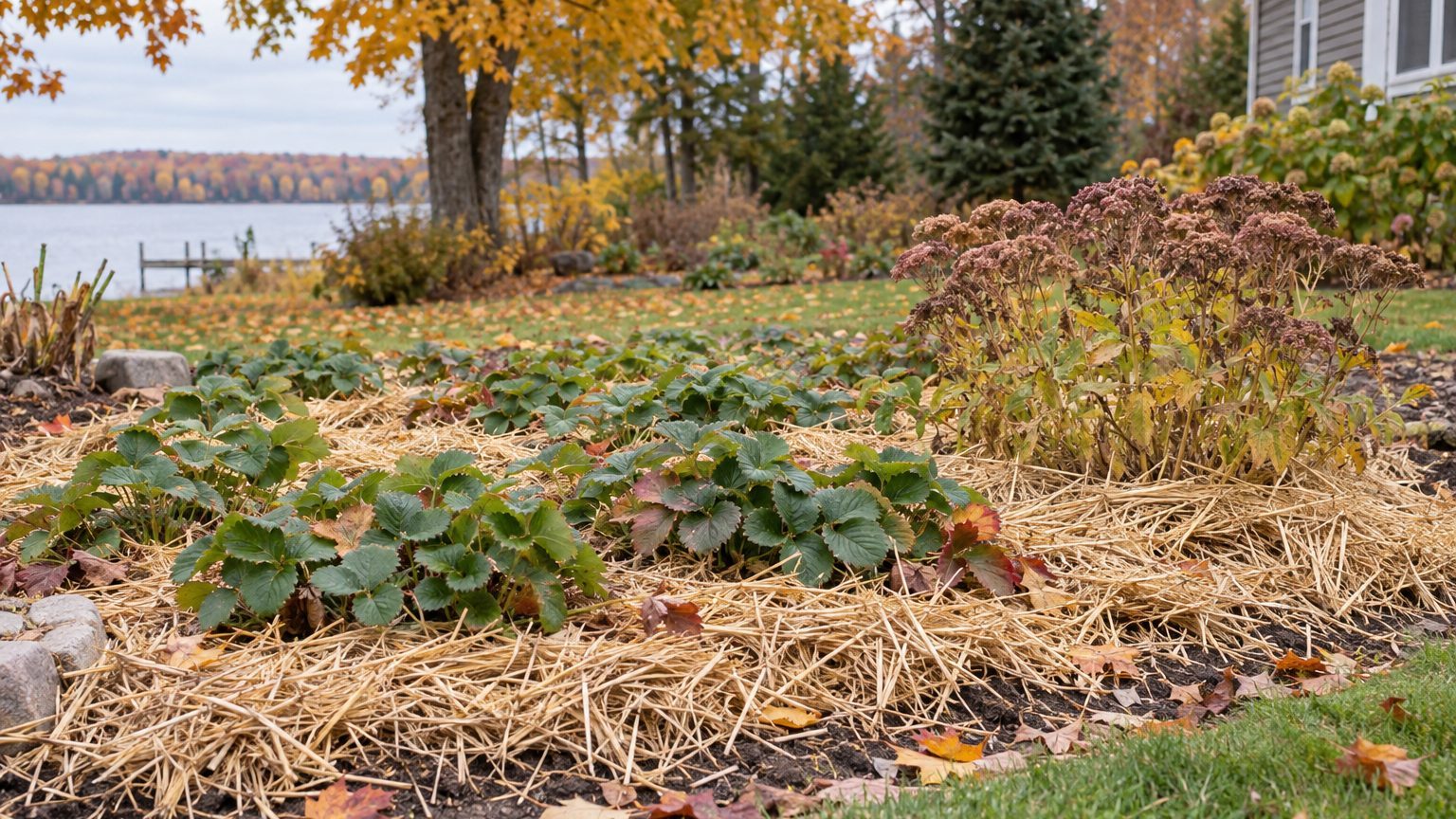

Winter mulch goes on after the ground starts to freeze, which comes later than the first frost. At Boston’s Logan Airport, the first 32°F freeze arrives between November 3 and November 14 (NOAA NCEI 1991-2020 Climate Normals). Mulch strawberries and perennials in the weeks after that window, usually late November into early December. Inland towns and the Berkshires run colder, so the job moves earlier there. More seasonal tasks are collected in the Massachusetts guides.
When to put winter mulch down in Massachusetts
A frost is one cold night. A frozen garden takes a run of cold days and nights, and the soil stays stiff even at midafternoon. The distinction matters because winter mulch is not a blanket meant to keep plants warm. It is insulation that keeps frozen soil frozen. Boston’s coldest month has a mean daily minimum of 23.1°F (NOAA NCEI Climate Normals 1991-2020), so the ground does freeze here, but January thaws and February sun keep trying to wake it up. Plants that heave out of the soil or break dormancy during a thaw are the ones that suffer.
Mulch put down on warm fall soil does the opposite job. It holds heat and moisture against the crowns, which invites rot, and it gives mice and voles a cozy place to settle in before the cold even arrives. So wait. Apply winter mulch after several hard freezes, in the weeks following the November 3 to November 14 first-frost window around Boston, which usually means late November into early December.
How can you tell the ground has started to freeze?
Use the soil, not the calendar. Push a trowel into the bed in the morning. If the top layer is stiff and crusty, and it is still stiff by afternoon, the ground has begun to freeze. Shallow puddles that keep a skin of ice all day tell you the same thing. The plants also give signals: strawberry leaves flatten, darken, and stop growing, and most perennials have died back or gone dormant by then.
Does the timing change inland and in the Berkshires?
Yes. Logan is a waterfront urban station and the mildest spot in the state. Inland suburbs and the Berkshires get their first frost noticeably earlier in fall and their last frost later in spring, so mulching moves earlier in fall and uncovering moves later in spring in those colder places. The USDA Plant Hardiness Zone Map (2023) lists Massachusetts as 5a-7b, a wide range built on the average annual extreme minimum temperature, so a gardener in the hills and a gardener on the coast are running different calendars. Check the local dates in First and Last Frost Dates in Massachusetts and shift your own start date toward the colder end if you live inland or at elevation. The general rules for putting mulch on without harming the plant are in Mulching Without Killing the Plant.
Strawberries
Strawberry plants go into winter with their growing point, the crown, sitting right at the soil surface. That makes them vulnerable in two ways. Bare cold can injure the crown directly, and repeated freeze and thaw cycles push the soil up and down, which lifts the plant partly out of the ground and exposes the roots to drying winds. A layer of mulch applied after the ground freezes holds the soil steady and shields the crown from both problems.
What kind of mulch works best on strawberries?
Clean straw is the standard choice. Look for straw, which is the dry stalk left after grain harvest, and avoid hay, which is full of seed and will fill the bed with grass next spring. Straw is light, sheds water, and stays fluffy enough to let air move through, so it does not pack down on the crowns the way wet leaves do. Whole leaves are a poor substitute because they mat into a soggy sheet. Shredded leaves can work if they stay loose.
For depth, use the range NC State Extension gives for mulch in general, a 2-inch to 3-inch layer, and cover the whole plant evenly. Straw settles over the winter, so lay it on loosely and do not tamp it down. Spread it over the crowns and the soil between plants so the whole row is insulated. Leave the leaves under the straw alone and do not trim them off. The patch is easy to manage when it is set up properly, and the basics are in Growing Strawberries.
When do you pull strawberry mulch back in spring?
Watch the plants, then the calendar. Pull the straw back once new growth shows under it, which comes later inland and in the Berkshires. New leaves under the straw look pale yellow or whitish, and that is the signal to act. Rake the straw off the crowns and into the aisles, where it keeps the soil cool, holds down weeds, and keeps the berries off the dirt later on.
Do not tear it all off at the first warm day in March. Keep the straw nearby for the weeks when frost can still return. If cold is forecast after the plants start to bloom, shake the straw back over the plants for the night and remove it the next morning, because open blossoms are the part most easily lost.
Perennials and borderline plants
Most established perennials that are rated for the local zone do fine without winter mulch. The plants that benefit are the ones with something to protect: newly planted perennials with young roots, shallow-rooted plants that heave in thaws, and plants that are borderline for a particular spot. Hardiness is decided by the coldest nights, and Boston’s coldest-month mean daily minimum of 23.1°F is mild enough for many plants. The same winter looks very different in the Berkshires. Your hardiness zone on the USDA 2023 map, which runs 5a-7b across Massachusetts, tells you how much margin you have, and a plant that sits at the edge of its range is the one to mulch.
Which perennials need winter mulch?
The plants below are the usual candidates in Massachusetts gardens:
| Plant type | Why mulch helps | What to use |
|---|---|---|
| Perennials planted this fall | Roots have not anchored, so thaws can push them up | Shredded leaves or straw, loosely spread |
| Shallow-rooted plants such as coral bells and garden mums | Crowns heave out of the soil in freeze and thaw cycles | Shredded leaves or straw around the plant |
| Borderline shrubs and perennials, such as bigleaf hydrangea | Extra insulation for roots and the base of the stems | Straw or shredded leaves after the ground freezes |
| Evergreen perennial herbs such as lavender and thyme | Cover roots without holding moisture against the foliage | Light, dry mulch, kept off the crown |
Herbs have their own quirks, since many of them prefer dry crowns and sharp drainage. The details are in Getting Perennial Herbs Through the Winter.
How do you mulch around a perennial crown?
Make a ring around the plant, and leave the crown itself uncovered or only lightly covered. A pile of mulch on the crown holds water against the stems and buds, which is where rot starts, and it gives voles a sheltered place to chew. A ring does the job of insulating the roots without smothering the plant.
On depth, the NC State Extension Gardener Handbook (chapter 11, Woody Ornamentals) says: “A 2-inch to 3-inch layer of mulch suppresses most annual weed seeds and makes it easy to hand-pull any that do germinate.” It adds, “Provide a 3-inch layer of mulch to reduce water loss and maintain uniform soil moisture and temperature around roots.” Both sentences point to the same order of depth, and more is not better. Stay at 2 to 3 inches, start after the ground freezes, and taper the layer toward the crown.
What goes wrong
Winter mulch fails in a handful of predictable ways, and each one is easy to spot if you know the signs.
- Mulching too early looks like soft, brown crowns in spring and a patch that never wakes up. Warm soil under a thick layer holds moisture and encourages rot, so wait for the ground to freeze.
- Matted mulch forms a wet, gray sheet over the plants, usually from whole leaves or from straw that was wet when it went on. Use dry straw or shredded leaves and fluff it if it packs down.
- Voles and mice nest in thick mulch and chew on the crowns and bark of young shrubs over the winter. Keep the layer within the 2-inch to 3-inch range, pull it back from stems and trunks, and put it down late so the animals have already found other shelter.
- Forgetting to uncover leaves plants pale, leggy, and slow in spring, because mulch left on blocks light and holds the soil cold and wet.
The last one is the easiest to miss because spring gets busy. Set a reminder to check under the straw and the leaves, later inland and in the Berkshires. If you see pale new growth, lift the mulch away and rake it into the aisles. If the plants are still dormant and a cold snap is forecast, leave it a little longer.
Common questions
Should I mulch strawberries right after the first frost?
No. The first frost range at Boston, November 3 to November 14, only marks the start of cold weather. The ground has not frozen yet, and mulch on warm soil invites rot and rodents. Wait until the soil stays stiff through the day, which usually happens in the weeks after that window.
Is straw or shredded leaves better for winter mulch?
Clean straw is the better choice for strawberries because it stays loose and sheds water. Shredded leaves work well around perennials and shrubs if they are dry and not packed. Whole wet leaves mat down and should be avoided on any crown.
How deep should winter mulch be?
Stay within the 2-inch to 3-inch range from NC State Extension. Deeper layers do not give extra protection and make rot and rodent problems worse. Leave a gap around crowns, stems, and trunks.
Do I need to mulch every perennial in my garden?
No. Established plants that are well within their zone usually do fine without it. Focus on plants set out this fall, shallow-rooted plants that heave, and borderline plants near the edge of their range. Your county extension office can tell you how local winters compare with the Boston figures.