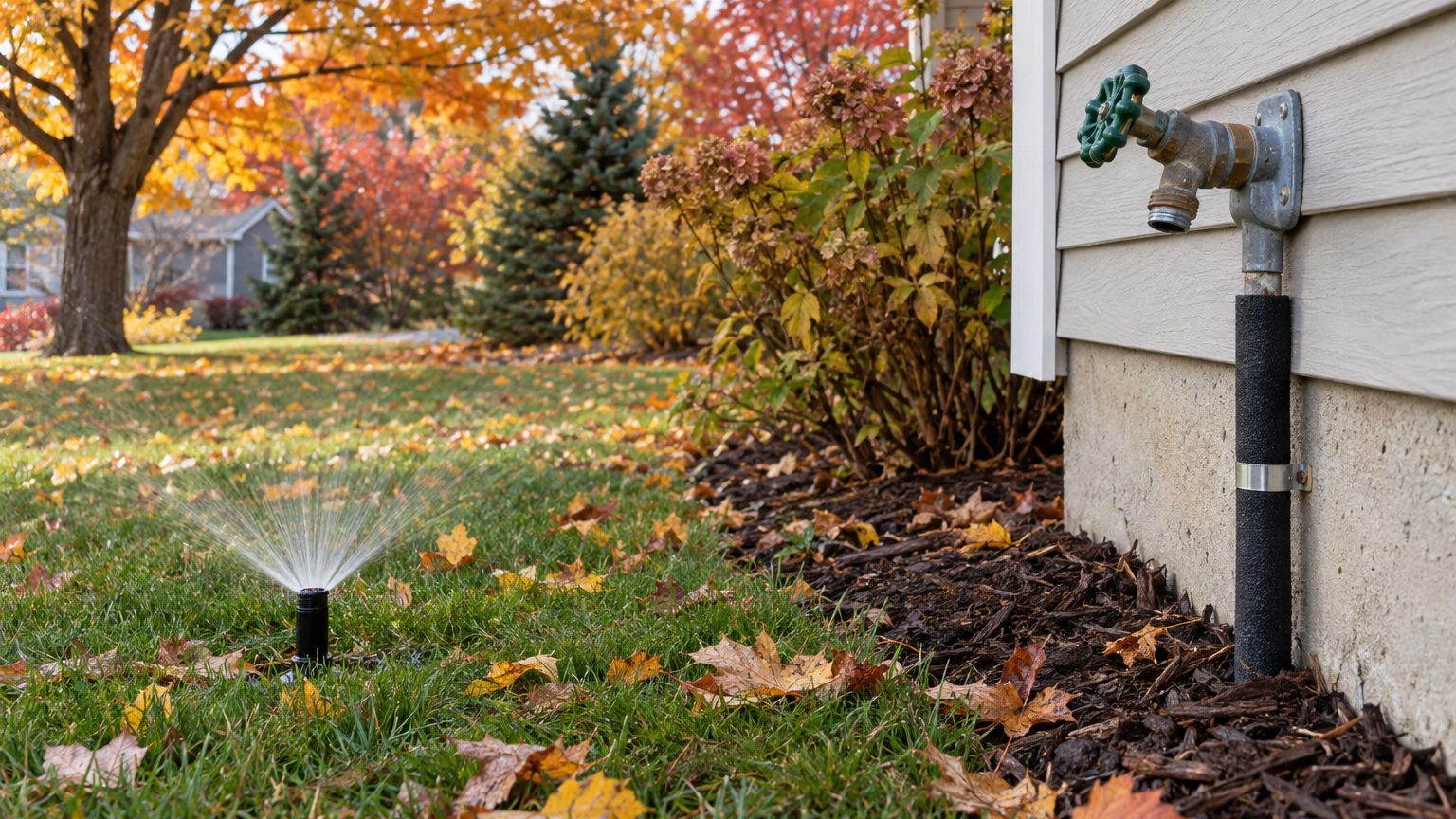

Winterize a Massachusetts sprinkler system and outdoor faucets late in the fall, once the lawn has stopped needing water and before the first hard freeze. Boston’s first freeze normally arrives in the first half of November. Colder inland towns and the Berkshires get theirs sooner, so their deadline comes sooner too. Winters here are cold enough that a full compressed-air blowout is the standard answer, not an optional extra. The job has three parts: clear the sprinkler lines, shut off and empty each outdoor tap, and pull every hose off the house.
When to do it in Massachusetts
Finish before the first hard freeze, not after the first light one. For Boston, NOAA’s 1991-2020 Climate Normals (Logan Airport station) put the first 32°F freeze, in the 30-70% probability band, between November 3 and November 14, so the sprinkler blowout and the faucet shutoff should be done ahead of the November 3 to November 14 range, and sooner in colder inland towns and the Berkshires. That window is a deadline. The work itself fits comfortably into a dry spell, when the ground is still easy to walk on.
A light frost, with white grass at sunrise and a thin film on the windshield, seldom does harm to buried lines. It does tell you the hard freezes are close, and it is the last call to get the job on the calendar. A hard freeze is a different animal: a night that stays below 32°F long enough for the cold to reach water sitting in a pipe, a valve or a faucet barrel. Once that happens, whatever water remains in the system turns to ice and expands.
Why does the date move earlier inland and in the Berkshires?
Logan is a waterfront urban station and the mildest spot in the state. Inland suburbs and the Berkshires frost noticeably earlier in fall, and the same places thaw later in spring. Colder ground gets its first freeze sooner, so fall jobs such as draining move earlier as you go north or uphill. If your home sits well away from the coast, treat the Boston range as the latest possible date and finish ahead of it, with a good margin if you live at higher elevation.
The USDA Plant Hardiness Zone Map (2023 edition, built on 1991-2020 normals) lists zones 5a through 7b across Massachusetts. That system rests on a single variable, the average annual extreme minimum temperature, and it shows how much the state’s cold varies from the Berkshires to the coast. Boston is the reference for the dates above. Your own town may run colder.
Do you need a full blowout in Massachusetts?
Yes. NOAA’s 1991-2020 normals for Boston show the mean daily minimum of the coldest month at 23.1°F, well under freezing. Nights below 32°F are routine through the heart of winter, so any water left in a line has many chances to freeze. This is not a climate where you can skip the job and hope for a mild winter. The sensible routine is to shut off the water supply to the irrigation system, drain or blow out the lines, empty the backflow preventer and valves, and set the controller to its off or rain mode so it does not try to run a cycle. Other seasonal timing for the state sits in the Massachusetts guides.
Sprinkler lines: drain or blow out
Water expands as it turns to ice, and a closed pipe has nowhere to put the extra volume. The pressure splits the pipe wall, cracks a fitting or breaks the body of a valve. The damage stays hidden all winter. You find it in spring, when the system is pressurized again and water sprays out of a crack that was sealed by ice a few months before. Sprinkler heads, the backflow preventer and the valves are the most exposed parts, because they sit at or near the surface where the cold gets in first.
How do manual drain, automatic drain and blowout differ?
All three aim at the same result, which is lines that hold air instead of water. They get there in different ways, and they do not leave the same amount of water behind.
| Method | How it works | Fit for Massachusetts |
|---|---|---|
| Manual drain | You open drain valves at the low points of the system and let gravity pull water out. | Works only if every low point has a valve. Dips and slopes can trap water. |
| Automatic drain | Valves open on their own when pressure drops and let water run out. | Convenient, but water can stay in sections that sit below the valve. |
| Compressed-air blowout | Air pushed through each zone forces water out of the pipes and heads. | The most thorough option and the usual choice for a hard-freeze climate. |
Manual and automatic drains depend on gravity. Any section of pipe that dips below its drain point keeps its water, and a pocket of leftover water is all it takes to crack a fitting. With the coldest month averaging a low of 23.1°F at Boston (NOAA 1991-2020 normals), that pocket will freeze at some point. A blowout pushes water out regardless of the slope of the ground, which is why most installers here treat it as the standard fall shutdown.
When is a professional the sensible choice?
Hire one if you do not own a compressor sized for irrigation work or have never blown out zones before. Air that is too forceful, or pushed through a zone with the wrong valves open, can crack heads and fittings, and a compressed-air line can hurt someone who stands over a pressurized component. A trained technician works through the zones one at a time and handles the backflow preventer, which is the costliest part of the system to replace. The same goes for systems with long runs, steep ground or no drain valves that you can find. Book the blowout for the stretch before the November 3 to November 14 range at Boston, and earlier if you live inland or in the Berkshires, because irrigation companies get crowded as the first freeze nears.
Outdoor faucets and hoses
The routine is quick and needs no tools beyond your hands. Start by disconnecting every hose, along with splitters, timers and spray nozzles, since these hold water and keep it in the faucet. Next, find the interior shutoff valve that feeds each outdoor tap, usually in a basement, crawl space or utility closet, and turn it to the closed position. Then go outside and open the faucet fully so the water left in the pipe can drain out. Leave the outside handle open for the whole winter. Open air in the pipe has room to hold whatever small amount of moisture remains. Drain the hoses too and store them in a garage or shed, coiled loosely so they do not trap water.
Why does a frost-free faucet still fail with a hose attached?
A frost-free faucet has a long stem that puts the shutoff seat inside the warm part of the wall. When you close it, water in the barrel should run out through the spout on its own, which only works if the spout is open. A hose, a splitter or a vacuum breaker cap left on the spout holds the water inside. The barrel sits inside the cold wall. The water freezes there, splits the pipe, and the break stays hidden until spring, when the faucet is turned on and water sprays inside the wall. Frost-free hardware does not replace the habit of pulling hoses. The details on how these faucets work are in Frost-Free Outdoor Taps, and a step-by-step routine for the standard type appears in Winterizing Outdoor Faucets Before the First Freeze.
Stop at turning valves. If the interior shutoff will not close, the outside faucet keeps dripping after the valve is shut, or the faucet has no interior valve at all, call a plumber. Cutting pipe, replacing parts or adding drains is work for a licensed plumber. Do the hose removal and valve shutoff in the same sitting as the sprinkler shutdown, ahead of the November 3 to November 14 range at Boston and sooner inland.
What goes wrong here
The most common failure is timing. A cold snap arrives while the hoses are still on and the system is still full, usually in places that frost before Boston does. Logan is the mildest spot in the state, so a date that looks safe on the coast can already be late in the Berkshires or in an inland suburb. The spring signs are a zone that will not build pressure, a geyser from a broken head, a wet stripe in the lawn above a pipe, or a valve that leaks at the body. The prevention is to treat the Boston range as the latest date and finish ahead of it. If the forecast shows a night at or below 32°F before the November 3 to November 14 range, do the job that day.
The forgotten hose comes next. A hose left on a frost-free faucet traps water in the barrel, and the freeze splits it inside the wall. In spring you may see water spraying behind the faucet when you turn it on, a stain on a basement ceiling, damp drywall or a pool of water at the foundation. Prevention is a habit: walk the house once, touch every outdoor tap, and look at each spout. Anything that has already frozen belongs in the hands of a plumber, and Frozen Pipes explains what to look for and what to do first.
Valve boxes are the third trap. They sit in the ground, often in low spots, and collect water from rain, snowmelt and sprinkler leaks. Valves and fittings sitting in a flooded box can freeze even after the lines have been blown out. In spring a cracked valve body, a weeping manifold or a box full of ice-stained water gives it away. Keep lids closed, clear leaves and mud from the box, and ask the technician to check that the box drains before the freeze. Mention it by name when you book the blowout.
Common questions
Is October too early to shut down the irrigation system?
No. Once the lawn has stopped needing water, nothing is gained by leaving the system full, and a warm spell in late fall is no reason to wait. Draining early costs you nothing if the grass is dormant or the weather has turned wet. Lawn work for the same stretch is covered in Winterizing a Lawn.
Does the date change in the Berkshires?
Yes. The Boston range of November 3 to November 14 comes from a waterfront station, the mildest in the state. Higher and farther inland, the first fall frost comes earlier, so the shutdown should come earlier as well. If you are unsure of your local date, your county extension office can tell you when the first hard freeze usually arrives where you live.
Can I drain the sprinkler system myself?
You can open manual drain valves and close the supply valve, which is simple valve work. Blowing out the lines with compressed air carries more risk, because the wrong settings can damage heads and fittings. If you do not have the right equipment or experience, hire a professional for that step.
What if a hose stayed on and a freeze hit?
Wait for a thaw, then remove the hose and open the interior shutoff slowly while someone watches the pipe inside the wall or the basement ceiling. Any spray, drip or stain means a crack, and the repair is a plumber’s job. Close the interior valve until the plumber arrives, so a small leak does not turn into a wet wall.