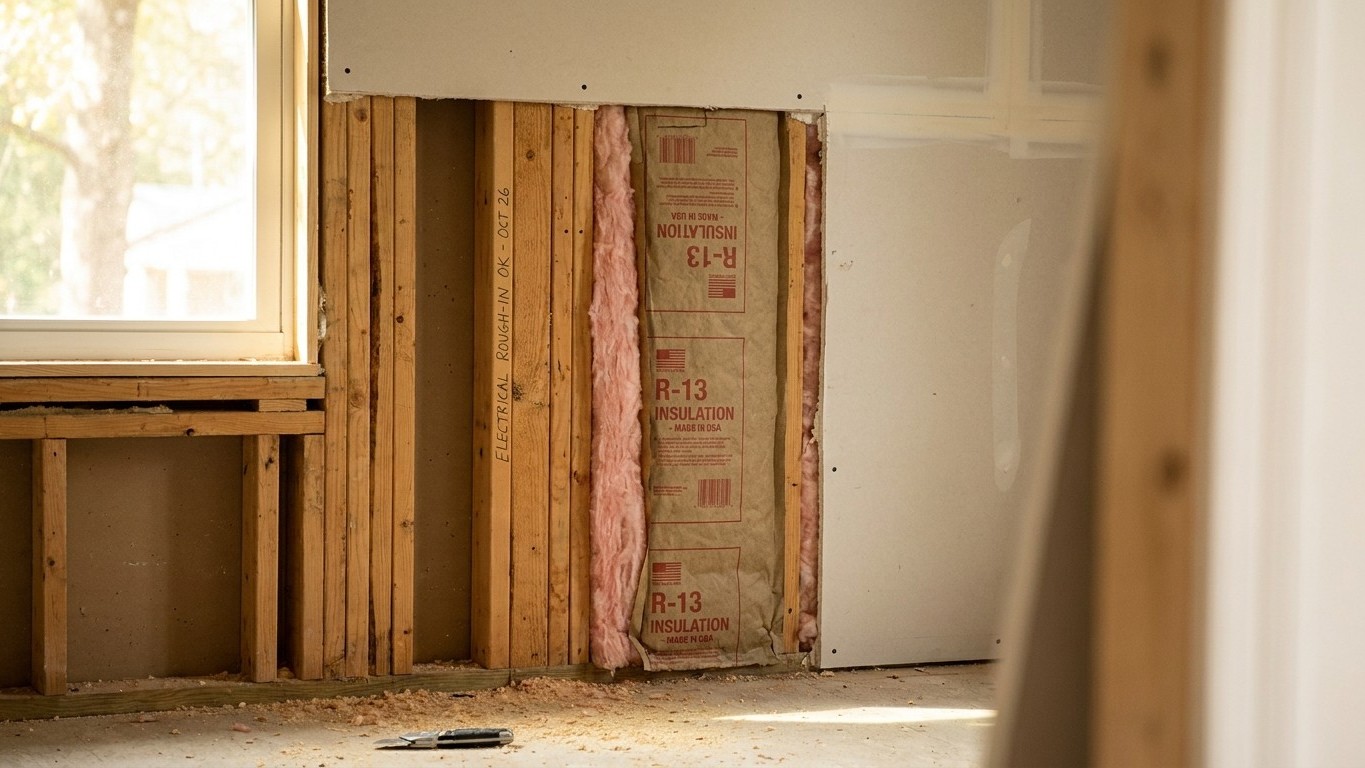

Yes. Under Section R702.7 of the 2021 International Residential Code, above-grade frame walls in Michigan need an interior vapor retarder, and that answer holds statewide because every one of the state’s climate zones sits outside the code’s one exception for warm climates. That makes Michigan simpler than a lot of states in this series, but the reason it’s simple is worth understanding before anyone touches a wall.
What the code asks for in Michigan

The 2021 IRC says it plainly: a vapor retarder of the class listed in Table R702.7(2) “shall be provided on the interior side of frame walls.” That’s the baseline rule, and it applies unless one of four listed exceptions kicks in. The one that matters most for the whole country is this: “A vapor retarder shall not be required in Climate Zones 1, 2 and 3.” Those are the warm and hot-humid zones, roughly the Gulf Coast and the Southeast. Michigan isn’t in any of them.
Michigan’s 83 counties split across three IECC climate zones: 44 counties sit in zone 6A, 37 counties in zone 5A, and 2 counties in zone 7. All three are cold-climate zones with a moist regime, and none of them is 1, 2 or 3. That means the exception simply doesn’t reach Michigan. A county in zone 6A and a county in zone 5A get the same answer here, even though they’d fall into different rows of an insulation table for other purposes. The zone split matters for how much insulation goes into the wall; it doesn’t change whether the wall needs a vapor retarder.
Not required elsewhere doesn’t mean forbidden here
It’s worth being precise about the exception’s wording, because it gets misread often. “Shall not be required” removes an obligation for builders in zones 1 through 3. It does not ban vapor retarders there, and it certainly doesn’t make them illegal anywhere in the country. Michigan just happens to be a state where the obligation stands rather than lifts, for every county regardless of which of its three zones applies.
None of this substitutes for a call to the local building department. Michigan cities and counties adopt code editions on their own timelines, sometimes with local amendments, and the department enforcing permits in a given jurisdiction is the only source that can confirm which edition and which amendments apply to a specific project. A wall built with the wrong vapor control doesn’t announce the mistake. It sits fine for years, then rots from the inside, and the owner finds out only when the drywall comes off for an unrelated repair.
Why the answer is the opposite in a warm climate
The reason zones 1 through 3 get a pass isn’t arbitrary. It comes down to which direction the moisture is moving. In a cold climate like Michigan’s, the warm damp air that matters is on the inside of the house, generated by cooking, showers, breathing, laundry. That air pushes toward the cold sheathing behind the siding, and if it reaches a cold surface, it condenses. An interior vapor retarder stops that damp air before it gets there, which is exactly the job R702.7 assigns it.
Flip the climate and the direction of travel flips too. In a warm-humid state, the humid air is mostly outside, pressing inward through the wall assembly, especially when air conditioning keeps the interior cooler than the outdoor air. The U.S. Department of Energy’s Building America program lays out what happens if a builder installs the same Class I retarder used up north on a wall in that setting: “If the wall contains a vapor retarder on the interior side of the insulation, the water vapor will condense on this cool, impermeable surface.” The retarder that protects a Michigan wall becomes the cold surface that condenses moisture inside a Southern one.
The DOE spells out the damage that follows, and it’s not cosmetic: “ruined insulation, mold, and structural rot of framing members.” That’s a Class I sheet doing real harm in the wrong climate, not a hypothetical. It’s also the exact reason the code doesn’t write one rule for the whole country. The requirement in R702.7 isn’t bureaucratic caution stacked on more caution. It’s the code tracking which way the water is actually moving through the wall, zone by zone, and Michigan’s zones all point the same direction: keep the vapor retarder in.
The three classes, and why the word matters
Vapor retarders aren’t a single product category. The code splits them into three classes by how much moisture they let through, measured in perms, and the differences aren’t small.
| Class | Example materials | Perm rating |
|---|---|---|
| Class I | Sheet polyethylene, nonperforated aluminum foil | 0.1 perm or less |
| Class II | Kraft-faced fiberglass batts, vapor retarder paint | Above 0.1 up to 1.0 perm |
| Class III | Latex or enamel paint | Above 1.0 up to 10.0 perm |
Sheet polyethylene is often called “a vapor barrier” in casual conversation, but that shorthand skips the part that actually matters to a building department: it’s Class I, the tightest of the three, and that tightness is exactly what makes it useful in Michigan and risky in a warm-humid state. The disagreement between a builder up north and a builder down south was never about whether to install something. It was always about which class belongs on that wall.
There’s a detail most homeowners never notice: ordinary latex paint on interior drywall is itself a Class III vapor retarder. Anyone who’s painted a bedroom in the last few years already has one on the wall, whether or not the word ever came up at the hardware store.
One more distinction worth keeping straight. A vapor retarder controls moisture diffusion through a wall assembly. An air barrier stops bulk air movement. They’re different jobs, sometimes performed by the same sheet of material, sometimes not, and confusing the two is a common source of bad advice online.
Where the rule stops
R702.7 lists exceptions where the interior vapor retarder isn’t required even in a cold climate like Michigan’s. Beyond the climate-zone exception already covered above, three more apply:
- Basement walls
- The below-grade portion of any wall
- Construction where accumulation, condensation or freezing of moisture will not damage the materials
The basement one is the exception most Michigan homeowners actually run into, because so many houses in the state have a full or partial basement. Concrete holds moisture and releases it slowly, sometimes for years after a pour, and that assembly needs to be able to dry toward the interior. Trap that moisture behind an impermeable sheet on the inside, and it has nowhere to go, which is the same condensation problem the DOE describes for warm climates, just triggered by a different source of water. That’s part of why basement wall assemblies get treated separately in the code, and it’s covered in more detail in the basement wall guide on this site.
The below-grade exception works on the same logic for any wall, not just basements: soil-contact assemblies deal with a different moisture source than above-grade walls, so the rule that governs a wood-frame wall exposed to interior air doesn’t automatically transfer underground.
Who actually decides, in Michigan
The 2021 IRC is a model code. It becomes law only when a state or local jurisdiction adopts it, and adoption isn’t uniform or instant. Some jurisdictions amend sections, some lag several code cycles behind the current edition, and the version actually enforced on a given street is whatever the local building department has on file, not whatever edition happens to be discussed online. That gap between model code and enforced code is exactly why this page can describe the rule and the reasoning behind it, but can’t tell an individual reader what belongs in their own wall.
Michigan’s winters give this question real weight rather than academic interest. At Detroit Metro AP, the 1991-2020 climate normal runs about 6,067 heating degree days a year against roughly 847 cooling degree days, a base-65 measure of how much heating demand accumulates day after day through the cold season. That’s a heating load several times the cooling load, which lines up with why every zone in the state, whether 5A, 6A or 7, sits on the cold side of the code’s dividing line and keeps the interior vapor retarder requirement in force.
None of that changes the practical next step. Anyone planning a wall assembly, whether new construction or a gut renovation that exposes the studs, gets the binding answer from the local building department: which code edition is adopted, which amendments apply, and what class of retarder the inspector expects to see before the drywall goes back up. A wall built with the wrong vapor control doesn’t fail at inspection or crack a week later. It sits quiet, and the framing rots from the inside, often for years, before anyone finds out.